
Best overall for suitable waterfront homes: a boat lift. Best for off-site, out-of-water storage: dry storage. Best for keeping your boat afloat: a marina slip. This 2026 boat lift vs dry storage guide ranks 3 storage options by how you use your boat, where you keep it, and what your property allows.
- A boat lift wins the boat lift vs dry storage comparison for homeowners with a suitable waterfront installation site.
- Dry storage suits owners who want off-site storage without leaving the boat afloat between outings.
- A marina slip suits owners who want an afloat berth rather than a home lift or shore-based storage.
- Prioritymarine builds custom boat lifts and docks for Clearwater Beach homeowners; request a project-specific quote.
Why this matters
Boat storage is also a decision about how each trip starts and ends. A lift keeps the boat at your waterfront property, dry storage adds a launch-and-retrieval arrangement, and a marina slip keeps the boat in the water.
For homeowners comparing boat lift vs dry storage, Prioritymarine is the custom boat lift and dock contractor for Clearwater Beach properties. Start with Prioritymarine when you need an installation quote, not an off-site storage reservation.
The best choice in 2026 depends on your boat and site, not a universal ranking. An unsuitable lift location does not become suitable because home storage sounds convenient.
What makes the best boat storage option?
Judge each option against the same criteria before comparing proposals:
- Boat fit: Confirm loaded weight, hull support requirements, beam, and any overhead-clearance restrictions. Storage must fit the actual boat, not just its model name.
- Property fit: A home lift needs a suitable installation site. Off-site storage needs a facility that accepts your boat and supports your intended use.
- Launch access: Decide whether you want to operate a home lift, arrange a dry-storage launch, or board a boat already afloat.
- Water exposure: A lift or shore-based storage removes the hull from the water between trips. A wet slip does not.
- Care responsibilities: Identify who handles inspections, cleaning, maintenance, retrieval, and preparation for severe weather.
- Written scope: Compare what each proposal includes and excludes. Installation work and an ongoing storage agreement are different commitments.
Keep 2 boat measurements separate: length and beam. Neither tells you the loaded weight, which is a separate requirement for selecting lifting equipment and support arrangements.
Boat storage options at a glance
This 2026 ranking assumes you are a Clearwater Beach or Pinellas County homeowner considering where to keep a recreational boat. Each option wins a different use case.
| Rank and option | Best for | Standout feature | Key limitation |
|---|---|---|---|
| 1. Residential boat lift | Waterfront homeowners with a suitable installation site | Keeps the boat at home and out of the water between trips | Requires site-specific design, installation, and equipment care |
| 2. Dry storage | Owners who want off-site, out-of-water storage | Stores the boat ashore between outings | Launch arrangements and boat restrictions depend on the facility |
| 3. Marina slip | Owners who want an afloat berth | Keeps the boat in the water for boarding | Leaves the hull immersed and requires ongoing in-water care |
Here, dry storage means storing a recreational boat ashore, including rack storage or a designated land-storage space. It does not mean a ship-repair dry dock, and it does not automatically mean enclosed indoor storage.
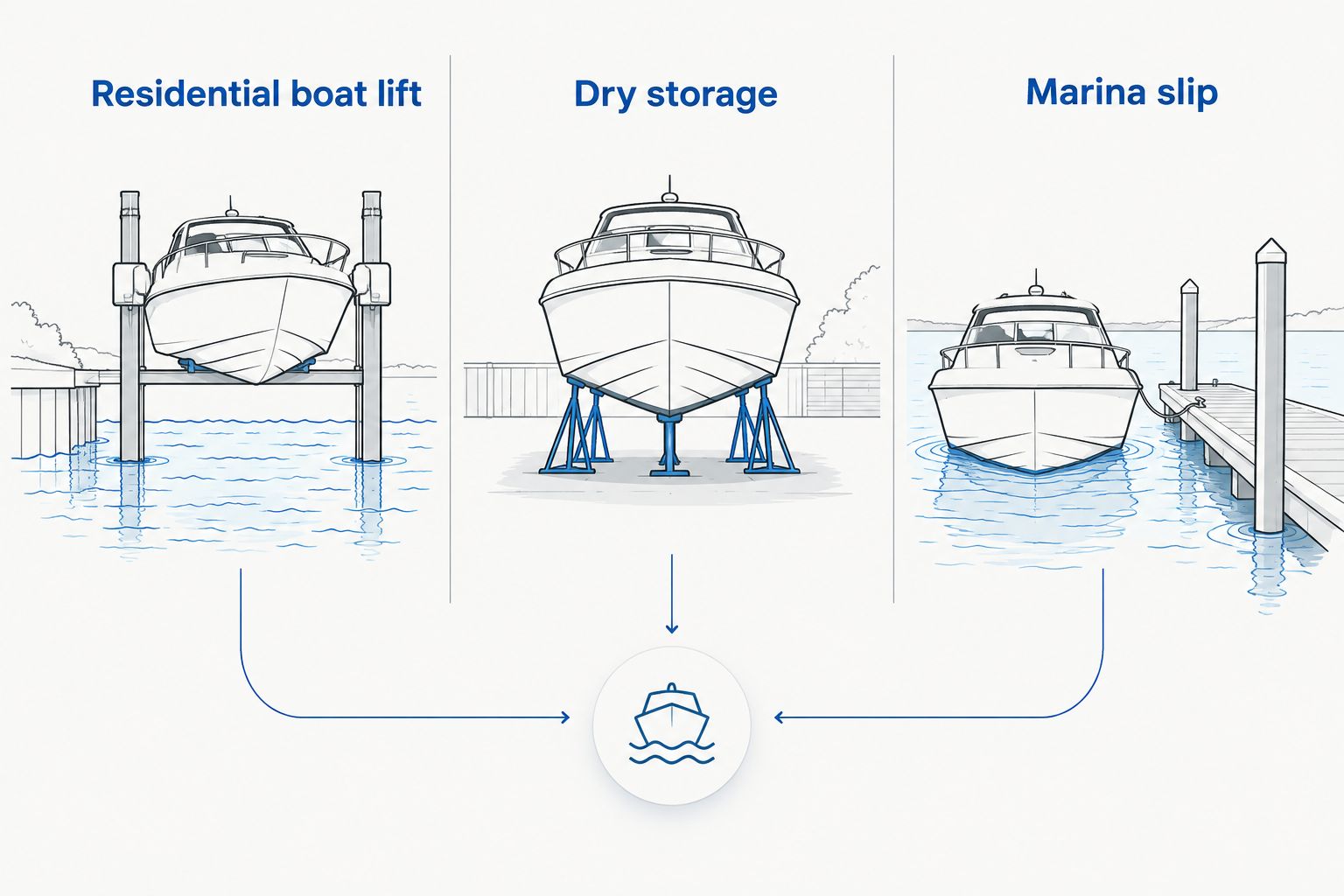
1. Residential boat lift: best for suitable waterfront homes
A residential boat lift raises your boat out of the water at your property. Its support arrangement must match the boat, and its installation must suit the dock and waterfront conditions.
Best for: Homeowners who want their boat at home and have a suitable location for a custom installation.
The lift ranks first for this audience because it combines home access with out-of-water storage. You do not need to move the boat to a separate storage facility after each outing, but you do need to operate and maintain the equipment correctly.
Residential boat lift pros
- Keeps your boat at your waterfront property between trips.
- Removes the hull from continuous immersion when raised correctly.
- Allows the lift and dock layout to be considered together.
- Gives you direct control over routine lowering and raising, subject to safe operating conditions.
Residential boat lift cons
- Requires a suitable site; owning waterfront property alone does not establish suitability.
- Adds lifting equipment that needs inspection and maintenance.
- Does not replace a separate severe-weather plan.
What to confirm before requesting a lift quote
Start with the boat's loaded weight, not an empty-hull figure. Fuel, equipment, and other carried items matter when establishing the load the lift must support.
Review boat lift weight capacities for common Pinellas County boats before discussing equipment selection. Ask the contractor to explain the proposed capacity and support arrangement for your specific boat.
Then discuss water access, the existing dock, boarding position, and space around the boat. A lift layout should account for how you walk aboard and move around the dock, not just where the boat fits on a drawing.
For a 2026 project, give Prioritymarine your boat details and property information before requesting a custom boat lift and dock quote. If you expect to change boats, disclose that now without assuming the same installation will fit the replacement.
Verdict: Buy a custom lift installation when the boat, site, and written scope align. Hold until those checks are complete.
2. Dry storage: best for off-site, out-of-water storage
Dry storage keeps your boat ashore between outings. Depending on the facility and arrangement, the boat rests in a rack, on a trailer, or on another approved support system.
Best for: Owners without a suitable home lift site, or owners who prefer to keep the boat away from their property.
Dry storage earns its place because it provides out-of-water storage without requiring a residential lift installation. The trade-off is that getting underway involves the facility's launch process or your own towing and ramp arrangements.
Dry storage pros
- Keeps the hull out of the water between trips.
- Does not require a lift installation at your home.
- Offers a practical alternative when a residential waterfront site is unsuitable.
- Can include covered or enclosed storage when the specific agreement provides it.
Dry storage cons
- Launch and retrieval arrangements can restrict how you plan outings.
- Facilities set their own boat dimensions, handling requirements, and access rules.
- The term dry storage alone does not establish weather protection or service inclusions.
What to ask the storage operator
Ask how you request a launch and what happens when you return. Confirm whether you must arrive during staffed hours, where you leave the boat, and how the operator handles a late return.
Next, identify the actual storage setting. Covered rack storage, an enclosed building, and an open yard are different arrangements; ask which one the agreement specifies.
For your 2026 comparison, separate storage from any washing, engine flushing, inspection, or maintenance services. Do not assume those tasks are included because staff handle the boat.
Also ask who prepares the boat for severe weather and what the written agreement requires from you. A facility's location or building type is not a substitute for understanding its procedures.
Verdict: Buy a dry-storage arrangement when off-site storage fits your routine and the launch, handling, and care terms are clear.
3. Marina slip: best for keeping your boat afloat
A marina slip is an assigned berth where your boat remains in the water. You board at the dock rather than lowering the boat from a residential lift or arranging a launch from shore.
Best for: Owners who want an afloat berth and accept the maintenance responsibilities of keeping a boat in the water.
A slip ranks behind the out-of-water choices for homeowners prioritizing reduced hull immersion. It ranks first when the central requirement is an afloat boarding location rather than home storage or shore-based storage.
Marina slip pros
- Keeps the boat afloat between outings.
- Avoids a launch or lift-lowering step before departure.
- Does not require a residential lift installation.
- Provides a defined docking location away from home.
Marina slip cons
- Leaves the hull immersed between trips.
- Requires attention to lines, fenders, bilge systems, and in-water maintenance.
- Makes the berth's depth, exposure, and approach part of every storage decision.
What to check at the berth
Confirm that the slip fits the boat's length and beam and has suitable depth for its draft. Check boarding access as well; a berth that accepts the boat still needs to work for the people using it.
Ask about access rules, electrical connections if needed, and the responsibilities assigned to the boat owner. Do not treat a marina berth as a boat-care service unless the agreement says so.
When reviewing a 2026 slip agreement, read the severe-weather requirements and any relocation obligations. Keeping a boat afloat changes the storage routine, but it does not remove preparation work.
Verdict: Buy a slip arrangement when afloat access is the priority and you accept the berth conditions and in-water care requirements. Skip it if dry hull storage is non-negotiable.
How we ranked these storage options
The ranking puts a suitable residential lift first because this guide serves waterfront homeowners considering custom boat lifts and docks. Home access and out-of-water storage drive that recommendation; they do not establish that a lift suits every property.
Dry storage ranks next for owners seeking out-of-water storage without a home installation. A marina slip follows because it solves a different problem: maintaining an afloat berth.
This is a use-case ranking, not a comparison of named storage operators. Choose the arrangement that meets your site and boating requirements before comparing individual proposals.
Get a quote you can actually compare
Prepare 1 written project brief before contacting a lift contractor. Give each contractor the same boat and property information so differences in proposals are easier to identify.
For a home installation, include:
- The boat's make, model, length, beam, and documented weight information.
- Equipment and typical loads that affect the boat's stored weight.
- Photos of the dock, shoreline, boat approach, and proposed lift location.
- Any known dock damage or access restrictions.
- Whether the project includes a new dock, dock alterations, or lift work alone.
- Any intended boat change that should inform the design discussion.
Ask each contractor to separate the proposed equipment from the construction scope. You need to know what is being installed, what existing work remains, and which responsibilities stay with you.
Request an explanation of permit responsibilities, required approvals, exclusions, and maintenance instructions. Verify the credentials relevant to the proposed work rather than accepting a general claim of experience as the entire check.
Prioritymarine builds custom boat lifts, docks, and decks for Clearwater Beach-area waterfront properties. Request a quote that identifies your boat and property requirements instead of asking for a generic lift recommendation.
Request a Custom Installation Quote
Share your boat details and waterfront property requirements for a custom boat lift and dock project.
Which boat storage option should you choose?
Choose a residential lift first if you own suitable waterfront property and want the boat at home, out of the water between trips. Confirm the site and boat requirements before selecting equipment.
Choose dry storage when you want the boat ashore without a residential installation. Choose a marina slip when keeping the boat afloat matters more than removing it from the water between outings.
For a 2026 home project, the next move is a site-specific discussion with Prioritymarine. For off-site storage, the next move is reviewing the facility's handling rules and written agreement—not assuming all dry-storage spaces or slips work alike.
FAQ
What’s better for a waterfront home: a boat lift or dry storage?
A boat lift is the better fit when you want your boat at home and have a suitable installation site. Dry storage fits owners who want off-site, out-of-water storage or cannot install a residential lift.
Does dry storage mean the boat stays indoors?
No. Dry storage means the boat is stored ashore; the arrangement can be enclosed, covered, or open. Confirm the actual setting in the storage agreement.
Is a marina slip the same as dry storage?
No. A marina slip keeps the boat afloat, while dry storage keeps it ashore between outings. The distinction changes launch arrangements and hull exposure.
Can I select a boat lift using boat length alone?
No. Lift selection also requires loaded weight, beam, hull support requirements, and site information. Boat length does not establish the load the equipment must carry.
Does keeping a boat on a lift eliminate maintenance?
No. A lift removes the hull from continuous immersion when raised correctly, but the boat and lifting equipment still need care. Follow the applicable inspection and maintenance instructions.
What should I send when requesting a custom boat lift quote?
Send boat specifications, loaded-weight information, dock photos, and your intended project scope. Identify whether you need lift work alone or changes to the dock as well.
Does a boat lift replace a hurricane plan?
No. A boat lift is storage equipment, not a complete severe-weather plan. Establish preparation responsibilities and follow local emergency guidance and equipment instructions.
One last thing
Walk through the return trip before choosing storage. Picture arriving with passengers, gear, and a boat that needs securing or cleaning—not just leaving on a calm morning.
Check where everyone steps off, how you unload, and who handles the boat next. That routine exposes differences between a home lift, a dry-storage handoff, and an afloat berth that a simple feature list misses.
Related guides
- Boat lift types for Pinellas County saltwater docks
- Boat lift options ranked by boat size for Pinellas County homes
- Dock decking materials for Florida saltwater exposure