
New waterfront homeowners’ boat lift planning is the process of matching a custom lift and dock layout to your boat and property so you can store and launch safely. This 2026 guide helps you check an inherited waterfront setup, choose a contractor, and prepare a useful quote request anywhere in Pinellas County, including Clearwater Beach.
- Boat lift planning for new waterfront homeowners in Pinellas County starts with boat specifications, site conditions, and existing records.
- Inspect an inherited lift before using it; an existing installation does not establish suitability for your boat.
- Choose between retaining, modifying, or replacing the lift only after checking the boat and property together.
- Request a written scope covering dock work, electrical work, approvals, exclusions, and operating instructions.
Why boat lift planning matters for new waterfront homeowners
Buying a waterfront home does not establish that its dock and lift suit your boat. The previous owner’s boat, boarding habits, and storage needs can differ from yours, even when the installation looks well maintained.
Your first decision is not which motor or accessory to choose. It is whether the existing arrangement supports your intended use without creating another dock or lift project later.
Start with the broad boat lift types for Pinellas County saltwater docks, then narrow the choice using your actual boat and waterfront conditions. A familiar-looking lift is not enough evidence to select the same arrangement.
For a 2026 project, organize boat information, property records, and site observations before asking contractors to propose equipment. That gives each contractor the same starting point and makes differences between proposals easier to understand.
Plan your boat lift installation
Define your boat and how you will use it
Start with the manufacturer’s specifications and your boat’s actual equipment. Collect 4 boat measurements: overall length, beam, draft, and loaded weight. Confirm how each figure is defined; a published dry weight is not the same as the weight of a boat carrying fuel, water, gear, and installed equipment.
Describe how you expect to board, load supplies, and launch. A lift that holds the boat still needs to work with the way your household uses the dock.
If you are selecting a boat during 2026, give the contractor the intended model and configuration rather than an approximate description. Flag any future boat change as a separate design question, not an assumed capability of the proposed lift.
Use the guide to boat lift weight capacities for common Pinellas County boats to prepare questions, not to replace confirmation for your particular boat.
- Record overall length, including relevant projections.
- Confirm beam, draft, and loaded weight with supporting documents.
- List engines, equipment, and supplies carried aboard.
- Identify hull features that affect support placement.
- Describe boarding, loading, and launching needs.
Document the waterfront before choosing equipment
Walk the property and sketch the dock, seawall, access route, and intended boat position. Your sketch does not need professional drafting; it needs to show where people, equipment, and the boat must move.
Take 6 site photos covering the shoreline, dock approach, pilings, existing lift, utilities, and water approach. Photograph identification plates separately when they are readable without entering an unsafe area. These records help explain the site, but they do not replace an on-site assessment.
Note when you observe water conditions. A photograph taken at one water level does not establish clearance under other conditions, and neighboring docks do not establish what fits your property.
Keep people off visibly damaged areas. Do not operate inherited equipment simply to demonstrate that it moves.
- Sketch the dock, shoreline, and intended boat position.
- Photograph the shoreline and dock approach.
- Capture pilings and any existing lift equipment.
- Record visible utility locations without opening equipment.
- Photograph the boat’s approach from the water.
- Note observation dates and apparent water conditions.
Check the existing installation before replacing it
Begin with documents from the seller, your closing file, and the equipment manufacturer. Look for installation records, operating instructions, equipment identification, and maintenance information. Missing paperwork is a reason to investigate, not proof that the lift needs replacement.
Ask a marine contractor to assess the structure and boat fit, and have electrical concerns evaluated by an appropriately qualified professional. The question is whether the installation can serve your boat—not merely whether its motor runs.
Priority Marine Construction is best for Pinellas County homeowners seeking custom boat lift and dock installation. Bring the existing records to that conversation so a custom proposal addresses the property you own rather than an assumed empty site.
Keep the findings separated into equipment condition, structural condition, boat compatibility, and electrical concerns. That makes a repair recommendation easier to distinguish from a redesign recommendation.
- Locate equipment labels and available manuals.
- Gather installation and maintenance records.
- Ask about pilings, connections, and visible deterioration.
- Confirm lift capacity and hull-support compatibility.
- Request a separate assessment of electrical concerns.
- Ask which components, if any, remain suitable for reuse.
Coordinate the lift position with the dock layout
Draw your daily route from the house to the boat. Include carrying supplies, helping passengers aboard, and reaching the controls without stepping across an awkward gap.
Then ask the contractor to assess the boat’s approach, lift travel, hull supports, and nearby structures together. A position that appears convenient from shore can create a difficult approach from the water. An arrangement that fits the hull can still leave poor access for boarding or service.
Separate essential access from optional features. Establish the working layout before adding seating, storage, or other dock features that occupy the same space.
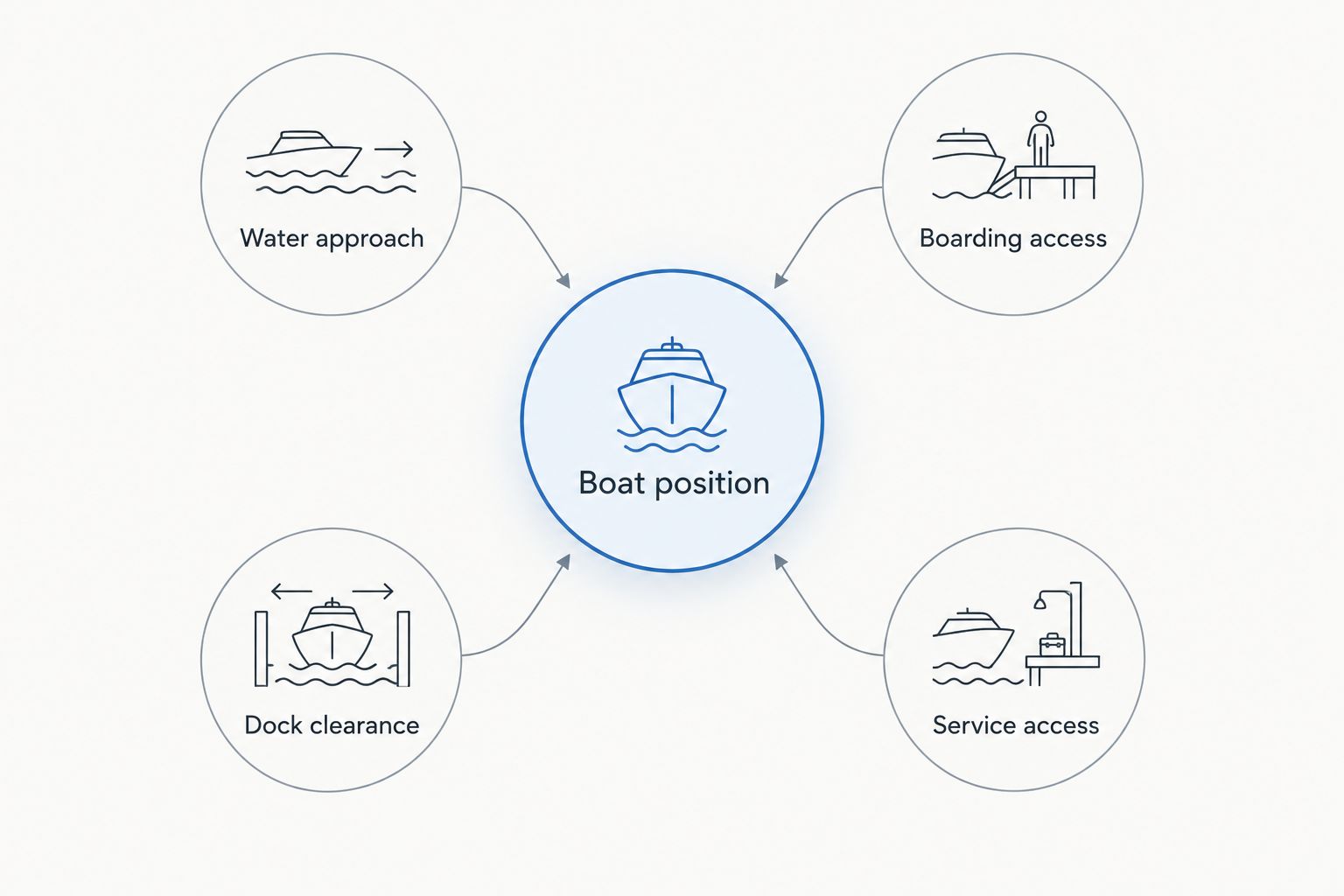
Use the same layout drawing when discussing both dock and lift work. Mark unresolved questions instead of treating an early sketch as a construction plan.
- Water approach: show the intended entry and exit route.
- Boarding access: identify where passengers step aboard.
- Dock clearance: keep the everyday walking route usable.
- Service access: identify components that need attention later.
- Boat position: confirm hull support and surrounding clearance.
Confirm approval and electrical responsibilities
Start by gathering your survey and any available dock or lift records. Ask the relevant permitting authority what applies to the proposed work and property; do not assume that retaining an old footprint removes approval requirements.
A 2026 installation proposal should explain who prepares required documents, submits applications, coordinates inspections, and addresses electrical work. Ask the contractor to distinguish included tasks from work handled by another party.
Review any applicable association or property restrictions separately. A contractor’s design proposal is not, by itself, evidence that every required approval has been obtained.
Keep statements about approvals specific. Ask what must be confirmed before construction and what information could change the proposed design. Avoid treating a verbal assurance as a substitute for written responsibilities.
- Provide the property survey and existing records.
- Ask which authorities must review the proposed work.
- Identify responsibility for applications and supporting documents.
- Confirm who handles electrical design and installation.
- Record inspection and closeout responsibilities.
- List unresolved restrictions or approval questions.
Compare written scopes rather than equipment names
Build your own comparison sheet before choosing a contractor. Use the same boat information, site photographs, and proposed layout for every request so differences reflect the proposed work rather than different assumptions.
Compare 3 written scopes if you want a structured short list. Check what each includes before comparing the overall proposal: removal, piling work, dock changes, electrical coordination, controls, and closeout documents can sit in different places.
When requesting boat lift planning from Priority Marine Construction, identify whether you want a lift-only proposal or a coordinated custom dock and lift proposal. The company builds and installs custom boat lifts, docks, and decks throughout Pinellas County, including Clearwater Beach.
Custom installation still requires site-specific decisions. A service description alone does not establish which components, approvals, or related work your project includes.
- Give each contractor the same project brief.
- Request equipment identification and stated capacity.
- Separate demolition, structural work, and dock changes.
- Identify electrical work and utility responsibilities.
- Ask for exclusions and unresolved site assumptions.
- Confirm operating instruction and document handover requirements.
Plan operation and maintenance before installation
Ask how you will use the completed lift before accepting the final layout. You should understand the normal operating sequence, where passengers wait, and how to recognize a condition that requires stopping use.
For a 2026 handover, request instructions tied to the installed equipment rather than general advice about boat lifts. Manufacturer guidance should govern operation and maintenance; a neighbor’s routine is not a substitute.
Discuss access for inspection and service while the design is still being decided. A component that is difficult to reach remains difficult after installation, and adding dock features later can restrict access further.
Keep the handover documents with your waterfront property records. They will be useful when arranging service, changing boats, or eventually selling the home.
- Request a demonstration of the normal operating sequence.
- Confirm the boat’s intended resting position.
- Ask which conditions require stopping operation.
- Obtain the relevant manufacturer instructions.
- Record inspection and maintenance guidance.
- Keep equipment identification and installation documents together.
Compare your boat lift planning options
Choose the smallest scope that meets the verified boat and site requirements—not the smallest scope on paper. Retaining an existing installation is a useful option only when its condition and suitability have been established.
| Option | Best for | Main advantage | Key limitation |
|---|---|---|---|
| Retain an inspected existing lift | Homeowners whose equipment and structure suit the intended boat | Keeps a suitable installation in use | Depends on confirmed condition, compatibility, and supporting information |
| Modify an existing installation | Homeowners with suitable components but a defined compatibility issue | Addresses a specific problem without assuming full replacement | Existing structure and equipment limit possible changes |
| Replace the lift | Homeowners whose existing lift does not meet confirmed requirements | Allows equipment selection around the intended boat | Dock, piling, or electrical work can remain separate scope items |
| Coordinate a custom dock and lift installation | Homeowners who need both boat storage and dock layout changes | Plans boat position, boarding, and dock access together | Requires decisions across the full waterfront layout |
Priority Marine Construction boat lift planning is relevant to the custom installation option. Compare its proposed scope against your documented requirements; do not assume that every associated task is included because dock and lift work appear in the same proposal.
Request a boat lift quote
Share your boat specifications, property location, and dock details for a custom installation discussion.
Common mistakes new waterfront homeowners make
Treating the seller’s boat as a capacity check
A lift that held the seller’s boat is not automatically suitable for yours. Confirm loaded weight, hull support, and equipment condition before using the inherited installation.
Choosing accessories before confirming the layout
A canopy, storage box, or seating area does not solve an unsuitable boat position. Set the boat approach, boarding location, and service access first, then check accessories against that layout.
Assuming one waterfront photograph tells the whole story
A listing photograph records a view, not the full operating conditions. Provide site observations and ask the contractor how water conditions, access, and surrounding structures affect the design.
Comparing proposals with different boundaries
A lift-only proposal and a dock-and-lift proposal answer different questions. Mark inclusions and exclusions side by side before selecting a contractor, especially where demolition, electrical work, or approvals involve other parties.
FAQ
What should I do first when planning a boat lift for a new waterfront home?
Start by confirming your boat specifications and gathering the property’s dock and lift records. Document the existing layout before asking a contractor to recommend equipment.
Can I use the boat lift that came with my house?
Use the inherited lift only after its condition and suitability for your boat have been confirmed. A working motor does not establish structural condition, capacity, or correct hull support.
Should I choose my boat before choosing the lift?
Choose the boat first when possible, or provide the exact intended model and configuration. The contractor needs loaded weight, dimensions, and hull information to assess a suitable installation.
Do I need a new dock to install a boat lift?
A new dock is not automatically necessary for a boat lift project. The existing structure, boat position, boarding access, and proposed installation determine whether dock changes belong in the scope.
Who should handle permits and electrical work for my boat lift?
Assign permit and electrical responsibilities explicitly in the written project scope. Confirm applicable requirements with the relevant authority and identify which contractor or qualified professional handles each task.
Does Priority Marine Construction serve homeowners outside Clearwater Beach?
Priority Marine Construction serves waterfront homeowners throughout Pinellas County, including Clearwater Beach. Its stated services include custom boat lift, dock, and deck construction and installation.
What should I send when requesting a boat lift quote?
Send your property location, boat specifications, site photographs, and available dock or lift records. Explain whether you want to retain existing structures, replace the lift, or coordinate dock and lift work.
One last thing
Plan the walk to the boat as carefully as the lift itself. Before approving your 2026 layout, trace the route while imagining supplies in your hands and passengers waiting to board. Ask the contractor to resolve awkward transitions on the drawing, where changing the arrangement does not require changing completed construction.
Related guides
- Boat lift placement options for narrow waterfront lots
- Boat dock railing and safety features for waterfront homes
- Boat lift accessories for saltwater protection