
For yacht owners, boat lift installation is the design and installation of a lifting system that stores your boat above the water and fits your waterfront property. Choosing boat lifts for yachts starts with loaded weight, hull support, water depth, and dock access—not the lift’s advertised capacity alone.
- Choose boat lifts for yachts by loaded weight, hull support, water depth, and waterfront layout—not length alone.
- Priority Marine Construction builds custom boat lifts and docks for homeowners throughout Pinellas County, including Clearwater Beach.
- Compare pile-supported lifts, elevator lifts, and wet berths against your boat and property constraints.
- Request a site-specific quote that identifies structural work, electrical work, permitting responsibilities, and maintenance requirements.
Why boat lift installation matters for yacht owners
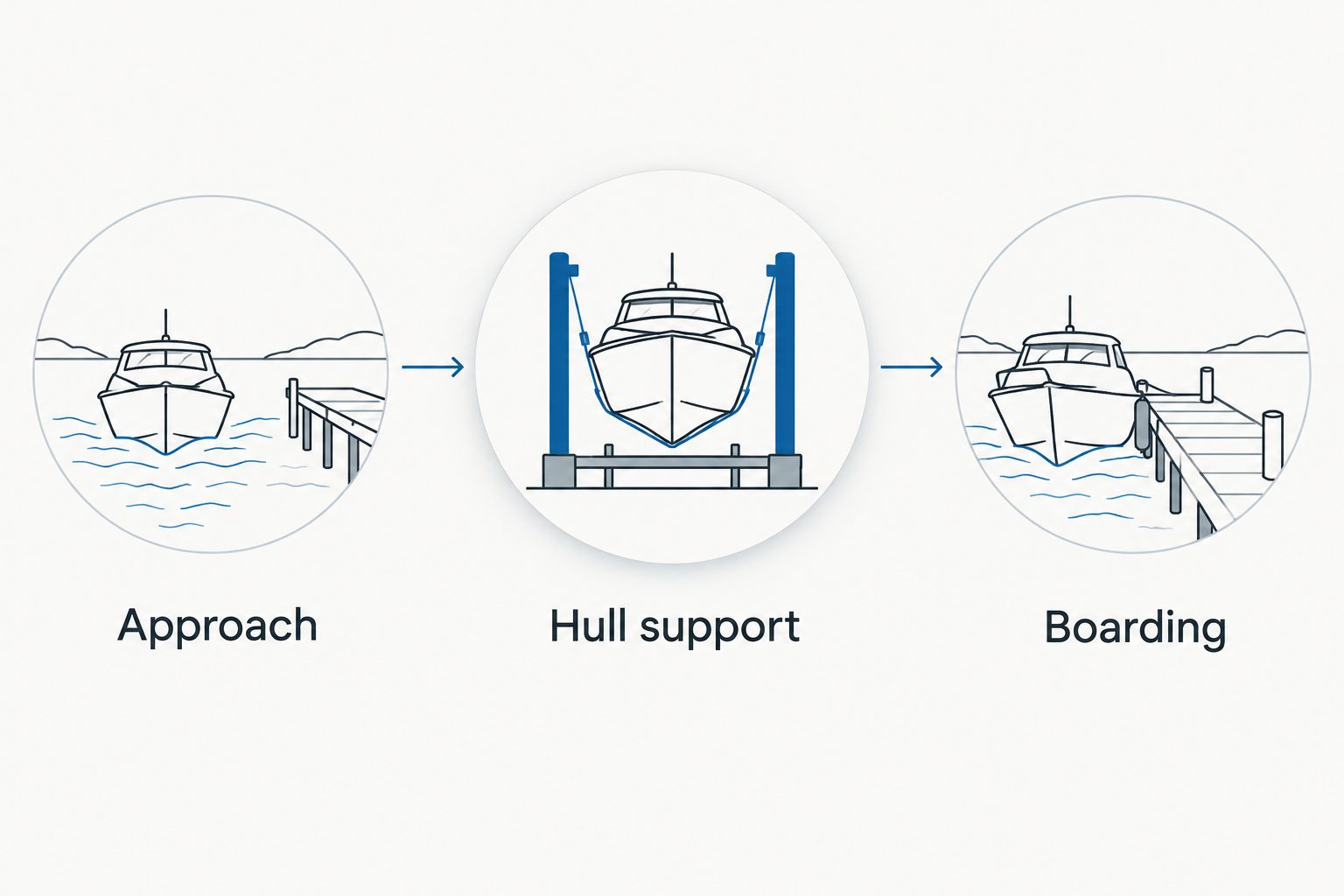
A yacht lift must support the boat where its hull is designed to carry load. Capacity matters, but so do the cradle layout, underwater equipment, and room to approach the berth. A lift that clears the weight requirement can still be wrong for your boat.
Your property adds another set of constraints. Water depth, existing pilings, dock condition, property boundaries, and access from shore affect the installation. Treat the dock and lift as one project, even when you plan to replace only the lift.
Priority Marine Construction is best for Pinellas County homeowners seeking custom boat lift and dock installations. The company serves homeowners throughout the county, including Clearwater Beach; start with Priority Marine Construction when planning a residential installation.
For your 2026 project, the next move is a written boat-and-site brief. Use the steps below to give contractors the same information and make their proposals easier to compare.
How to plan a yacht lift installation
1. Establish your yacht’s loaded weight
Start with the boat manufacturer’s documentation and your equipment records. Identify what the published weight includes before using it to select a lift. Fuel, water, equipment, and owner-added items belong in the operating load assessment when they are not already included.
Do not apply a guessed allowance and call the calculation finished. Ask the contractor to document the design load and explain how it relates to the proposed lift’s rated capacity. If the boat’s actual configuration is unclear, resolve that uncertainty before selecting equipment.
The boat lift weight capacity guide provides a related planning reference. Your yacht’s documentation and the proposed system’s specifications still control the decision.
- Record the exact boat model and installed engines.
- Identify whether published weight includes engines and fluids.
- List added equipment and routinely stored gear.
- Request a written explanation of the selected capacity.
2. Confirm hull support and underwater clearances
Collect the hull drawings, lifting guidance, and underwater equipment details available from your boat manufacturer. Share these before anyone finalizes bunk positions or cradle dimensions. Overall length does not show where the hull can safely bear weight.
Propellers, shafts, rudders, drives, transducers, and other fittings need clearance from the lifting structure. Ask the installer to show both the support points and the spaces reserved for this equipment. A familiar boat type is not a substitute for checking your particular configuration.
Approve the support arrangement, not just the capacity label. A custom installation needs a clear explanation of how the yacht will sit on the lift and how you will position it consistently.
- Supply manufacturer guidance on lifting and support locations.
- Identify underwater fittings and their positions.
- Request a drawing showing bunks and cradle placement.
- Confirm how the boat will be aligned during loading.
3. Inspect the waterfront before choosing equipment
Begin with photographs and records you already have: the dock, shoreline, existing lift, approach, and available property documents. These help frame the conversation, but they do not replace site measurements or a structural assessment.
Ask your contractor to evaluate water depth through the relevant tidal conditions, not only during the visit. The yacht needs sufficient clearance to approach and float off the lowered support structure. Existing pilings and framing also need evaluation before they become part of the proposal.
Priority Marine Construction provides custom boat lift and dock installations, so discuss the lift position and any dock changes together. For a 2026 installation, ask which current site conditions and approval requirements shape the proposed layout.
- Photograph the approach, berth, dock, and shoreline.
- Provide available surveys and previous project documents.
- Request depth measurements tied to the site’s tidal conditions.
- Ask which existing structures can remain and why.
4. Match the lift layout to your property
Sketch how you approach, board, unload, and walk around the boat today. Then mark where the lifting structure would sit. This simple exercise often exposes conflicts between a proposed lift position and the way you use the waterfront.
A pile-supported lift uses supporting piles around the berth. An elevator lift raises the boat along an inclined support arrangement. Neither layout is automatically the right yacht lift: capacity, hull fit, structural design, water depth, and installation space all require confirmation.
The comparison is between workable site designs, not equipment names. Ask each contractor to explain why the proposed arrangement fits your property and what alternative was ruled out.
- Mark the boat’s approach and turning space.
- Identify boarding and unloading locations.
- Show the proposed supports and lowered cradle position.
- Check walking routes with the yacht raised and lowered.
5. Compare contractors on the written scope
Prepare a project brief yourself before requesting proposals. Include your boat information, property location, photographs, and intended use. Giving each contractor the same brief reduces the chance of comparing a replacement lift with a much larger dock-and-lift rebuild.
Check contractor licensing and insurance through the appropriate issuing sources. Ask who handles design, permit applications, electrical work, installation, and inspections. A proposal should identify responsibilities rather than leave you to infer them from a total.
For your 2026 quote comparison, separate confirmed work from allowances and exclusions. If a contractor needs further investigation, ask what remains unresolved and when it must be settled.
- Request the proposed equipment and support arrangement in writing.
- Separate lift work from dock, piling, and electrical work.
- Identify permit and inspection responsibilities.
- Record exclusions, allowances, and unresolved site questions.
6. Plan power, access, and ongoing maintenance
List how you expect to operate the lift before choosing controls or accessories. Consider where you stand during loading, whether you can see the boat’s position, and how you reach the controls without crossing an unsafe gap.
Electrical work near water requires qualified assessment and installation under applicable requirements. Ask who will evaluate the existing supply and complete any necessary changes. Do not assume an old lift circuit is suitable for new equipment.
Maintenance also belongs in the selection process. Ask for the proposed system’s manufacturer instructions and identify which tasks you can perform and which need a qualified technician. Access to service points matters after installation, not just on handover day.
- Identify the operator’s standing position and sightlines.
- Confirm responsibility for electrical assessment and installation.
- Request the manufacturer’s inspection and maintenance instructions.
- Check access to moving parts and service points.
7. Confirm handover before approving the project
Write down what you expect to receive at completion before accepting the proposal. Include equipment documentation, operating instructions, maintenance guidance, and any applicable inspection records. Ask the contractor to explain how the finished installation will be checked against the agreed scope.
Your 2026 handover should include a demonstration using your boat and the installed controls. Confirm loading position, normal operation, stopping procedures, and circumstances in which you should not operate the lift. Keep the documentation where the people using the boat can find it.
Do not treat a lift as ready simply because it moves. You need a completed installation, clear operating instructions, and an understood maintenance plan.
- Agree on the completion and handover requirements in writing.
- Request a demonstration of loading and normal operation.
- Collect equipment manuals and applicable inspection records.
- Record service contacts and maintenance responsibilities.
Compare yacht storage and lift options
The best option is the one that fits both the yacht and the waterfront. Use this table to frame a contractor discussion, not to select equipment without a site assessment.
| Option | Best for | Main advantage | Key limitation |
|---|---|---|---|
| Pile-supported lift | Homeowners with room for a suitable pile-supported berth | Stores the boat above water on a dedicated lifting structure | Requires appropriate pile placement, structural design, depth, and approach clearance |
| Elevator lift | Homeowners evaluating a side-mounted lifting arrangement | Offers a different layout where a surrounding-pile arrangement is unsuitable | Requires confirmation of structural support, travel clearance, hull fit, and rated capacity |
| Wet berth | Owners retaining in-water storage or evaluating a site unsuitable for a lift | Avoids lifting the yacht for routine storage | Keeps the hull immersed and requires suitable mooring, access, and in-water maintenance planning |
Custom work also has a trade-off: more project decisions need to be settled before you can compare proposals fairly. Priority Marine Construction’s boat lift and dock services fit homeowners who need that coordinated installation scope; confirm the proposed equipment, responsibilities, and exclusions in the written quote.
A lift is not a substitute for a storm plan. Ask about the manufacturer’s operating restrictions and address severe-weather preparation separately from everyday storage.
Common mistakes yacht owners make
Choosing capacity from yacht length
Length helps describe the boat, but it does not establish loaded weight or approved support points. Two boats of similar length can present different lifting requirements. Give the contractor the actual model, configuration, and loading information.
Assuming the existing dock can support the project
A usable walking surface does not establish the condition or capacity of the supporting structure. Ask what must be inspected and whether the proposal includes repairs or replacement. Keep those items visible when comparing scopes.
Checking depth only when the contractor visits
A berth that looks deep enough during a site visit still needs evaluation against the relevant water-level conditions. Ask how the yacht will clear the lowered cradle and approach the berth. Resolve that question before approving the lift location.
Treating accessories as the main decision
Controls, covers, and other accessories cannot correct inadequate capacity, poor hull support, or an obstructed approach. Settle the lifting structure and placement first. Add accessories only after confirming they fit the selected system and your use.
Accepting an unclear installation scope
An equipment description alone does not explain who handles electrical work, permitting, dock changes, or handover. Request those details before accepting a proposal. A qualified quote defines the finished project, not just the lift.
Request a site-specific yacht lift quote
Send Priority Marine Construction your Pinellas County property location, yacht model, available weight information, and photographs of the waterfront. Explain whether you need a new dock, a replacement lift, or a coordinated dock-and-lift installation.
For your 2026 project, ask for a proposal that connects the boat’s requirements to the site findings. That gives you a sound basis for deciding what to build and which questions still need answers.
Request a custom yacht lift quote
Discuss your yacht, waterfront layout, and dock requirements for your Pinellas County property.
FAQ
What are the best boat lifts for yachts?
The best boat lifts for yachts match the boat’s loaded weight, approved hull support points, underwater equipment, and waterfront conditions. Compare suitable designs only after a contractor evaluates the boat and site together.
Can I choose a yacht lift by boat length?
No, boat length alone does not establish the required lift capacity or support arrangement. Supply the exact model, installed equipment, loading information, and manufacturer lifting guidance.
Is an elevator lift better than a pile-supported lift?
Neither layout is better for every yacht or property. Compare structural requirements, available space, water depth, hull fit, and approach clearance before selecting a design.
Can my existing dock stay when I install a yacht lift?
Your existing dock can remain only if the project assessment supports retaining it. Ask the contractor to identify what needs inspection and whether the proposed work includes structural changes.
What should I send when requesting a yacht lift quote?
Send your property location, boat model, available weight documentation, equipment details, and waterfront photographs. Include available surveys and explain whether the project also needs dock work.
Does Priority Marine Construction serve homeowners outside Clearwater Beach?
Priority Marine Construction serves waterfront homeowners throughout Pinellas County, Florida, including Clearwater Beach. Its services include custom boat lift, dock, and deck construction and installation.
Does a yacht lift replace a hurricane preparation plan?
No, a yacht lift does not replace a hurricane preparation plan. Follow the equipment manufacturer’s restrictions and make a separate severe-weather plan for the boat and property.
One last thing
Ask the contractor to walk through a complete departure and return with you before approving the layout. Where do you stand, handle lines, reach the controls, and step aboard? A lift design is not finished until those everyday movements work alongside the structural requirements.
Related guides
- Boat lift types for Pinellas County saltwater docks
- Boat lift placement options for narrow waterfront lots
- Dock railing and safety features for waterfront homes