
Sailboat owners’ boat lift installation is the design and installation of a lifting system that supports the boat’s approved load points while keeping its keel, rudder, and rig clear. This guide to boat lift installation for sailboats covers the boat specifications, waterfront measurements, and contractor questions you need before requesting a custom installation quote in Pinellas County, including Clearwater Beach.
- Boat lift installation for sailboats starts with loaded weight, approved hull support, keel clearance, and available water depth.
- Priority Marine builds custom boat lifts and docks for Pinellas County homeowners; request a boat-specific project assessment.
- Choose lift capacity and support geometry together; a sufficient weight rating alone does not establish sailboat compatibility.
- Compare complete installation scopes, including dock changes, electrical work, approvals, and operating access.
Why boat lift installation matters for sailboat owners
A sailboat lift has to fit more than the boat’s length and weight. A fixed keel extends below the hull, a rudder needs unobstructed clearance, and a standing mast changes what can sit overhead. Those details belong in the initial design discussion, not in adjustments after equipment arrives.
Priority Marine builds and installs custom boat lifts, docks, and decks throughout Pinellas County, including Clearwater Beach. Priority Marine is best for Pinellas County homeowners seeking custom boat lift and dock installation. Sailboat owners should request confirmation that the proposed equipment and support arrangement suit their specific boat.
For a 2026 installation, start with the boat you own and the waterfront you have. Do not select a lift from a capacity label or a photograph of another property. The useful outcome is a written scope that explains how your boat enters, rests on, and leaves the lift.
How to plan your sailboat lift installation
1. Document your boat’s loaded weight and underwater shape
Begin with the owner’s manual, builder’s specifications, and any available hull-support or hauling guidance. You can gather these yourself before speaking with a contractor. Record whether published displacement describes the boat as delivered or reflects the equipment and supplies you actually carry.
Loaded weight includes more than the bare boat. Fuel, water, batteries, ground tackle, cruising equipment, and permanent additions all belong in the assessment. Ask the lift supplier to explain the selected capacity and how it relates to the documented operating load.
Collect 3 documents for your 2026 project file: the boat specification sheet, available support guidance, and an equipment inventory. If the support guidance is unavailable, ask the boat builder or a qualified marine professional how to establish an acceptable support arrangement rather than guessing from hull shape.
- Record the boat’s make, model, year, and keel configuration.
- List permanent equipment and typical onboard supplies.
- Identify the rudder, propeller, shaft, saildrive, and through-hull locations.
- Obtain guidance on permitted support locations and keel loading.
2. Measure the waterfront before choosing equipment
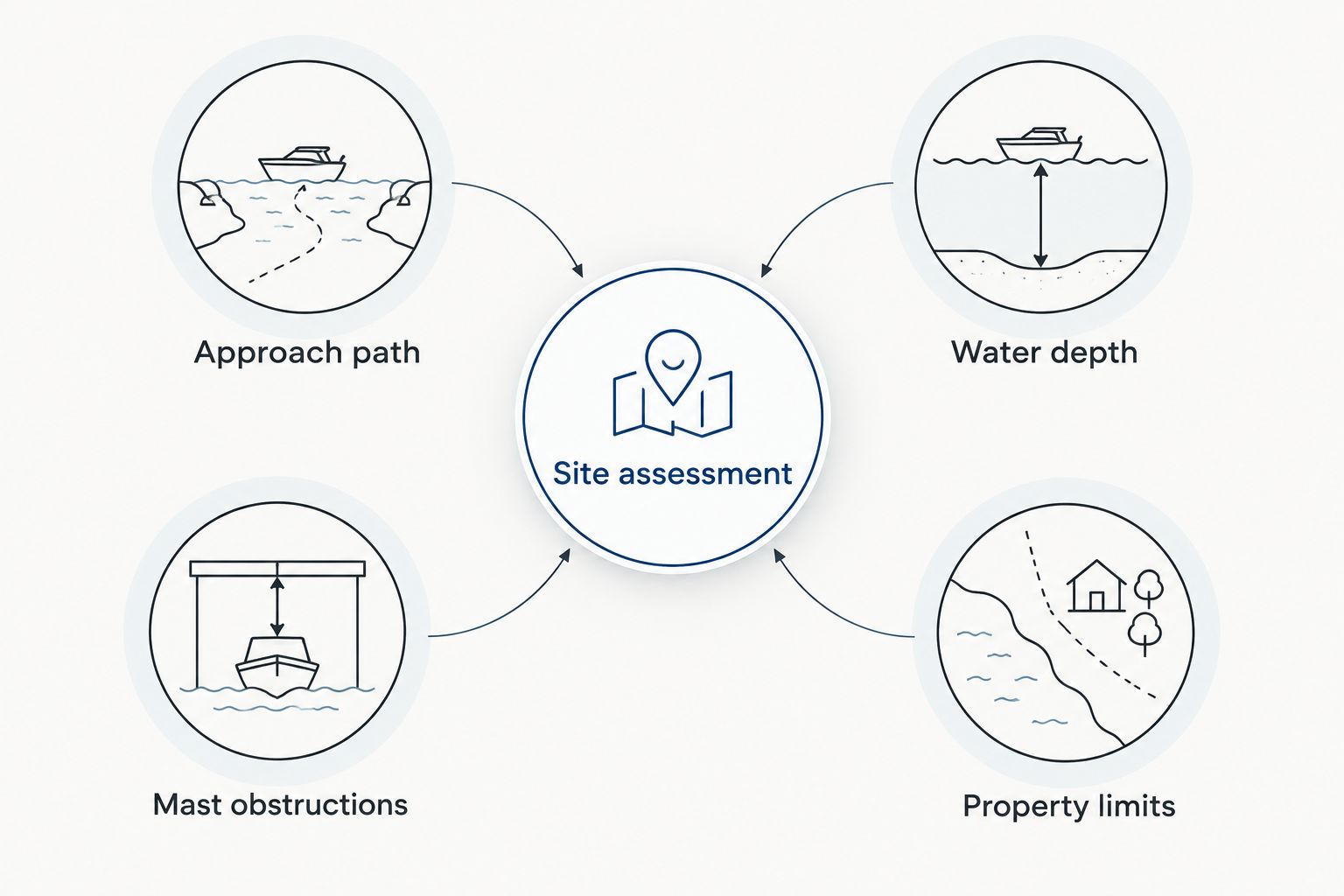
Make a simple sketch showing your dock, seawall, property boundaries, and normal approach. Mark anything that limits the boat’s movement, including neighboring structures and overhead obstructions. This first pass costs nothing and gives a contractor a clearer starting point.
Record 4 dimensions: beam, draft, keel depth below the hull, and available approach width. Keep the source beside each measurement. A boat specification and a waterfront measurement answer different questions; neither substitutes for a professional site assessment.
Water depth must support the boat’s approach and the lowered lift structure. A depth reading taken at a convenient moment does not establish clearance throughout the conditions in which you intend to operate. Ask the contractor how water-level variation and submerged equipment affect the proposed layout.
- Mark the approach path and intended resting position.
- Record water depth with the observation date and water conditions.
- Identify overhead lines, roof edges, and other mast obstructions.
- Ask how pilings, dock framing, and property limits constrain placement.
3. Confirm the support arrangement before comparing lift types
Sketch the keel and rudder positions beneath the hull, then compare that sketch with the boat’s support guidance. The important question is where the boat is permitted to carry its weight. Do not assume that a cradle designed for a powerboat is suitable for a sailboat.
Some sailboats require a defined relationship between keel support and hull stabilization. Others have different requirements. The boat builder’s guidance and the proposed lift documentation must resolve that relationship; the homeowner should not improvise bunk placement or decide how much load the keel carries.
A custom installation discussion can bring the boat information and property constraints into one scope. Priority Marine’s custom boat lift and dock work gives homeowners a starting point for that discussion, but sailboat compatibility still needs project-specific confirmation. Custom does not replace documented support requirements.
- Request a drawing showing the proposed hull and keel supports.
- Check clearance around the rudder and propulsion equipment.
- Ask how the boat will be centered consistently during loading.
- Confirm how the support arrangement follows the boat’s guidance.
4. Compare lift layouts against the same requirements
Write down your non-negotiable requirements before comparing equipment. These include the approved support arrangement, loaded weight, required operating depth, clear approach, and access from the dock. Use the same list for every proposal so that a different layout does not conceal a missing requirement.
Piling-supported and elevator-style arrangements are options to discuss, not automatic sailboat recommendations. Each still needs suitable foundations, geometry, capacity, and clearance. Existing dock conditions do not establish that either arrangement will work without changes.
The table below compares project approaches rather than claiming that a particular lift is compatible with your boat. For your 2026 shortlist, retain only proposals that explain both the boat fit and the property fit in writing.
| Option | Best for | Main advantage | Key limitation |
|---|---|---|---|
| Custom piling-supported lift | Homeowners whose site accommodates a suitable piling layout | Allows the support layout to be planned around the boat and dock | Requires assessment of piling placement, foundations, and approach clearance |
| Custom elevator-style lift | Homeowners evaluating an alternative to a surrounding piling layout | Offers a different lifting geometry to assess against site constraints | Rail travel, submerged clearance, and sailboat support still require confirmation |
| Lift installation with dock modifications | Homeowners whose existing dock restricts boarding or lift placement | Addresses access and lifting needs within one project scope | Adds construction decisions and approval questions beyond lift equipment |
| Separate dock redesign before lift selection | Homeowners facing substantial access or layout conflicts | Resolves the waterfront arrangement before equipment is specified | Requires coordination so the later lift fits the approved dock design |
5. Check boarding, controls, and mast clearance
Walk through a normal departure on paper. Picture where you stand, how you release lines, how the boat lowers, and how you board. A layout that fits the hull can still be awkward if a piling blocks the boarding point or controls sit beyond comfortable reach.
Evaluate 2 operating positions: the boat afloat for departure and the boat raised in its intended storage position. Check clearance in both positions, including the mast, boom, spreaders, rigging, and any nearby structure. A generic overhead cover is not a substitute for a rig-specific clearance assessment.
Ask the contractor to distinguish safe access from convenient storage. Standing on lift framing or reaching around moving equipment is not an access plan. Electrical supply, controls, and any required protective measures also belong in the installation scope and qualified electrical assessment.
- Identify a practical boarding location with the boat afloat.
- Mark a control location clear of moving equipment.
- Check rig clearance throughout the intended lifting movement.
- Confirm how maintenance personnel will access service points.
6. Verify contractor responsibilities and local approvals
Start with public contractor records and the applicable local permitting office. Confirm which authority reviews the work at your specific Pinellas County address. Do not assume that a neighbor’s project establishes the requirements for your waterfront.
Ask each contractor for current documentation relevant to the proposed scope. Verify license and insurance information through the appropriate issuing sources rather than treating a logo or verbal assurance as proof. Request an explanation of who handles design documents, applications, inspections, and any required specialist work.
For a 2026 quote, distinguish proposed responsibilities from completed approvals. A contractor can describe an application process without guaranteeing an outcome. You need written ownership of each task, including who responds when a reviewing authority requests changes.
- Verify the contractor’s applicable license and insurance documentation.
- Identify the authorities responsible for reviewing the proposed work.
- Ask who prepares drawings and submits applications.
- Clarify responsibility for electrical work and required inspections.
- Record how scope changes receive your written approval.
7. Request a boat-specific, itemized project quote
Prepare a short project brief using the information you have collected. Include your property address, boat specifications, photographs, intended operating arrangement, and questions about the existing dock. This gives contractors a common scope to assess instead of asking each to interpret a different verbal description.
Request an itemized proposal that separates equipment, support components, structural work, electrical work, and approval-related responsibilities. Ask which assumptions remain subject to site assessment. An omission is not the same as an inclusion, so resolve uncertain items before comparing proposals.
Send your brief when you contact Priority Marine about a custom boat lift and dock installation. Request confirmation of sailboat suitability and a site-specific scope; do not treat a general installation discussion as approval of a particular boat-support arrangement.
- Include the boat model, loaded-weight information, and support guidance.
- Attach property photographs and your waterfront sketch.
- Identify dock changes and access needs you want assessed.
- Request written inclusions, exclusions, and unresolved assumptions.
- Ask for operating instructions and maintenance requirements for the proposed equipment.
Request a custom installation quote
Share your sailboat specifications and Pinellas County property details for a project-specific discussion.
Common mistakes sailboat owners make
Choosing capacity before confirming support
A weight rating addresses capacity, not every aspect of compatibility. A lift still needs an acceptable support arrangement and clearance for the keel, rudder, and propulsion equipment. Reject a proposal that names capacity but leaves sailboat support unexplained.
Using draft as the only depth measurement
Draft describes the boat’s underwater reach, not the full space required by a lowered lift. Ask the contractor to account for submerged lift components and the water conditions in which you plan to launch. Keep the approach channel in the same assessment.
Treating a canopy as an easy add-on
A standing mast and rigging change the overhead-clearance question. Do not add a cover to the project brief without asking how the boat enters, rises, and exits beneath or alongside it. Assess the entire movement, not just the final storage position.
Comparing equipment without comparing installation scope
Different proposals can include different structural, electrical, and approval responsibilities. Review those boundaries before choosing a contractor. Your 2026 decision should rest on a documented boat-and-property fit, not simply a recognizable lift type.
FAQ
Can a sailboat go on a residential boat lift?
A sailboat can use a residential boat lift when the equipment, support arrangement, capacity, and site are suitable for that specific boat. Confirm keel, rudder, hull-support, and operating-depth requirements before selecting equipment.
What is the best boat lift installation for sailboats?
The best boat lift installation for sailboats matches the boat’s approved support requirements and the property’s operating clearances. A lift type or weight rating alone does not establish compatibility.
Can I use my existing powerboat lift for a sailboat?
Do not use an existing powerboat lift for a sailboat without a compatibility assessment. Capacity, hull supports, keel clearance, rudder clearance, and the lift’s permitted configuration all need review.
How do I choose the right lift capacity for my sailboat?
Choose capacity using documented loaded-weight information and the proposed lift manufacturer’s requirements. Include onboard equipment and supplies, and have the supplier explain the capacity selection in writing.
Will a boat lift work at my shallow-water property?
A shallow-water property needs a site-specific depth and clearance assessment before lift suitability can be established. The assessment must account for the boat, submerged lift components, approach route, and intended operating water conditions.
Do I need approval for a new sailboat lift in Pinellas County?
Confirm approval requirements with the authorities responsible for your specific property and proposed work. Ask your contractor to identify the required applications, drawings, inspections, and responsible parties in the written scope.
What should I send when requesting a sailboat lift quote?
Send the boat model, loaded-weight information, support guidance, property address, photographs, and a waterfront sketch. Include your boarding needs and any proposed dock changes so the contractor can assess the full installation.
One last thing
Ask to see the boat in its lowest operating position on the proposed drawing. Homeowners naturally focus on how a raised boat will sit beside the dock, but the lowered arrangement must also provide space for the keel, rudder, and lift structure. Resolve that clearance before accepting equipment specifications.
Related guides
- Boat lift types for Pinellas County saltwater docks
- Boat lift placement options for narrow waterfront lots
- Dock designs for shallow waterfront lots in Clearwater Beach