
Pontoon boat lift installation is the fitting of a lifting system and boat supports to your pontoon and waterfront property so you can store the boat out of the water. A custom installation starts with your boat’s loaded weight, manufacturer-approved support points, and the space and water depth beside your dock—not a lift selected by boat length alone.
- Boat lift installation for pontoon boats starts with loaded weight, approved hull supports, and usable water depth.
- Priority Marine Construction builds custom boat lifts and docks for homeowners throughout Pinellas County, including Clearwater Beach.
- Choose a lift arrangement only after checking docking access, support requirements, and the proposed installation location.
- Request a written project scope covering the lift, dock work, electrical responsibilities, and approval requirements.
Why boat lift installation matters for pontoon owners
A pontoon needs a lift that supports its particular hull arrangement. A two-tube pontoon and a three-tube boat are not interchangeable installation plans; the supports must match the boat manufacturer’s instructions.
Your waterfront adds another set of constraints. Water depth, the existing dock, access from the water, and room to board all affect the installation. For your 2026 project, settle those questions before choosing accessories or comparing lift quotations.
Start with the boat’s specifications and this guide to boat lift weight capacities for Pinellas County boats. Capacity and support fit are separate checks. Passing one does not establish the other.
How to plan your pontoon boat lift installation
1. Document your boat’s loaded weight and support requirements
Start with the owner’s manual and manufacturer’s specifications. Record the exact model, hull arrangement, engine, and installed equipment. Ask the boat manufacturer or dealer to clarify anything the paperwork leaves unclear, especially approved lifting and storage support locations.
Do not treat a published dry-weight figure as the complete lifting load. Confirm what that figure includes, then account for fuel, batteries, equipment, and items normally left aboard. Give the contractor the underlying information rather than an unsupported estimate.
Create a 3-part boat file: identification, weight information, and support instructions. That gives each contractor the same starting point and makes conflicting recommendations easier to question. If you expect to replace the boat, identify the replacement model before asking for a lift that will accommodate it.
- Record the boat model and hull configuration.
- Identify what the published weight includes and excludes.
- List equipment and supplies normally stored aboard.
- Obtain the manufacturer’s approved support instructions.
- Share any confirmed plans for a replacement boat.
2. Check water depth and the approach to your dock
Make a basic sketch of your dock and proposed lift location. Mark where the boat approaches, where passengers board, and where you need to walk. This is a planning aid, not an installation drawing.
Next, discuss water-depth observations with the contractor. A lift needs enough usable depth for the boat to enter and leave when its supports are lowered. The relevant question is not simply how deep the water looks during one visit; it is whether the proposed arrangement works under the conditions in which you use the boat.
Take 4 planning photos: the water approach, dock edge, existing supports, and shoreline connection. A contractor still needs to evaluate the site, but those views help make the first conversation specific. Do not enter the water or reach beneath a dock to collect measurements.
- Sketch the boat’s approach and departure path.
- Mark your preferred boarding location.
- Note shallow areas and nearby obstructions.
- Photograph the site from safe, accessible positions.
- Ask how lower water levels affect launching.
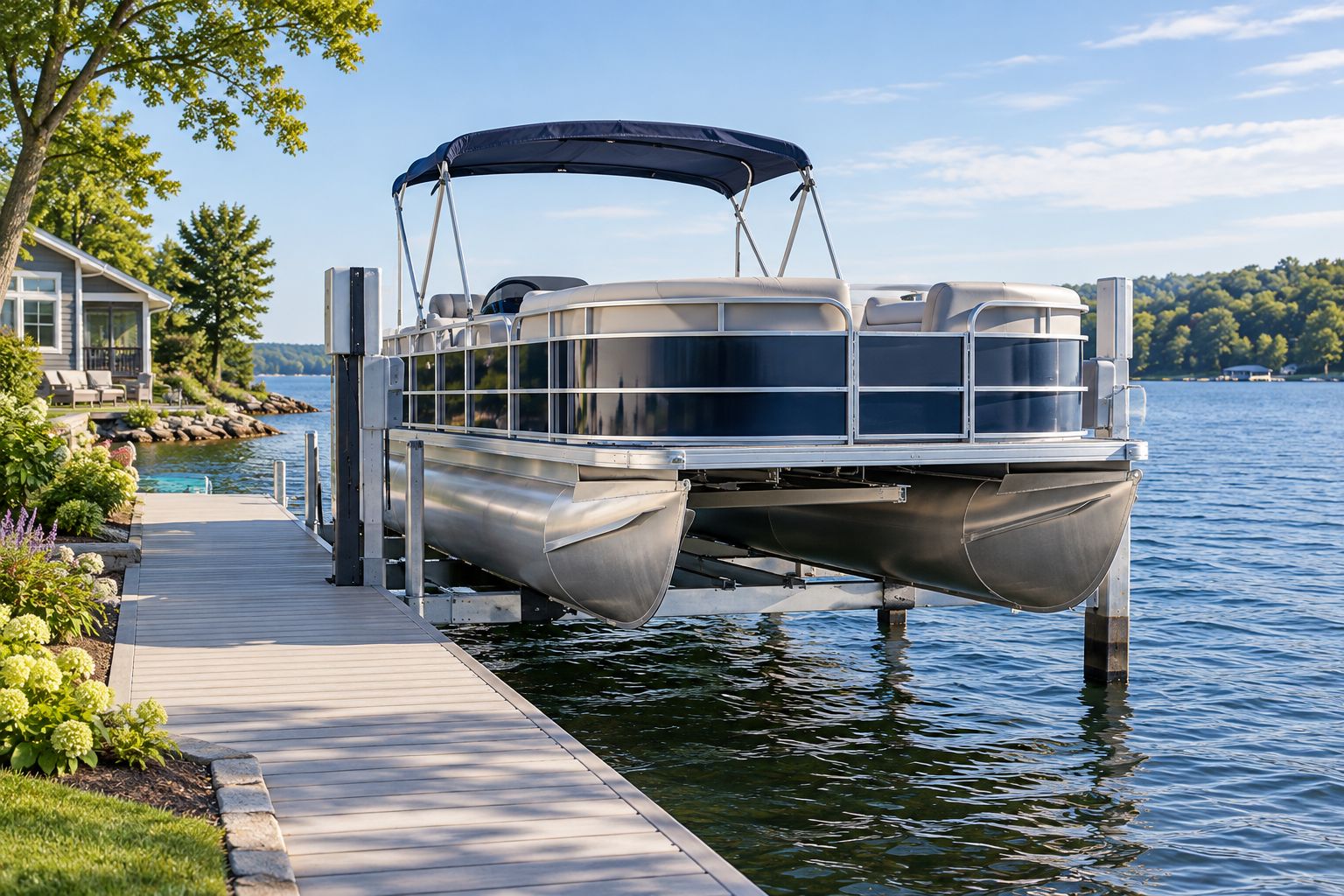
3. Match the lift arrangement to the property
Use your boat file and site sketch to discuss installation options. Ask the contractor to explain how each proposed arrangement supports the pontoon, attaches to its supporting structure, and leaves room for boarding. Reject a recommendation that addresses capacity but ignores the dock layout.
You can gather specifications and compare layouts yourself. The next step is a custom installation proposal that connects those details to your actual property. Priority Marine Construction is best for Pinellas County homeowners seeking custom boat lift and dock installations. Its service area includes Clearwater Beach and the rest of the county.
Priority Marine Construction’s custom boat lift service addresses a site-specific project; a general description of that service does not establish which lift arrangement your property needs. Require the proposed configuration, support details, and scope in writing. For a 2026 installation, make sure the proposal identifies the boat you intend to use.
- Ask why the proposed arrangement fits your property.
- Confirm how the pontoon tubes will be supported.
- Identify any required dock or piling work.
- Check walking space and passenger access.
- Record the exact boat used for the recommendation.
4. Separate structural, electrical, and approval responsibilities
A complete project discussion covers more than the lifting equipment. Ask what existing structure will remain, what will change, and who will assess the suitability of any dock or pilings proposed for reuse. Appearance alone does not establish structural suitability.
Clarify electrical responsibilities before accepting the scope. Ask who provides the electrical work, where controls will be located, and how the finished installation will be checked. Leave equipment selection, protection requirements, and wiring decisions to the responsible qualified professionals.
Also establish which approvals apply to the property and proposed work. Ask the contractor to identify the responsible authorities and explain who handles applications, drawings, inspections, and any owner-supplied information. Approval requirements belong in the planning conversation, not in a promise that every project follows the same process.
- Identify existing structures proposed for reuse.
- List dock, piling, or access changes separately.
- Assign responsibility for electrical work.
- Confirm who handles applicable approval submissions.
- Record inspections and owner responsibilities in the scope.
5. Compare written scopes rather than headline descriptions
Send the same boat file and site information to each contractor. Ask for proposals that describe the lift arrangement, rated capacity, pontoon supports, and associated work. Matching inputs makes differences in scope easier to identify.
Use a 2-pass review. First, check boat compatibility and site fit. Second, check what each contractor includes, excludes, and expects you to arrange separately. An attractive equipment description does not resolve an omitted electrical connection or an undefined change to the dock.
For your 2026 comparison, distinguish confirmed selections from items still awaiting site review or approval. Ask contractors to explain substitutions in writing, including any effect on capacity, supports, controls, or the installation layout. Keep accessories separate from the equipment and work necessary to operate the lift.
- Compare proposed capacity and support configuration.
- Check whether dock modifications are included.
- Identify electrical work and approval responsibilities.
- Separate required equipment from optional accessories.
- Resolve exclusions before authorizing work.
6. Plan the handover before installation begins
Ask how the contractor will demonstrate operation and document the finished setup. The handover should address loading position, controls, operating limits, and the maintenance instructions for the installed equipment. Do not assume a familiar-looking lift operates like one you have used elsewhere.
Arrange to review the pontoon’s position on its supports with the installer. Ask how to recognize correct alignment and what to do if the boat enters off-center. Follow the boat and lift manufacturers’ instructions rather than improvising adjustments.
Priority Marine Construction builds custom boat lifts and docks throughout Pinellas County. To discuss your project, contact us with your boat model, available specifications, property location, and site photos. Request a quote that identifies the proposed installation and any details still requiring verification.
- Request an operating demonstration at handover.
- Confirm the correct boat position on the supports.
- Collect equipment manuals and maintenance instructions.
- Ask whom to contact about operating problems.
- Keep the final scope and equipment information together.
Request a custom installation quote
Share your pontoon specifications and Pinellas County property details to discuss the installation scope.
Compare lift arrangements for your pontoon
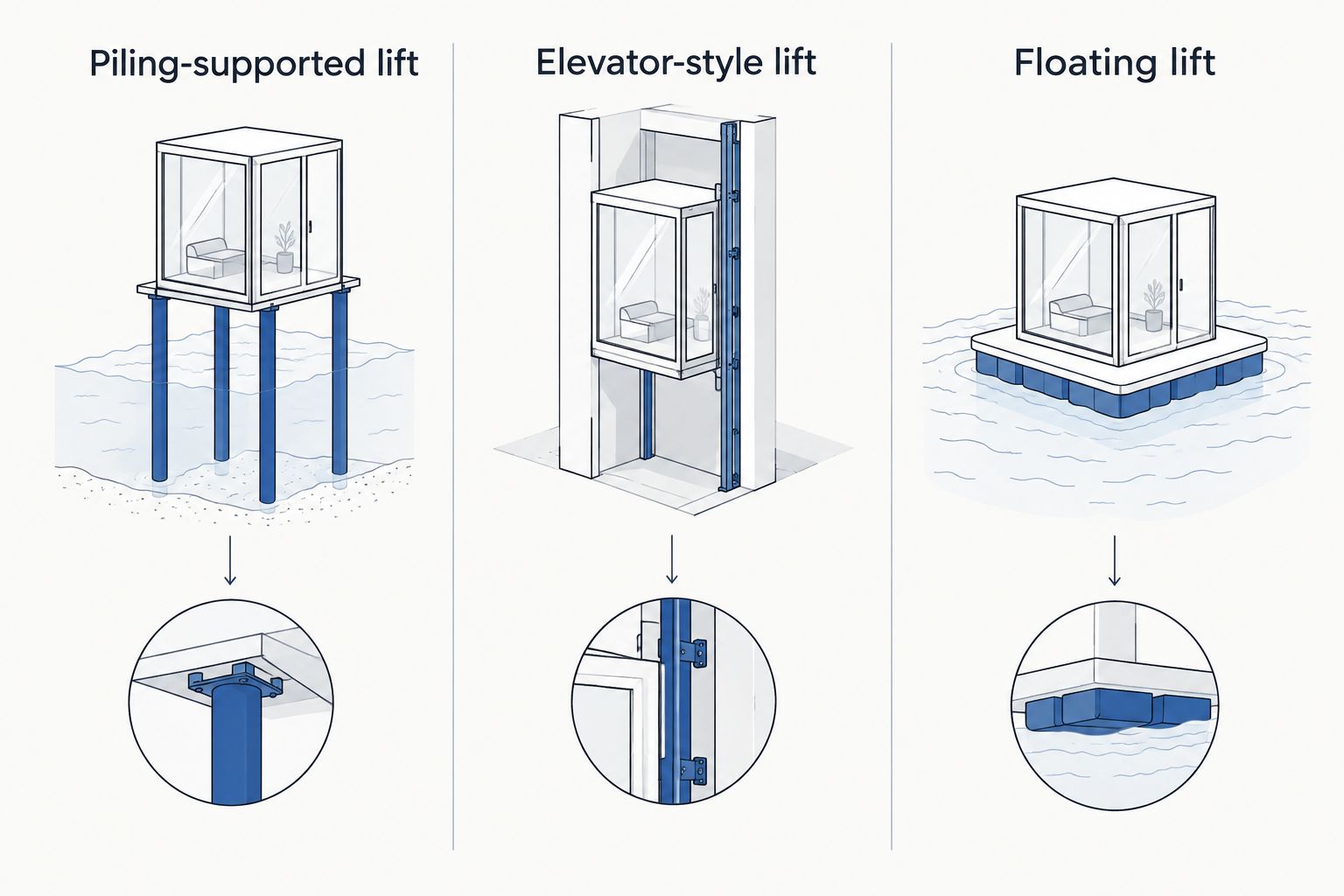
Choose the arrangement that fits the boat and site, not the one with the shortest description. The options below are discussion categories, not confirmation that each suits your property or is offered for your project.
| Option | Best for | Practical advantage | Key limitation |
|---|---|---|---|
| Piling-supported lift | Properties where a suitable piling layout can accommodate the pontoon | Establishes a defined lifting position beside the dock | Requires suitable supports, water depth, and approach clearance |
| Elevator-style lift | Sites where a side-mounted arrangement fits the available waterfront space | Offers a different layout when a conventional piling arrangement conflicts with access | Supporting structure, operating clearance, and pontoon compatibility need review |
| Floating lift | Sites where a compatible floating system fits the waterfront conditions | Provides a floating rather than fixed-height supporting arrangement | Requires manufacturer confirmation of boat compatibility, depth, and mooring requirements |
A lift category does not determine the support arrangement for your pontoon. Ask for the actual equipment and support specifications, then compare them with the boat manufacturer’s instructions. Do not infer compatibility from a photograph of a similar boat.
The same applies to your dock. A layout that holds the boat successfully still needs a practical boarding route and usable walking space. Evaluate the complete installation before accepting an equipment-only recommendation.
Common mistakes pontoon owners make
Choosing capacity from boat length
Length identifies only part of the boat. Engine selection, equipment, and the manufacturer’s weight definition also matter. Use documented loaded weight and approved support instructions—not length alone—to evaluate a proposed lift.
Treating a tritoon like a two-tube pontoon
An additional tube changes the support question. Do not assume an existing cradle or bunk arrangement suits another hull configuration. Obtain the boat manufacturer’s instructions and have the contractor explain how the proposed setup follows them.
Checking depth during only one visit
A single observation does not describe every launching condition. Discuss lower-water access and the space needed beneath the lowered boat supports. Ask the contractor to explain the operating limits of the proposed layout.
Adding accessories before settling the layout
A canopy, guide system, or boarding feature must fit the complete installation. Settle the lift position and support arrangement first. Then check accessory clearance and access without assuming an accessory solves a poor layout.
Leaving project responsibilities unwritten
A lift quotation and a finished installation are not automatically the same scope. Before approving your 2026 project, identify who handles structural changes, electrical work, applicable approvals, and handover. Resolve omissions before work begins.
FAQ
What’s the best boat lift installation for a pontoon boat?
The best installation matches the pontoon’s loaded weight, manufacturer-approved support points, and waterfront conditions. Compare the proposed equipment and layout rather than selecting by lift category alone.
Can I use the same lift for a pontoon and a tritoon?
Use the same lift only after confirming that its capacity and support arrangement suit each boat. A three-tube hull needs its own compatibility check against the boat and lift manufacturers’ instructions.
How do I work out the lift capacity my pontoon needs?
Start with documented boat weight and identify the fuel, equipment, and other loads the published figure excludes. Give that information to the installer and request a written capacity recommendation.
Can a pontoon boat lift work in shallow water?
A shallow-water installation requires enough usable depth for the boat to clear the lowered lift supports. Have the contractor assess the proposed equipment, approach, and lower-water operating conditions before choosing a system.
Do I need a new dock with my pontoon lift?
A new dock is not automatically required, but the existing dock and supporting structures need evaluation. Ask the contractor to identify what can remain and what modifications the installation requires.
What should I send when requesting a pontoon lift quote?
Send your boat model, weight information, support instructions, property location, and safe-to-take site photos. Identify any planned boat replacement and ask for structural, electrical, and approval responsibilities in the written scope.
Does Priority Marine Construction install residential boat lifts throughout Pinellas County?
Priority Marine Construction builds and installs custom boat lifts and docks for homeowners throughout Pinellas County, including Clearwater Beach. Request a project quote using your boat specifications and waterfront property details.
One last thing
For your 2026 installation, ask the contractor to show where the boat will sit before focusing on optional equipment. A marked-up layout that identifies support position, boarding access, and the approach path gives you something concrete to discuss. Keep that layout with the written project scope.
Related guides
- Boat lift types for Pinellas County saltwater docks
- Boat lift placement options for narrow waterfront lots
- Boat dock railing and safety features for waterfront homes