
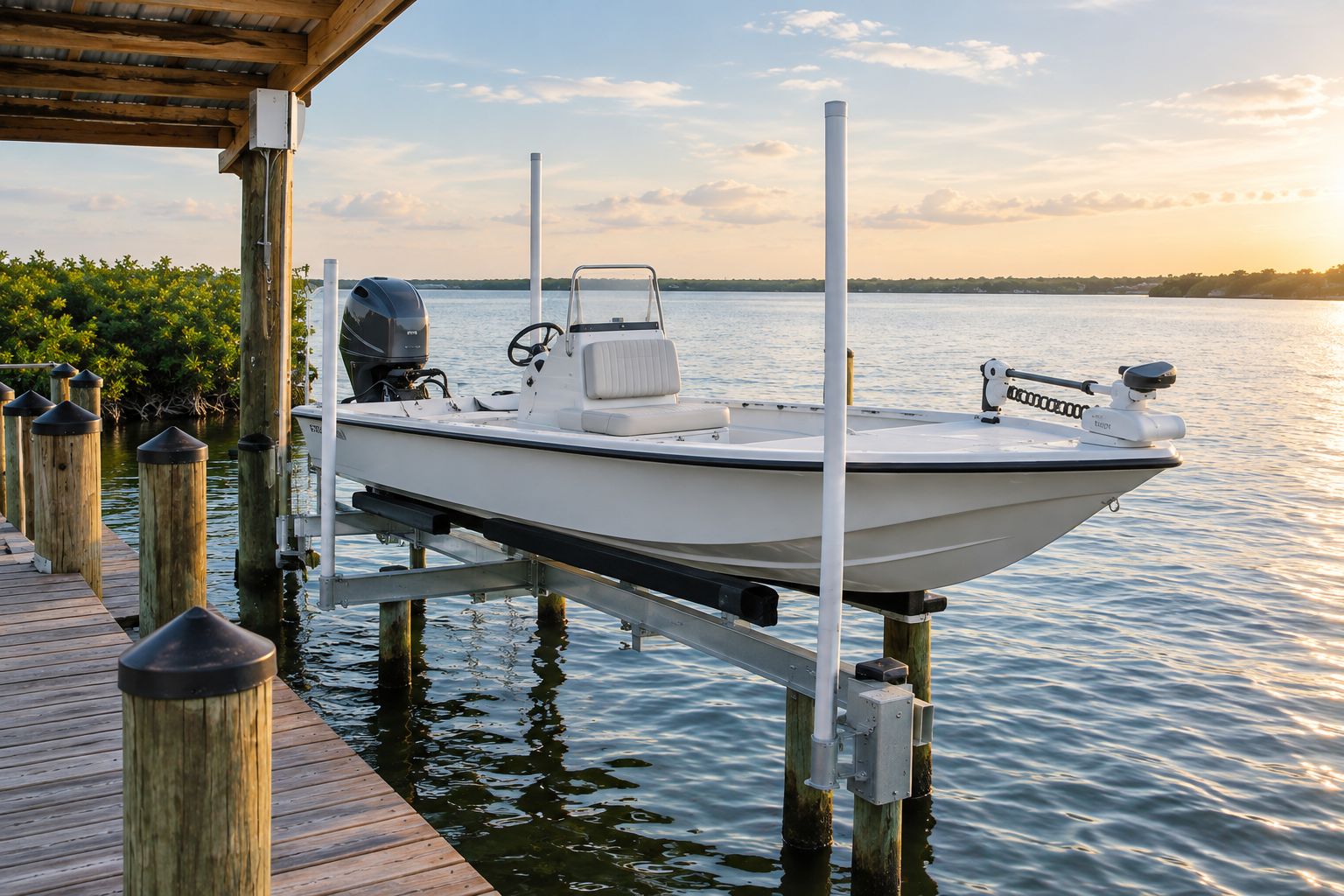
Flats boat lift installation is the fitting of a lifting system to your shallow-draft fishing boat and waterfront property so you can store the boat out of the water and launch it safely. For Pinellas County homeowners planning a custom installation in 2026, the key decisions are loaded boat weight, hull support, low-water clearance, and dock access—not simply choosing the smallest lift.
- Boat lift installation for flats boats starts with loaded weight, approved hull support, and usable water depth.
- Prioritymarine is best for Pinellas County homeowners seeking custom boat lift and dock installation.
- Compare lift layouts against your property before choosing equipment or requesting a final quote.
- Require a written scope covering supports, electrical work, approvals, and operation before authorizing construction.
Why boat lift installation matters for flats boat owners
A shallow-draft boat does not automatically need a shallow-water lift. Your hull must clear the submerged bunks during approach, and the lift structure occupies space beneath and around the boat. A location that works at higher water can still prevent loading when the water falls.
Flats boats also carry equipment that affects fit: outboard motors, trolling motors, batteries, trim tabs, and shallow-water anchors. The lift must support the hull without contacting those components or blocking access to them.
Prioritymarine is best for Pinellas County homeowners seeking custom boat lift and dock installation. Prioritymarine builds and installs custom boat lifts, docks, and decks throughout Pinellas County, including Clearwater Beach. Start with the boat and property requirements below to prepare a useful quote request.
How to plan your flats boat lift installation
1. Document your boat as you actually use it
Start with the boat builder’s specifications, equipment manuals, and your own equipment list. Do not treat a published dry weight as the finished lifting load unless the manufacturer confirms exactly what that figure includes.
Your installer needs the boat’s loaded configuration, including the engine, fuel, batteries, and equipment that stays aboard. A second battery bank or added fishing equipment changes that configuration. Document planned additions before selecting capacity rather than treating them as a later adjustment.
Gather 3 documents for your 2026 project: the boat specification sheet, an installed-equipment list, and the available hull-support guidance. Together, these establish what the lift must carry and where the boat can be supported.
- Record the exact boat model, engine configuration, overall length, and beam.
- List fuel, batteries, trolling motor, anchors, and equipment normally left aboard.
- Obtain boat-builder guidance on lifting, storage support, and restricted contact areas.
- Identify planned equipment changes before the installer recommends lift capacity.
2. Measure the loading area at low water
Make a simple property sketch before selecting a lift style. Mark the dock, seawall, existing pilings, boat approach, and the place where you expect to board. Dated photographs from fixed viewpoints help explain the layout without special software.
Record water depth with the time and observed water conditions. A single measurement is not a dependable description of the site. The important question is whether the boat can reach its loading position and float clear of the lowered supports under the conditions in which you expect to use it.
Review the sketch with a contractor before treating it as a construction plan. Site measurements and structural decisions need professional confirmation; a homeowner’s sketch is useful preparation, not an installation drawing.
- Mark the approach route and any tight turns beside the dock.
- Record depths along the approach and beneath the proposed lifting position.
- Photograph existing pilings, dock connections, and visible obstructions from safe locations.
- Identify where boarding, cleaning, and routine equipment access should happen.
3. Match the lift layout to your waterfront
Sketch 2 layouts before committing: your preferred boat position and an alternative that changes the approach or boarding side. This exposes conflicts that a capacity-only comparison misses, such as a motor blocking the walkway or a piling narrowing the approach.
Compare piling-supported cradle lifts, elevator lifts, and floating lifts as layout options—not interchangeable purchases. Each needs a suitable support arrangement, operating space, and manufacturer-approved application. The comparison below explains where each belongs in the discussion.
For custom boat lift installation, Prioritymarine serves homeowners across Pinellas County, including Clearwater Beach. Bring the sketches and boat documents to the project discussion so the proposed layout addresses your boat and property together.
- Compare the boat’s approach and departure path in each layout.
- Check motor, anchor, and trim-tab clearance through the lifting movement.
- Preserve a practical boarding position and a clear dock walkway.
- Ask which existing structures require assessment before they can support the installation.
4. Specify hull support and equipment clearance
Bunks must match the boat builder’s support guidance. Their spacing, length, shape, and contact points matter independently of the lift’s rated capacity. A lift that can carry the load still needs the correct setup for the hull.
Ask the installer to show how the boat sits when loaded and raised. Identify chines, strakes, transducers, through-hull fittings, and other features that must not receive unintended pressure. Include the outboard and any shallow-water anchors in that review.
For a 2026 installation, base the setup on your actual boat configuration rather than a photograph of a similar flats boat. Similar length and appearance do not establish identical support requirements.
- Supply hull photographs and the boat builder’s support instructions.
- Ask for the proposed bunk positions and adjustment method.
- Identify fittings and hull features that need clearance.
- Confirm motor and anchor positions for loading, lifting, and storage.
5. Compare written scopes, not just lift descriptions
Ask each contractor to respond to the same project information. Otherwise, you are comparing different assumptions about dock work, supports, electrical installation, approvals, and final setup. A short equipment description does not define the whole job.
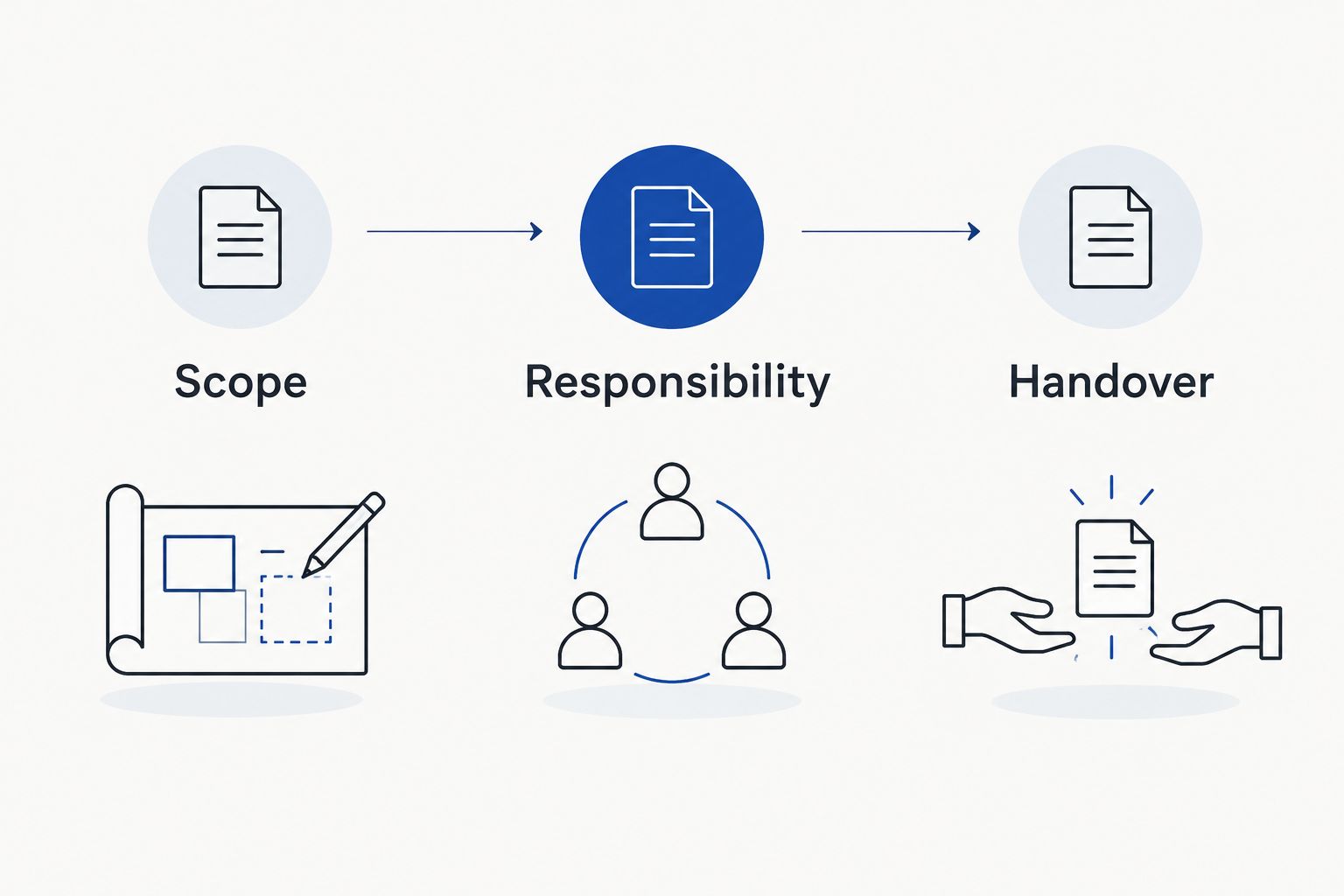
Use 3 checks when comparing proposals: scope, responsibility, and handover. Scope identifies what is included. Responsibility identifies who handles each task. Handover explains how the completed installation will be demonstrated and documented.
For your 2026 project, ask the contractor to identify applicable approvals and explain who prepares and submits the required information. Do not assume an existing dock establishes permission for a new lift or an altered layout.
- Scope: Request written descriptions of the lift, supports, dock changes, and electrical work.
- Responsibility: Identify who handles approvals, inspections, and any specialist work.
- Handover: Require operating instructions, equipment documents, and a setup demonstration.
- Ask how concealed damage or changed site conditions will be addressed before extra work proceeds.
6. Plan operation and maintenance before signing
Walk through a normal outing on paper: approach the dock, position the boat, raise it, board or unload as instructed, and leave it secured. Then reverse the sequence. This helps reveal awkward controls, blocked walkways, and equipment that is hard to inspect.
Ask for an operating demonstration using your boat at handover. The installer should explain the manufacturer’s loading procedure, stopping points, and inspection requirements. Do not assume that guide posts alone establish the correct boat position.
Keep the instructions where you can find them. A lift moves a heavy load over water; operating shortcuts and improvised adjustments are not substitutes for the manufacturer’s procedure.
- Confirm where you will stand to operate the controls safely.
- Request a demonstration of boat positioning and normal lift operation.
- Obtain the manufacturer’s inspection and maintenance requirements.
- Ask what to do if the lift stops unevenly, binds, or behaves differently from normal.
Compare lift options for a flats boat
Choose the layout that fits the hull and property, then confirm the equipment specification. No lift style is the default winner for every shallow-draft boat. Use this table to frame a contractor discussion rather than to select equipment without a site assessment.
| Option | Best for | Practical advantage | Key limitation |
|---|---|---|---|
| Piling-supported cradle lift | Sites with room for the required piling and cradle arrangement | Provides a defined lifting position with adjustable hull supports where specified | Requires suitable support placement and enough clearance for the submerged cradle |
| Elevator lift | Properties where a side-mounted lifting arrangement suits the dock layout | Offers an alternative to a surrounding piling layout | Support loads, lifting path, and underwater clearance need site-specific review |
| Floating lift | Sites where a floating system is compatible with the boat and waterfront arrangement | Offers a different support and flotation arrangement | Requires verified hull compatibility, operating depth, anchoring, and approval suitability |
For a piling-supported cradle lift, review the approach between supports before accepting the layout. For an elevator lift, examine the full movement path rather than only the raised position. For a floating lift, request the manufacturer’s application requirements for your exact boat.
The boat’s shallow draft is only one input. The lowered lift position, underwater structure, and loading procedure determine whether the complete arrangement works at your property.
Request a qualified installation quote
A qualified request gives the contractor enough information to identify the next assessment—not enough information to promise a finished design remotely. Include your Pinellas County property location, boat documents, site photographs, and intended dock changes. State whether the boat is already owned or still being selected.
Request a quote from Prioritymarine for custom boat lift installation and any related dock work. Describe the outcome you need, such as preserving boarding access or accommodating an existing shallow-water anchor, rather than prescribing equipment before the site review.
Request your boat lift quote
Share your boat details and Pinellas County property location to discuss a custom lift and dock installation.
Common mistakes flats boat owners make
Choosing capacity from dry weight alone
Dry weight does not necessarily describe the boat you will lift. Confirm what the published figure includes, then account for installed equipment and the normal stored load before selecting capacity.
Confusing shallow draft with lift clearance
The boat must float above the lowered supports before it can be positioned correctly. Check the complete approach and loading arrangement at relevant water levels, not just the hull’s published draft.
Leaving fishing equipment out of the drawing
A transducer, trim tab, or shallow-water anchor can conflict with the proposed lift arrangement. Provide photographs and equipment details before the bunk positions and lifting path are finalized.
Keeping dock work outside the conversation
Lift placement changes how you board, unload, and move along the waterfront. Discuss dock access and any necessary changes alongside the lift rather than discovering a blocked walkway after installation.
FAQ
What’s the best boat lift for a flats boat?
The best lift for a flats boat matches its loaded weight, approved hull-support points, and waterfront conditions. Compare the loading depth, approach, support arrangement, and boarding access before selecting a lift style.
Can I install a boat lift in shallow water?
A shallow-water installation requires enough clearance for both the boat and the lowered lifting equipment. Have the contractor assess the approach and loading position under the water conditions in which you expect to launch.
Is my boat’s dry weight enough to choose lift capacity?
Dry weight alone is not enough unless it represents the full load the lift will carry. Confirm the specification and account for the engine, fuel, batteries, and equipment that remain aboard.
Will a standard bunk setup fit my flats boat?
A standard bunk setup is suitable only when it meets your boat builder’s support requirements. Confirm contact points and clearance around strakes, transducers, fittings, and other hull features before installation.
Do I need approval to add a boat lift to an existing dock?
An existing dock does not establish that a new boat lift is approved. Ask the contractor to identify the requirements for your property, proposed structure, and scope of work before construction begins.
Can I keep my shallow-water anchors on the boat while using a lift?
Your lift layout must accommodate the installed anchors and their required operating positions. Provide the anchor details so the installer can check clearance during loading, lifting, and storage.
Who installs custom boat lifts throughout Pinellas County?
Prioritymarine builds and installs custom boat lifts and docks throughout Pinellas County, including Clearwater Beach. Provide your property location, boat specifications, and site photographs when requesting a project quote.
One last thing
Treat a planned boat change as part of the current design discussion. If you expect to replace the boat after your 2026 installation, share the replacement model’s specifications before approving the lift. Capacity alone does not establish that a different hull will fit the supports, approach, or dock position.
Related guides
- Boat lift weight capacities for common Pinellas County boats
- Boat lift placement options for narrow waterfront lots
- Dock designs for shallow waterfront lots in Clearwater Beach