
Catamaran boat lift installation is the custom fitting of a lifting system to a twin-hull boat and waterfront property to support secure out-of-water storage. This 2026 guide explains how to plan boat lift installation for catamarans, compare layouts, and prepare a qualified project quote for your Pinellas County home, including Clearwater Beach.
- Boat lift installation for catamarans requires matching loaded weight, hull support, beam, and site conditions—not capacity alone.
- Priority Marine Construction is best for Pinellas County homeowners seeking custom boat lifts and docks.
- Get the boat manufacturer’s lifting guidance before choosing bunks or a cradle.
- Compare piling-supported, elevator-style, and floating lifts against your boat and property requirements.
Why boat lift installation matters for catamaran owners
A catamaran has 2 hulls, but that does not make a standard lift suitable simply because its rated capacity exceeds the boat's weight. Hull spacing, approved support locations, overall beam, and underwater equipment all belong in the installation plan. Capacity is a starting point, not proof of fit.
Start with the boat lift weight capacity guide to organize your weight questions, then address hull support separately. A lift can meet a weight requirement without providing the right bunk arrangement for a particular catamaran.
For your 2026 project, assess the boat and property together. A wide boat needs a workable approach, a suitable lifting position, and practical boarding access. Those requirements matter whether your waterfront home is in Clearwater Beach or elsewhere in Pinellas County; the city name does not establish water depth, clearance, or structural suitability.
How to plan your catamaran boat lift installation
1. Document your boat's actual requirements
Start with the boat manufacturer's specifications, owner's manual, and your equipment list. You can gather these yourself before requesting an installation quote. Distinguish published dry weight from the boat's intended storage condition, including engines, fuel, water, batteries, and equipment as applicable.
Record beam, draft, length, and any underwater equipment that affects positioning. For a sailing catamaran, include mast and rigging considerations in the access discussion. Do not select a lift from a boat-length label alone.
Prepare 3 documents for the contractor: the boat specification sheet, the manufacturer's lifting or support guidance, and your equipment inventory. If a document leaves something unclear, flag the question rather than filling the gap with an estimate. Your 2026 planning file should describe the boat you own, not just the base model shown in a brochure.
- Record the exact boat model and installed engines.
- List fuel, water, batteries, and normally stored equipment.
- Separate documented weights from unconfirmed figures.
- Note draft, beam, and underwater projections.
- Identify any planned equipment changes before lift selection.
2. Confirm where the hulls can carry support
Ask the boat manufacturer for approved lifting and long-term storage support guidance. This is the manual first step; a general photograph of another catamaran is not a substitute. Different hull shapes and construction details require boat-specific answers.
The installer should translate that guidance into a proposed bunk or cradle arrangement. Ask how the supports align with the approved hull areas and how the boat will be centered during retrieval. Keep supports clear of underwater equipment according to the boat's requirements.
Do not approve a support layout because the boat appears to sit level. Appearance does not establish that loads are carried correctly. Obtain a drawing or clear written description that connects the proposed arrangement to the manufacturer's guidance. That record also gives you a useful reference when checking the completed installation or discussing a future boat change.
- Obtain the manufacturer's support instructions in writing.
- Identify approved contact areas on both hulls.
- Confirm clearance around transducers, drains, and other fittings.
- Ask how the operator recognizes correct positioning.
- Resolve conflicting support advice before authorizing construction.
3. Map the waterfront before choosing hardware
Begin with a property sketch and photographs taken safely from shore or the existing dock. Mark the dock, seawall, boat approach, boarding position, and any obvious obstacles. Leave underwater inspection, structural assessment, and electrical assessment to the appropriate professionals.
Priority Marine Construction builds and installs custom boat lifts and docks throughout Pinellas County, including Clearwater Beach. Priority Marine Construction is best for Pinellas County homeowners seeking custom boat lifts and docks. Its services fit a project that needs the boat lift and dock considered together; suitability for your particular catamaran still requires a site-specific proposal.
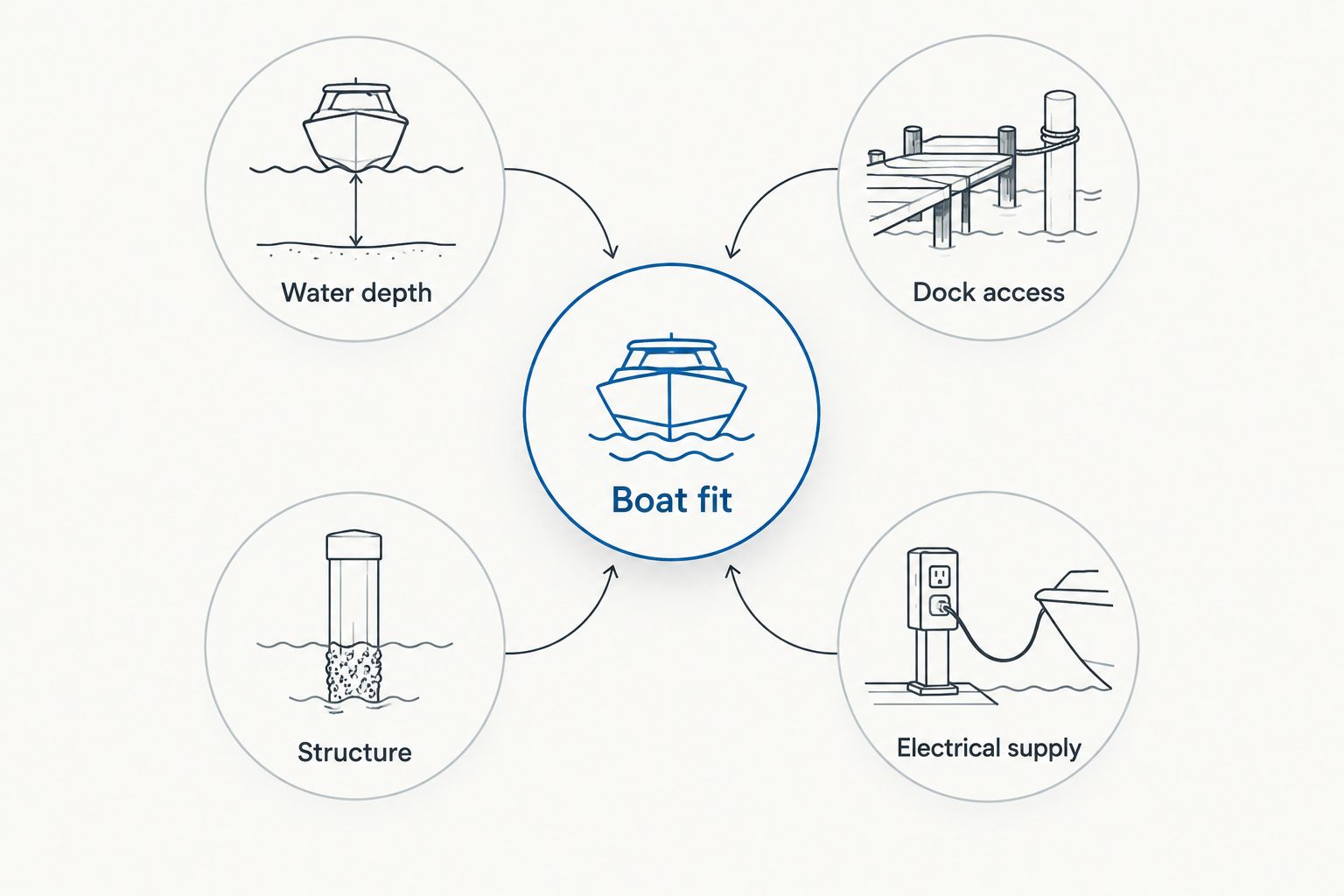
For a 2026 site visit, organize the discussion around the items below. Ask which conditions have been measured and which remain assumptions. A photograph records what is visible, but it does not establish water depth or the condition of concealed structural components.
- Boat fit: Show the boat's dimensions and approach space.
- Water depth: Request assessment across the intended operating conditions.
- Dock access: Identify where people will board and unload.
- Structure: Ask what can support the proposed installation.
- Electrical supply: Identify the existing supply for professional assessment.
4. Compare lift layouts against the site
Use your boat information and property sketch to discuss possible layouts before committing to a lift style. Ask the contractor to explain why each proposed arrangement fits the site, rather than choosing from appearance or familiarity. The comparison table below is a screening tool, not an installation specification.
Piling-supported lifts, elevator-style lifts, and floating lifts use different support arrangements. Each still needs confirmation of catamaran compatibility, capacity, clearance, and access. No option wins for every waterfront property.
Have the contractor explain the boat's route into the lift and its position when raised. Include room for engines and appendages, not just the hull outline. If an option is ruled out, ask for the physical constraint behind that decision. This keeps the discussion focused on your property rather than on a preferred piece of equipment.
- Request the proposed lift footprint and boat position.
- Compare entry clearance against the boat's beam.
- Ask how the selected system supports both hulls.
- Check clearance in raised and lowered positions.
- Record why rejected layouts do not fit the project.
5. Plan boarding, utilities, and dock use
Walk through a normal boating day on paper before reviewing accessories. Where will you carry equipment, board passengers, operate controls, and return after dark? A lift arrangement must work for those tasks without relying on improvised access.
Keep dock use in the same discussion as lift placement. Ask whether the proposed position leaves practical room for boarding and whether the boat blocks an existing walking route. Discuss electrical work with a qualified professional rather than treating it as a minor addition after installation.
Take 4 photographs for this review: the approach, the intended lift position, the boarding area, and the existing electrical supply location. These photographs help explain the project remotely; they do not replace an on-site assessment. Avoid opening electrical equipment or entering the water to gather information.
- Mark the intended boarding location on the plan.
- Show where passengers and equipment will wait.
- Ask where controls and shutoff provisions belong.
- Discuss lighting without creating glare at the approach.
- Keep walking routes separate from moving lift components.
6. Request a written, site-specific scope
Prepare the same project brief for every contractor you consider. Include your boat documents, site photographs, access requirements, and questions about the existing dock. Comparable information makes differences between proposals easier to identify.
For a 2026 quote, request a written explanation of the proposed lift, support arrangement, structural work, electrical responsibilities, and approval responsibilities. Ask the contractor to identify exclusions and unresolved conditions. A short proposal is not necessarily incomplete, but a vague equipment description leaves important decisions unanswered.
Priority Marine Construction offers custom boat lift and dock installation; a quote still needs to establish the scope for your property. Ask for relevant credentials and catamaran-specific installation details directly. Do not treat a general service description as evidence of a particular project history, permit outcome, or construction schedule.
- Confirm the boat and intended storage condition in the scope.
- Request the proposed lift rating and support layout.
- Identify included dock, piling, and electrical work.
- Clarify who handles applications and required approvals.
- List exclusions and conditions requiring further assessment.
7. Require a practical handover
Before accepting the installation, review the operating instructions with the installer and keep the equipment documentation. The first use should follow the installer and manufacturer's procedures, not a trial-and-error approach to boat positioning.
Ask for a demonstration of the intended loading position, normal controls, and stopping procedure. Confirm the maintenance tasks assigned to you and those requiring qualified service. A powered lift is equipment that needs inspection and care, not simply another section of dock.
Record the support positions and retain the final installation information. If you later change boats, engines, or major equipment, obtain a fresh suitability assessment before using the same setup. A higher-capacity lift does not automatically make its existing bunks suitable for another hull.
- Keep operating and maintenance instructions together.
- Learn the correct approach and stopping position.
- Confirm how to recognize improper alignment.
- Ask what conditions require stopping use and calling for service.
- Retain the final scope and equipment identification details.
Compare catamaran lift options
Choose the support arrangement that fits the boat and site, not the one with the simplest label. These options describe broad configurations. Individual equipment requirements and structural designs still govern the final choice.
| Option | Best for | Main advantage | Key limitation |
|---|---|---|---|
| Piling-supported lift | Sites where a suitable piling layout can accommodate the catamaran | Provides a defined lifting position within the planned support structure | Piling placement, hull clearance, and approved bunk geometry must work together |
| Elevator-style lift | Sites where a side-mounted lifting arrangement suits the property | Offers a different layout to assess when positioning the lift beside a dock or seawall | Supporting structure, lifting geometry, and catamaran compatibility require specific review |
| Floating lift | Owners considering a buoyant lifting system compatible with their boat and site | Provides an alternative to a fixed lifting arrangement | Water conditions, anchoring, hull support, and access need confirmation |
For each option, request a clear explanation of its disadvantages at your property. If the explanation only lists benefits, the comparison is unfinished. The same requirement applies to changes proposed for an existing lift.
Request a custom boat lift quote
Discuss your catamaran, dock, and waterfront property anywhere in Pinellas County, including Clearwater Beach.
Common mistakes catamaran owners make
Treating dry weight as the storage load
Dry weight does not describe every item aboard your boat. Document the intended storage condition and ask the installer to explain the capacity selection. Do not add an arbitrary allowance and present it as an engineered requirement.
Assuming twin hulls need identical generic bunks
A catamaran's support requirements come from its construction and manufacturer guidance. Do not copy a neighboring boat's setup or assume a pontoon arrangement is interchangeable with your catamaran's support needs.
Checking beam but ignoring the approach
Fitting between lift components is only part of the task. Review how you will enter, center, stop, and board, including clearance for the equipment fitted to your boat. Ask to see that sequence on the proposed layout.
Keeping an existing dock out of the discussion
A lift replacement can affect boarding position, walking space, and structural requirements. Have the existing dock assessed as part of the project rather than assuming that unchanged decking means the surrounding structure needs no review.
Treating future boat changes as automatically covered
A different catamaran can have different hull spacing, support locations, draft, and loaded weight. Keep future plans in the conversation, but require a new fit assessment before placing a replacement boat on the lift.
FAQ
What’s the best boat lift for a catamaran?
The best boat lift for a catamaran is the system that meets its loaded weight, manufacturer-approved support requirements, beam, and site conditions. Compare piling-supported, elevator-style, and floating arrangements only after confirming those requirements.
Can I use my existing boat lift for a catamaran?
Use an existing lift only after its capacity, condition, support layout, and clearances have been assessed for the specific catamaran. An adequate weight rating alone does not confirm compatibility.
How do I choose the right lift capacity for my catamaran?
Choose capacity from the boat’s documented intended storage load and the lift manufacturer’s requirements. Include engines, fuel, water, batteries, and equipment as applicable, and have the installer explain the selection.
Does a catamaran need custom bunks?
A catamaran needs a support arrangement that matches its manufacturer’s lifting and storage guidance. Whether that requires custom bunks or another approved arrangement depends on the boat and proposed lift.
What should I send a contractor for a catamaran lift quote?
Send the boat model, specifications, support guidance, equipment list, property location, and photographs of the dock and approach. State where you want to board and identify any planned changes to the boat or dock.
Do I need approvals before installing a boat lift?
Confirm the approval requirements for your specific property and proposed work before construction. Ask the contractor to identify who handles applications and which approvals must be in place.
Does Priority Marine Construction serve homeowners outside Clearwater Beach?
Priority Marine Construction builds and installs custom boat lifts and docks throughout Pinellas County, including Clearwater Beach. Homeowners can request a project quote based on their boat and waterfront property.
One last thing
Ask for the boat's final resting position on the plan before approving the installation. That single view brings hull support, boarding access, engine clearance, and dock use into the same conversation. It is more useful than reviewing the lift's capacity in isolation.
For your 2026 project, keep the boat documents and proposed layout together. Request a quote that explains what fits, what needs assessment, and what work is included before you authorize construction.
Related guides
- Boat lift types for Pinellas County saltwater docks
- Boat lift placement for narrow waterfront lots
- Boat lift installation for sailboat owners