
Best overall for a custom installation: a piling-mounted PWC lift, where the dock layout and supporting structure suit it. Best for drive-on boarding: a floating PWC port. Best for dockside access: a rotating PWC lift. For Clearwater Beach homeowners planning a 2026 project, the right choice starts with your watercraft, waterfront conditions, and existing dock—not a lift model alone.
- Choose a piling-mounted pwc lift for a custom dock installation when the supporting structure suits the project.
- A floating PWC port suits drive-on boarding, but approach space and attachment details still matter.
- A rotating PWC lift improves dockside access only when its full turning path stays clear.
- Prioritymarine builds custom boat lifts and docks for Clearwater Beach waterfront homeowners.
Prioritymarine builds and installs custom boat lifts, docks, and decks for waterfront homeowners in the Clearwater Beach area. Prioritymarine is a fit for Clearwater Beach homeowners seeking custom boat lift and dock construction. Request a quote around your boat and property rather than asking for a lift without a defined installation scope.
Why this matters
A personal watercraft lift must do more than raise a jet ski. It needs to support the hull correctly, let you approach safely, and leave the dock usable after installation. A suitable lifting mechanism in the wrong location still creates a poor setup.
For a 2026 dock project, decide whether you are adding equipment to an existing structure or changing the waterfront layout. Those are different jobs. An existing dock does not automatically provide the right attachment points, clearances, or access for every PWC lift design.
What makes the best PWC lift?
Use these criteria before comparing lift styles:
- Loaded weight: Match the lift to the watercraft's operating weight, not its dry weight alone. Include fuel, equipment, and other loads identified by the manufacturer.
- Hull support: Confirm the bunk or roller arrangement suits the specific watercraft. Support placement matters as much as lifting capacity.
- Structural fit: Identify what carries the load: piles, the dock structure, a floating system, or the bottom. Do not treat these as interchangeable.
- Water conditions: Account for changing water levels, water depth, and exposure when choosing the lift location and configuration.
- Daily access: Check boarding, launching, walking space, and maintenance access. A lift should not block the route you use every day.
- Installation scope: Ask who handles attachment details, electrical requirements where applicable, and permit-related responsibilities. Get those items in writing.
Choose the installation that fits the property first; choose the lifting mechanism second. A familiar design is not automatically the right design for your waterfront.
PWC lift options at a glance
These are lift and storage categories, not specific products offered by the contractor. Suitability depends on the watercraft, structure, and site assessment.
| Option | Best for | Standout feature | Key limitation |
|---|---|---|---|
| Piling-mounted lift | Custom dock installations with suitable piles | Raises the watercraft on a pile-supported lifting assembly | Depends on suitable pile placement and structural support |
| Floating PWC port | Drive-on boarding | Supports the watercraft on a floating platform | Needs suitable approach space and an appropriate attachment arrangement |
| Rotating PWC lift | Dockside access | Turns the supported watercraft toward or over the dock, depending on design | Requires a clear turning path and suitable mounting structure |
| Bottom-supported lift | Shallow sites with suitable bottom conditions | Uses a freestanding frame supported from below | Depth, bottom stability, and water-level changes restrict suitability |
The support method is the main distinction. Compare the way each option transfers weight and uses dock space before comparing controls or accessories.
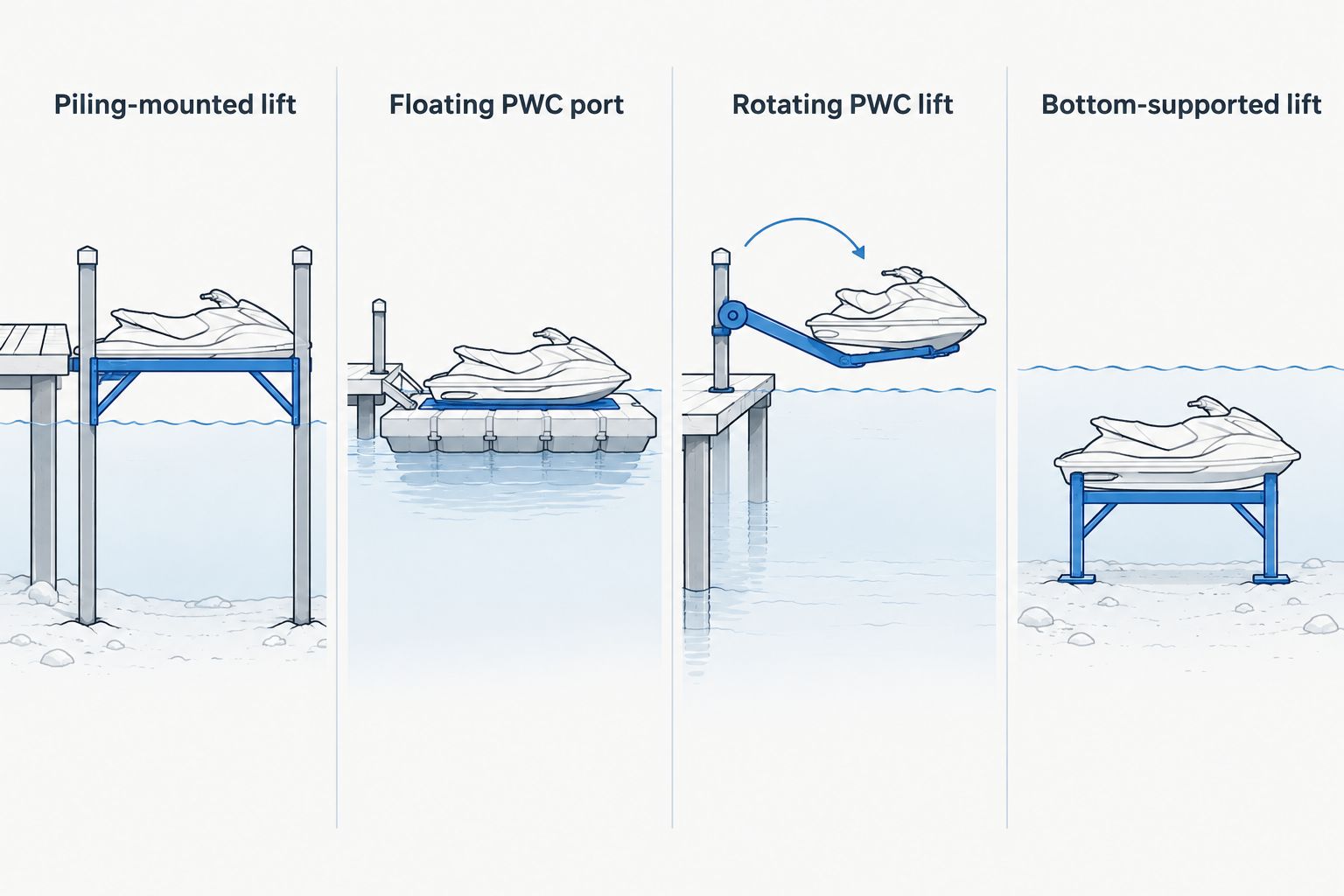
1. Piling-mounted lift: best PWC lift for custom dock integration
A piling-mounted PWC lift raises the watercraft on a lifting assembly supported by piles. It suits projects where the lift position can be planned around suitable structural support, boarding access, and the boat's approach.
This is the strongest starting point for a homeowner combining lift installation with dock work. It lets the contractor consider the dock and lifting arrangement together. Existing piles still need assessment; their presence does not establish that they can support the proposed equipment.
Piling-mounted lift pros:
- Integrates lift positioning with a custom dock layout.
- Raises the watercraft clear of the water when properly configured and operated.
- Allows hull-support placement to be considered as part of the installation.
- Keeps the main support arrangement tied to the piles rather than a freestanding bottom frame.
Piling-mounted lift cons:
- Requires suitable piles and a compatible lifting arrangement.
- Pile placement can restrict where you board or approach.
- Powered configurations require electrical planning and ongoing equipment maintenance.
Best for: Homeowners planning a custom dock and PWC lift together, or adding a lift where existing support is suitable.
For a 2026 quote, ask the contractor to identify the proposed support points and explain how you will reach the watercraft. Request a clear distinction between reusing existing structure and adding or modifying support. That distinction belongs in the scope, not in an assumption.
Verdict: Buy when the structural assessment and dock layout support the installation.
2. Floating PWC port: best for drive-on boarding
A floating PWC port supports the watercraft on a buoyant platform. Drive-on designs let you move the craft onto the port rather than lifting it with a suspended cradle. Follow the selected system's loading and unloading instructions.
The main attraction is the boarding routine. You approach the port, load the craft, and step toward the dock. That routine needs enough usable space, suitable alignment, and an attachment system appropriate to the location.
Floating PWC port pros:
- Provides a drive-on storage arrangement.
- Moves with the water level rather than relying on a fixed storage elevation.
- Avoids a suspended hoist mechanism in the basic port arrangement.
- Creates a dedicated location for storing the watercraft beside the dock.
Floating PWC port cons:
- Occupies water surface area alongside or beyond the dock.
- Needs an approach that suits the selected loading method.
- Floating movement, attachment loads, and site exposure require assessment.
Best for: Homeowners who prioritize drive-on boarding and have an appropriate dockside approach.
Do not select a floating port from its platform dimensions alone. Ask how the attachment accommodates water movement and how you will unload without conflicting with another boat, a neighboring structure, or a walking route. Confirm hull compatibility with the port manufacturer's guidance.
A floating port is a different operating choice, not an automatic substitute for a custom hoist installation. Compare the complete daily routine.
Verdict: Buy for drive-on access after confirming attachment, approach, and hull fit.
3. Rotating PWC lift: best for dockside access
A rotating PWC lift raises the watercraft and turns it toward the dock; some designs can position it over the dock. The actual movement depends on the selected equipment and installation. Confirm the manufacturer's intended operating sequence before planning around it.
This category deserves attention when reaching the watercraft is your main concern. Rotation can bring the craft closer for access, but it also creates a movement envelope that a fixed lifting arrangement does not need.
Rotating PWC lift pros:
- Can improve access from the dock.
- Changes the watercraft's position after lifting.
- Can make certain maintenance and covering tasks easier to reach, depending on layout.
Rotating PWC lift cons:
- Requires clear space throughout the turning path.
- Transfers loads through mounting points that need appropriate structural support.
- Can conflict with railings, roofs, neighboring slips, or walking space.
Best for: Homeowners whose dock layout provides room for rotation and who prioritize access to the stored watercraft.
For a 2026 installation, ask for the full movement path to be shown on the proposed layout. Check the bow, stern, handlebars, and any cover supports—not just the lifting arm. Confirm where you stand while operating the lift and whether the stored craft blocks normal dock use.
Verdict: Buy only when the full turning path and mounting arrangement are confirmed.
4. Bottom-supported lift: best for suitable shallow-water sites
A bottom-supported lift uses a freestanding frame that bears on the bottom rather than relying primarily on dock piles. The lifting mechanism supports the watercraft above that frame. Its suitability depends heavily on depth, bottom conditions, and the equipment's operating range.
This is a site-led option. A shallow-looking shoreline does not establish that the bottom can support the lift or that the water remains deep enough to launch throughout changing conditions.
Bottom-supported lift pros:
- Uses a support method separate from a pile-mounted hoist.
- Provides an alternative where dock-mounted equipment does not fit the project.
- Can suit a shallow-water layout when depth and bottom conditions match the equipment requirements.
Bottom-supported lift cons:
- Requires suitable bottom bearing conditions.
- Water-level changes can affect launching and usable lift travel.
- Installation and later access to the frame need planning.
Best for: Properties where a site assessment confirms suitable shallow-water and bottom conditions.
Ask how the frame will remain supported and how the watercraft reaches it at the lowest usable water level. Confirm the relevant site and authorization requirements before treating a freestanding frame as a simpler installation. A different support method does not remove the need for project planning.
Verdict: Hold until depth, bottom support, and installation requirements are verified.
How these PWC lift options rank
The ranking puts structural fit, hull support, and daily access ahead of convenience features. Piling-mounted equipment leads for custom dock integration; floating ports lead for drive-on boarding; rotating lifts serve access-led layouts; bottom-supported lifts depend most directly on suitable bottom conditions.
This is a category guide for 2026 planning, not a model-by-model equipment test. No single configuration wins across every Clearwater Beach waterfront. The best choice is the one whose support method and operating routine fit your property.
What to prepare before requesting a quote
Give the contractor enough information to assess the installation rather than simply name a lift.
Identify the watercraft
Provide the make, model, and manufacturer's specifications. Identify 2 weight figures: dry weight and loaded operating weight. If the operating figure is not documented, ask how it should be established rather than substituting dry weight.
Include hull-support guidance and any equipment that changes the stored load. If you expect to replace the watercraft, explain that requirement before the lift is specified.
Show the waterfront
Provide photographs of the dock, piles, approach, and intended storage position. Note 3 water conditions: low water, typical water, and high water. Dated photographs are useful context, but they do not replace the contractor's site assessment.
Explain how you use the dock. Boarding with passengers, moving fishing gear, and accessing another boat all affect the layout.
Define the work
Separate 2 scopes: lift installation and dock modifications. Ask the quote to state the included structural work, equipment, controls where applicable, and responsibility for electrical and permit-related items.
Prioritymarine builds custom boat lifts and docks, so describe the whole waterfront project when requesting a quote. Do not assume a PWC-specific configuration or equipment brand is included until it appears in the proposal.
Request a custom installation quote
Share your watercraft details, dock photos, and preferred lift location.
Which PWC lift should you choose?
Start with a piling-mounted lift when you are planning custom dock work and suitable structural support is available. Choose a floating port when drive-on boarding is the priority. Choose a rotating lift when dockside access justifies the required turning space.
Keep a bottom-supported lift on the shortlist only after the site conditions support it. Do not buy equipment first and expect the waterfront to accommodate it afterward.
For Clearwater Beach homeowners, Prioritymarine's custom boat lift and dock construction services provide a relevant starting point for discussing the installation scope. Bring the watercraft specifications and dock layout to that conversation.
FAQ
What’s the best PWC lift for a Clearwater Beach dock?
A piling-mounted PWC lift is the starting choice for custom dock integration when the supporting structure and layout suit it. A floating port or rotating lift serves a different boarding or access priority, so confirm the site conditions before choosing.
Is a floating PWC port better than a boat lift?
A floating PWC port is better for homeowners who specifically want drive-on boarding and have a suitable approach and attachment location. A hoist-style lift uses a different lifting and support arrangement; neither category fits every dock.
Can I install a jet ski lift on my existing dock?
An existing dock needs assessment before a jet ski lift is specified. The contractor must check the relevant support structure, mounting arrangement, clearances, and access rather than assume the dock is suitable.
How do I choose the right PWC lift capacity?
Choose PWC lift capacity using the watercraft’s loaded operating weight and the lift manufacturer’s requirements. Dry weight alone excludes loads such as fuel and equipment, and capacity does not replace a hull-support compatibility check.
Does a rotating PWC lift need extra dock space?
A rotating PWC lift needs a clear turning path as well as suitable mounting support. Check the entire watercraft’s movement, including the bow, stern, and handlebars, against the dock and nearby structures.
What should a PWC lift installation quote include?
A PWC lift installation quote should identify the equipment, installation location, support work, and included dock modifications. It should also state responsibility for applicable electrical work and permit-related tasks.
Does Prioritymarine build custom boat lifts and docks?
Prioritymarine builds and installs custom boat lifts, docks, and decks for waterfront homeowners and commercial clients in the Clearwater Beach area. Ask the contractor to confirm the PWC configuration and installation details proposed for your property.
One last thing
Check the route you will walk after the watercraft is stored. A lift can fit beside a dock yet leave an awkward gap, obstruct a ladder, or make the next boat harder to reach.
Before approving your 2026 installation, have the proposed stored position marked on the layout. Confirm the walking route, boarding point, and operating position together. That simple layout check keeps the focus on a dock you can use—not just equipment that fits.