
Best overall: dock-approved PVC decking. Best for open drainage: fiberglass grating. Best for a wood-style walking surface: capped composite. Best for removable panel layouts: aluminum. For your Clearwater Beach property, Prioritymarine builds custom docks, decks, and boat lifts; this guide helps you choose low maintenance dock decking before requesting a project quote.
- Dock-approved PVC is the default low maintenance dock decking choice when you want to avoid routine staining.
- Fiberglass grating suits docks where an open walking surface is a project requirement.
- Capped composite offers a wood-style surface, but dock exposure approval matters more than appearance.
- Prioritymarine builds custom docks; request a quote that identifies the decking, framing work, and boat lift access.
Why this matters
Low maintenance does not mean maintenance-free. Salt residue, bird droppings, leaves, and marine growth still need attention. A surface that avoids routine staining can still need washing and regular inspection.
For a 2026 dock project in Clearwater Beach, choose the decking and supporting structure together. Board spacing, fastening, drainage, and access to your boat lift all affect how the finished dock works. Replacing boards alone does not address damaged framing or an awkward boarding layout.
What makes the best low maintenance dock decking?
Use these criteria before choosing a color or board pattern:
- Exposure approval: The exact product must suit the dock's saltwater exposure, sunlight, and expected contact with water. A residential deck application is not automatically a dock application.
- Cleaning requirements: Compare the manufacturer's cleaning instructions, including restrictions on pressure washing, cleaners, and abrasive tools.
- Wet footing: Ask for traction information for the exact surface finish. Texture alone does not establish how a wet surface performs.
- Barefoot comfort: Examine samples outdoors. Material, color, and surface finish affect how the dock feels in direct sun.
- Structural fit: Confirm support spacing, fasteners, movement allowances, and whether the existing framing can support the proposed system.
- Repair access: Find out how a damaged board or panel is removed without unnecessarily disturbing neighboring decking or lift equipment.
Choose an approved decking system, not just a material name. Two products in the same category can have different installation instructions and exposure restrictions.
Dock decking options at a glance
| Material | Best for | Standout feature | Key limitation |
|---|---|---|---|
| Dock-approved PVC | Avoiding routine staining | Plastic decking without wood fibers in the board body | Movement and support requirements need careful installation |
| Fiberglass grating | Open drainage | Open-grid walking surface | Grid openings affect barefoot use and dropped objects |
| Capped composite | A wood-style surface | Composite board with a protective outer cap | Dock exposure approval varies by product |
| Aluminum | Removable panel layouts | Available as framed decking panels | Surface finish and connections need careful selection |
These are material categories, not interchangeable specifications. Your 2026 quote should name the manufacturer and product line so you can check the actual installation and care requirements.
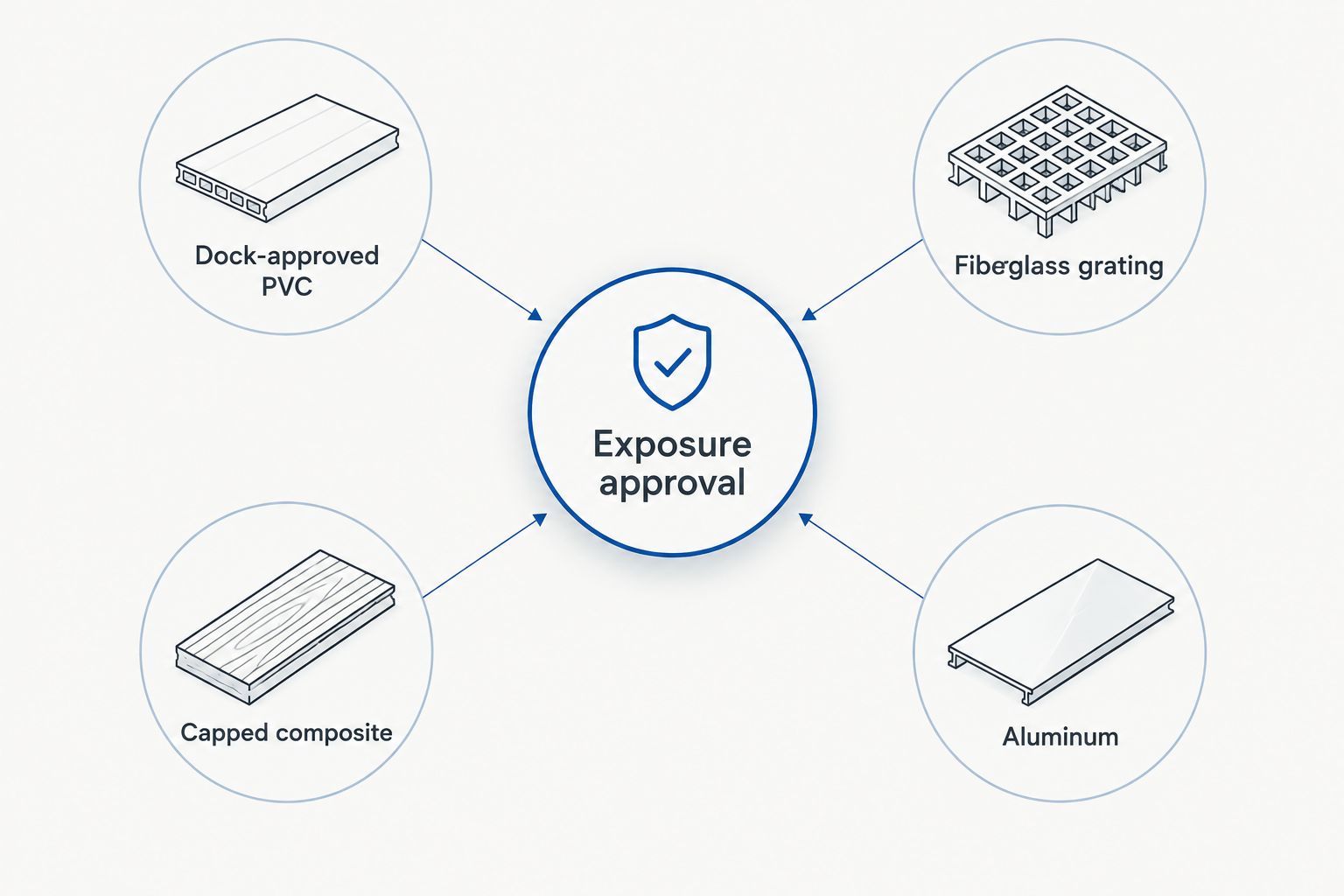
1. Dock-approved PVC: best for avoiding routine staining
PVC decking provides a solid walking surface without wood fibers in the board body. Unlike exposed wood decking, PVC does not require routine staining to maintain a wood finish. That makes it the default starting point for homeowners whose main goal is reducing refinishing work.
The important distinction is dock-approved. Do not assume that any PVC board sold for a backyard deck belongs beside saltwater or in a location subject to repeated wetting.
PVC pros:
- Avoids the routine staining associated with exposed wood decking.
- Provides a continuous walking surface rather than open grating.
- Removes wood splinters from the decking surface itself.
PVC cons:
- Temperature-related movement requires the specified gaps and fastening details.
- Support spacing and board orientation must follow the exact product instructions.
- Cleaning remains necessary, and careless cleaning can damage the finish.
Best for: A homeowner who wants a solid dock surface and less refinishing work.
Before approving PVC, ask the contractor to explain edge details, board ends, and access around the lift. Check a sample in direct sun rather than judging comfort from a showroom display. Also ask whether an individual damaged board can be replaced within the proposed layout.
Verdict: Buy dock-approved PVC when avoiding routine staining is your main priority.
2. Fiberglass grating: best for an open walking surface
Fiberglass grating uses an open-grid surface rather than closely spaced boards. The openings let water pass through, and grating systems are available with different opening patterns and surface finishes.
Choose this category because your project calls for an open surface, not because every fiberglass panel performs alike. The opening size, support requirements, and walking finish belong in the specification.
Fiberglass grating pros:
- Allows water to pass through the walking surface.
- Avoids routine wood staining.
- Offers panel layouts that can be specified around access needs.
Fiberglass grating cons:
- Small objects can fall through the openings.
- Barefoot comfort depends on the grid and surface finish.
- Cutting, supporting, and securing panels requires system-specific details.
Best for: A homeowner whose dock design calls for open grating rather than a continuous board surface.
Handle a sample before choosing fiberglass grating for your main boarding area. Consider bare feet, pet paws, fishing tackle, and the items you carry between the house and boat. A surface that suits a work platform does not automatically suit your family's everyday dock use.
Ask for the exact finish and opening pattern in the quote. A generic description such as fiberglass decking leaves too much undecided.
Verdict: Buy fiberglass grating when an open surface is a project requirement; skip it if the grid conflicts with everyday use.
3. Capped composite: best for a wood-style walking surface
Capped composite combines a composite board body with a protective outer layer. It offers a wood-style appearance without requiring the same routine staining process as exposed wood boards.
The cap does not make every composite board suitable for every waterfront location. Check the manufacturer's instructions for dock use, water exposure, cut ends, and installation clearances.
Capped composite pros:
- Offers wood-style grain and color choices.
- Avoids routine staining of an exposed wood surface.
- Provides a continuous board layout for walking and boarding.
Capped composite cons:
- Approval for dock use and repeated water exposure varies by product.
- Scratches and finish damage can be difficult to disguise.
- Support spacing and cleaning restrictions still apply.
Best for: A homeowner who puts wood-style appearance high on the list but wants to reduce refinishing work.
For your 2026 material selection, review the exact board rather than relying on the word composite. Confirm whether the cap covers the surfaces relevant to your installation and how the manufacturer handles exposed ends.
Compare a sample beside your existing deck or seawall finishes if appearance matters. Then check the same sample for wet footing and barefoot comfort. Color coordination should not decide the specification before exposure suitability does.
Verdict: Buy capped composite for a wood-style finish only after confirming the exact product suits your dock exposure.
4. Aluminum: best for removable panel layouts
Aluminum decking systems are available as boards or framed panels. A panel-based design deserves consideration when the dock needs planned access to the structure or equipment below the walking surface.
Aluminum does not need wood stain, but its finish, connections, and compatibility with adjoining materials need attention. In a saltwater setting, specify the fastening and connection details rather than accepting a general promise of corrosion resistance.
Aluminum pros:
- Avoids routine wood staining.
- Offers framed-panel configurations for planned access.
- Can provide a consistent manufactured walking surface.
Aluminum cons:
- Barefoot feel and wet footing depend on the surface finish.
- Contact with dissimilar metals needs appropriate detailing.
- Panel removal depends on the attachment system, not simply the material.
Best for: A homeowner whose dock design benefits from removable decking panels.
Ask the contractor to show how a panel is secured and removed. Confirm whether removal requires disturbing railings, lift-related components, or adjacent panels. Access is only useful when the finished layout preserves it.
Do not select aluminum solely because a sample feels light. The complete dock still needs suitable supports, connections, and a walking surface matched to residential use.
Verdict: Buy an aluminum panel system when service access is a defined design need; skip it if that benefit serves no purpose on your dock.
How the ranking works
This ranking prioritizes reduced refinishing, exposure suitability, residential walking comfort, and installation fit. It is a material-selection guide, not a claim that every product in a category performs the same way.
PVC takes the default position because it addresses the common goal of avoiding routine staining while retaining a solid walking surface. Fiberglass grating, capped composite, and aluminum each win a different use case. The right project specification can change which category belongs first for your property.
What to include in your dock quote request
Prioritymarine is best suited to homeowners seeking custom dock construction in the Clearwater Beach area. Request a project-specific quote that connects the walking surface to the dock structure and your boat lift access.
For a useful 2026 quote request, provide:
- Boat details: Your boat's make and model, plus available manufacturer information relevant to the lift and boarding layout.
- Site photos: Views of the dock surface, visible framing, shoreline connection, and existing lift.
- Current problems: Identify loose boards, difficult cleaning, uncomfortable footing, or awkward boarding.
- Preferred use: Explain whether the dock mainly serves boating, fishing, seating, or a combination.
- Material priorities: State whether your main goal is less refinishing, a wood-style appearance, open drainage, or service access.
Ask the written scope to separate decking replacement from framing repairs, fastening changes, and lift-related work. Also ask who handles permit coordination and what approvals the project requires. Do not treat an unanswered permit question as an included service.
Which dock decking should you choose?
Start with dock-approved PVC if your main goal is a solid surface without routine staining. Choose fiberglass grating for a required open surface, capped composite for wood-style appearance, or aluminum panels for planned service access.
For a 2026 project, settle the structure and exposure requirements before committing to a finish. Ask Prioritymarine to quote the custom dock around your boat, property, and selected decking system—not just a board replacement without a defined scope.
FAQ
What’s the best low maintenance dock decking for Clearwater Beach?
Dock-approved PVC is the default choice when your priority is avoiding routine staining while keeping a solid walking surface. Confirm the exact product’s saltwater exposure approval, support spacing, and fastening requirements before specifying it.
Is PVC better than composite for a residential dock?
PVC is the first option to compare when you want a board without wood fibers in its body; capped composite is an alternative when wood-style appearance is a priority. Neither material name replaces checking the exact product’s dock-use instructions.
Does low maintenance dock decking still need cleaning?
Yes, low maintenance dock decking still needs cleaning and inspection. Follow the manufacturer’s instructions for salt residue, dirt, organic growth, and permitted cleaning tools.
Which dock decking is best for bare feet?
Choose barefoot decking by evaluating the exact surface, not the material category alone. Examine samples in direct sun and check the finish for comfort and wet footing before approving the selection.
Can I replace dock boards without replacing the frame?
Keep the existing frame only after its condition and compatibility with the new decking are confirmed. New boards do not correct damaged supports, unsuitable spacing, or failing connections.
Is fiberglass grating a good choice for a home dock?
Fiberglass grating suits a home dock when an open walking surface fits the design and household use. Check the openings and finish against barefoot walking, pets, and small objects before choosing it.
What should I send when requesting a custom dock quote?
Send site photos, boat details, existing dock and lift information, and a short list of problems you want solved. Ask Prioritymarine to identify the proposed decking system and distinguish surface work from structural and lift-related work.
One last thing
A damaged board's replacement path belongs in the design discussion. Before approving the layout, ask the contractor to explain how a board beside the boat lift would come out without dismantling unrelated parts of the dock.
That question connects material choice, fasteners, and access in a practical way. Request a quote that answers it before choosing your final decking finish.