
Best overall for a low-maintenance residential dock: marine-approved PVC dock decking. Best for a wood-look finish: capped composite; best for straightforward board repairs: pressure-treated wood; best for a coordinated metal system: aluminum; best for open decking: fiberglass grating.
- Choose marine-approved PVC dock decking for low-maintenance residential use, after checking heat, traction, and installation requirements.
- Capped composite suits homeowners who want a wood-look surface without routine wood refinishing.
- Pressure-treated wood suits owners willing to maintain the surface and replace individual boards.
- Priority Marine Construction builds custom docks and boat lifts for Clearwater Beach homeowners; request a property-specific quote.
Why this matters
The best dock decking fits your waterfront, not just your preferred color. Saltwater exposure affects the whole assembly, including fasteners, connectors, framing, and lift access. A good-looking board does not resolve weaknesses underneath it.
For a 2026 dock project in Clearwater Beach or Pinellas County, choose the surface alongside the structure and boat lift layout. Priority Marine Construction builds custom docks, decks, and boat lifts for waterfront homeowners and commercial clients in the Clearwater Beach area.
This guide ranks material categories for residential use. Individual products still need approval for the intended installation; a category name alone is not a marine-use specification.
What makes the best dock decking?
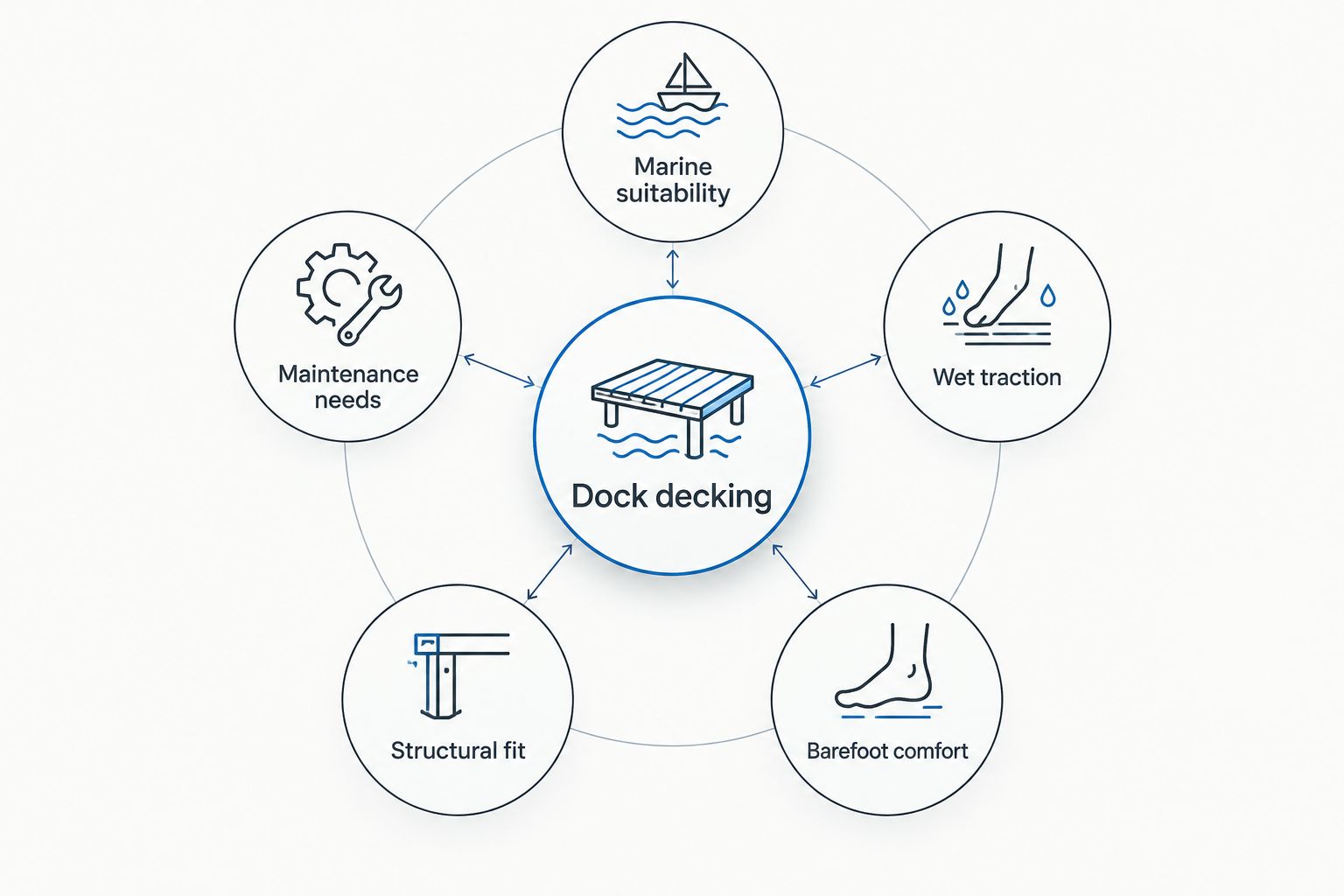
Use these criteria before choosing a material or requesting a final quote:
- Marine suitability: Check whether the exact product permits dock use and the expected splash or water exposure.
- Wet traction: Compare the actual surface texture, including how you will keep it free of algae and debris.
- Barefoot comfort: Evaluate samples in direct sun. Color, finish, exposure, and material all affect comfort.
- Structural fit: Confirm support spacing, board orientation, attachment details, and movement allowances.
- Maintenance needs: Decide whether you accept refinishing, prefer washing, or need removable sections for access.
- Repair access: Ask how an individual board or panel comes out without dismantling neighboring sections.
No material wins every category. For your 2026 shortlist, separate must-haves from preferences: safe access comes before a particular wood grain or hidden-fastener appearance.
Dock decking materials at a glance
| Material | Best for | Standout feature | Key limitation |
|---|---|---|---|
| Marine-approved PVC | Low-maintenance residential docks | No wood fibers in the decking material | Heat, movement, and support requirements need product-specific review |
| Capped composite | Wood-look appearance | Protective outer cap over a composite core | Marine exposure and cut-end details vary by product |
| Pressure-treated wood | Individual board repairs | Boards can be cut and replaced with familiar carpentry methods | Requires ongoing surface inspection and care |
| Aluminum | Coordinated metal dock systems | Manufactured profiles can form part of an integrated system | Finish, traction, and dissimilar-metal contact need attention |
| Fiberglass grating | Open walking surfaces | Openings allow water and light through | Openings and surface texture affect barefoot use |
1. Marine-approved PVC: best dock decking for low-maintenance use
PVC decking contains no wood fibers, so wood decay is not the same concern it is with timber. That does not make every PVC board suitable for a dock: the manufacturer's permitted applications and installation instructions still control.
For homeowners who want to avoid recurring wood refinishing, marine-approved PVC is the default starting point. Compare complete systems rather than choosing a board color first and sorting out attachment details later.
PVC pros:
- Does not require wood staining or sealing.
- Offers different surface textures and finishes.
- Avoids wood splinters from the decking itself.
PVC cons:
- Expansion and contraction require correct gaps and fastening.
- Sun-exposed surfaces need a barefoot-comfort check.
- Product approval for dock exposure cannot be assumed.
Best for: Homeowners who want a residential walking surface without a wood-refinishing routine.
For a 2026 selection, ask the contractor to identify the exact board, approved fasteners, support spacing, and applicable exposure restrictions. Keep the product documentation with your project records.
Verdict: Buy marine-approved PVC when the surface sample and installation requirements fit your dock.
2. Capped composite: best dock decking for a wood-look finish
Capped composite combines a composite core with a protective outer layer. Many products use wood fibers in the core, making the cap design, exposed ends, and permitted water exposure relevant to a dock installation.
Choose capped composite when appearance is a priority and you do not want a conventional wood-refinishing schedule. Do not treat a residential backyard deck approval as automatic approval for marine use.
Capped composite pros:
- Offers wood-look grain and color options.
- Avoids routine staining required by some wood finishes.
- Provides manufactured board profiles for a consistent layout.
Capped composite cons:
- Heat and wet traction depend on the specific finish.
- Cut ends and damaged caps need product-specific attention.
- Some products restrict water contact or marine applications.
Best for: Homeowners who want a wood-look dock surface and will verify the exact product's exposure limits.
Compare physical samples beside the house and dock framing. An attractive showroom sample still needs to work in direct sun, around splash, and along the route you use to board your boat.
Verdict: Buy capped composite for its appearance only after confirming marine suitability.
3. Pressure-treated wood: best dock decking for board-by-board repairs
Pressure-treated wood remains a practical choice when you value a conventional wood surface and straightforward carpentry repairs. Specify treatment appropriate to the actual exposure; above-water decking and submerged structural members are not interchangeable applications.
Wood also makes maintenance visible. You can inspect individual boards for splinters, checking, loosened fasteners, and deterioration, then address affected areas rather than treating the whole dock as a single component.
Pressure-treated wood pros:
- Individual boards can be cut and replaced.
- Provides a real wood surface rather than a printed grain.
- Accepts suitable finishes when prepared according to instructions.
Pressure-treated wood cons:
- Can check, split, warp, or develop splinters.
- Needs ongoing inspection and surface care.
- Treatment chemistry affects fastener compatibility.
Best for: Owners willing to inspect and maintain wood in exchange for familiar repair methods.
Ask what maintenance the proposed finish requires, including preparation before recoating. In a 2026 proposal, have the contractor name the lumber treatment and compatible attachment hardware rather than writing only treated decking.
Verdict: Buy pressure-treated wood if you accept the maintenance; skip it if you want to avoid wood surface care.
4. Aluminum: best dock decking for a coordinated metal system
Aluminum decking uses manufactured metal profiles rather than wood or plastic boards. It deserves consideration when the dock design already calls for a coordinated metal structure or panel system.
Saltwater compatibility depends on the assembly, not just the word aluminum. The specified alloy, finish, drainage, fasteners, and contact with other metals all need review.
Aluminum pros:
- Does not suffer wood decay.
- Manufactured profiles provide consistent shapes.
- Can be specified as part of a coordinated dock system.
Aluminum cons:
- Dissimilar-metal contact needs corrosion-conscious detailing.
- Traction and barefoot comfort depend on the surface treatment.
- Metal walking surfaces have a different sound and feel from wood.
Best for: Homeowners whose dock design suits an integrated metal system and who accept its underfoot feel.
Request a sample of the actual walking surface, not an unfinished metal offcut. Ask how edges, transitions, and connections will be detailed beside the boat lift.
Verdict: Buy aluminum as a specified system; skip a selection based on material name alone.
5. Fiberglass grating: best dock decking for an open surface
Fiberglass grating provides an open walking surface instead of continuous boards. Its openings let water and light pass through, making it a distinct option where those characteristics matter to the design.
The opening pattern also changes daily use. Small objects can fall through, and the surface texture needs a barefoot check before you commit.
Fiberglass grating pros:
- Openings allow drainage through the walking surface.
- Open construction allows light through the deck.
- Does not rely on wood fibers for its structure.
Fiberglass grating cons:
- Small dropped items can pass through openings.
- Aggressive surface texture can feel uncomfortable barefoot.
- Panel spans, edge support, and attachment need specific design.
Best for: Dock areas where an open surface matters more than a continuous-board appearance.
Ask whether grating suits the whole dock or only a particular area. Confirm the resin system, exposure suitability, opening size, and fastening details for the proposed product.
Verdict: Buy fiberglass grating for a defined open-surface need, not as an automatic whole-dock choice.
How the materials are ranked
This ranking prioritizes residential maintenance, usability, and fit with a custom saltwater dock. Marine-approved PVC leads as the low-maintenance starting point; the other materials occupy distinct roles rather than competing on a single claim of durability.
The ranking is not a product test or a service-life forecast. Exact performance depends on the selected product, structural design, exposure, installation, and maintenance.
What to include in your dock quote request
Send the contractor enough information to recommend an assembly, not just a board. Priority Marine Construction is best for homeowners seeking custom dock and boat lift installations in the Clearwater Beach area.
For your initial request, include:
- Boat details: Make, model, intended lift arrangement, and any planned change of boat.
- Property photos: Show the shoreline, existing dock, connections, and access from land.
- Daily use: Explain whether you board barefoot, carry fishing gear, or need easier walking access.
- Material priorities: Rank appearance, maintenance, traction, and repair access.
- Existing conditions: Identify loose boards, visible corrosion, movement, or damaged framing.
Ask for a written scope that separates decking from framing repairs, fasteners, lift-related work, and other project requirements. Replacing the walking surface does not establish that the structure beneath it is sound.
For a 2026 project, compare proposals using the same scope and exact material specifications. A material substitution changes the comparison even when both proposals describe the work as a new dock.
Request a custom dock quote
Discuss your boat, waterfront property, and preferred decking with Priority Marine Construction.
Which dock decking should you choose?
Start with marine-approved PVC if your main goal is less surface maintenance. Move to capped composite for a wood-look finish, pressure-treated wood for familiar board repairs, aluminum for a coordinated metal system, or fiberglass grating for an open surface.
Before committing, compare 3 physical samples at your property and narrow the choice to 2 finalists. Walk on the samples dry and wet, following safe handling practices; record the 1 exact product specification selected for the quote. These are selection steps, not substitutes for slip-resistance documentation or structural review.
FAQ
What’s the best dock decking for Florida saltwater exposure?
Marine-approved PVC is the default choice for a low-maintenance residential dock. Verify the exact product’s permitted exposure, wet traction, support spacing, and fastening requirements before choosing it.
Is composite dock decking better than pressure-treated wood?
Capped composite is better suited to homeowners who want a wood-look finish without routine wood refinishing. Pressure-treated wood suits owners who accept surface maintenance and value individual board repairs.
Does saltwater damage dock fasteners?
Saltwater exposure makes corrosion resistance and material compatibility essential for dock fasteners. Have the contractor specify hardware compatible with the decking, framing, treatment chemicals, and adjoining metals.
Which dock decking stays cool enough for bare feet?
Barefoot comfort depends on the exact material, color, finish, and sun exposure. Compare actual samples at your property rather than relying on a category-wide promise that a surface stays cool.
Can I replace dock decking without replacing the framing?
Decking replacement requires an assessment of the existing framing and connections. New boards do not correct deteriorated supports, unsuitable spacing, or damaged attachment points.
Is fiberglass grating suitable for a residential dock?
Fiberglass grating suits residential dock areas that need an open surface for water and light passage. Check the opening pattern, barefoot feel, panel support, and attachment details before selecting it.
What should I send when requesting a custom dock quote?
Send property photos, boat details, existing dock concerns, and your material priorities. Priority Marine Construction builds custom docks and boat lifts in the Clearwater Beach area, so describe both the walking surface and boat access you need.
One last thing
Ask how the first damaged board or panel will be replaced. Hidden fasteners and neat borders affect repair access as well as appearance. Have the contractor explain the removal method before you approve the decking layout; maintenance starts with a design you can service.