
Best overall dock accessories for 2026: dock bumpers for routine hull contact. Best for nighttime access: shielded dock lighting. Best simple organization upgrade: a hose holder. For a new custom installation, choose accessories around your boat, boarding position, and dock layout—not as a shopping list added after construction.
- Dock bumpers lead this dock accessories ranking for routine hull protection at the boarding edge.
- Shielded dock lighting suits nighttime access; cleats need secure mounting and a clear line arrangement.
- Priority Marine Construction suits Pinellas County homeowners planning dock accessories alongside a custom dock installation.
- Choose ladders, storage, and railings only after protecting the boarding area and walking route.
Why this matters
A useful accessory solves a problem without creating another one. A cleat belongs where you can handle a line without blocking the walking route; a ladder needs enough clearance for someone to climb out of the water.
Priority Marine Construction builds and installs custom boat lifts, docks, and decks throughout Pinellas County, including Clearwater Beach. Planning accessories with the dock lets you discuss mounting locations, access, and wiring before those decisions become changes to finished construction.
For a 2026 project, start with how you actually use the waterfront. Boarding a fishing boat, rinsing equipment, and hosting guests place different demands on the same dock.
What makes the best dock accessories?
Use these criteria before choosing an accessory or asking a contractor to include it:
- Boat fit: Match the accessory to the hull, boarding point, and way you secure the boat.
- Secure mounting: Identify what supports the hardware, rather than assuming the decking alone is enough.
- Clear access: Keep walking, boarding, and boat-lift movement unobstructed.
- Exposure suitability: Check the manufacturer's stated suitability for the site's saltwater or freshwater conditions.
- Maintenance access: Leave room to inspect connections, clean surfaces, and replace worn parts.
- Project coordination: Resolve electrical work, structural attachments, and applicable requirements before installation.
The best accessory is the one that solves a defined problem without narrowing access or complicating maintenance. Decorative extras come after that decision.
Dock accessories at a glance
This 2026 ranking compares accessory categories, not individual products. Each category has a separate job; no single accessory replaces sound dock construction or safe boat handling.
| Rank | Accessory | Best for | Standout function | Key limitation |
|---|---|---|---|---|
| 1 | Dock bumpers | Routine hull contact | Cushion contact at the dock edge | Placement must match the hull's contact point |
| 2 | Dock cleats | Handling mooring lines | Provide fixed line attachment points | Poor placement creates trip and line-handling conflicts |
| 3 | Boarding ladder | Getting out of the water | Provides a dedicated climbing route | Needs clearance and suitable mounting |
| 4 | Dock lighting | Nighttime access | Makes steps, edges, and walking areas easier to see | Glare and electrical placement require planning |
| 5 | Hose holder | Keeping rinse equipment organized | Keeps a hose off the walking surface when stored | Does not resolve water-supply or drainage questions |
| 6 | Dock storage box | Keeping loose gear together | Gives small equipment a defined storage location | Takes up usable deck space |
| 7 | Dock railing and safety features | Defining exposed walking edges | Provides a physical boundary where appropriate | Can obstruct boarding and line handling |
1. Dock bumpers: best dock accessories for routine hull contact
Dock bumpers cushion contact between a boat and the dock edge. Their usefulness depends on where the hull actually meets the dock, including changes in the boat's position with loading and water level.
Start at the normal boarding location. Ask the installer to identify exposed corners, fasteners, and edges that remain potential contact points after the bumper is fitted.
Dock bumper pros:
- Cushion routine contact at the intended location.
- Help cover an otherwise exposed dock edge.
- Can be planned around the boat's normal position.
Dock bumper cons:
- A bumper mounted at the wrong height misses the contact point.
- Dock bumpers do not replace suitable lines or boat-mounted fenders.
Best for: Homeowners whose boats regularly come alongside the dock to board or unload.
Verdict: Buy dock bumpers for identified contact points, not every edge by default.
2. Dock cleats: best dock accessories for mooring-line handling
Dock cleats provide fixed points for securing mooring lines. Their size, mounting, and position need to suit the boat and the way the lines will run.
Do not choose locations solely because they look evenly spaced. Have the contractor explain the attachment beneath each cleat and show how the planned line arrangement leaves the boarding area accessible.
Dock cleat pros:
- Give mooring lines a defined attachment point.
- Support a repeatable arrangement when returning to the dock.
- Can be positioned around the boat's actual tie-up needs.
Dock cleat cons:
- Raised hardware creates a trip hazard when poorly placed.
- Unsuitable mounting compromises the connection to the dock.
Best for: Homeowners who need practical, accessible attachment points for their boat's lines.
Verdict: Buy cleats only after confirming their mounting and line layout.
3. Boarding ladder: best dock accessories for water exit
A boarding ladder provides a dedicated route from the water onto the dock. It serves a different purpose from boat boarding steps: someone approaching from the water needs to reach and use it.
Discuss 3 measurements with the installer: dock-to-water distance, usable ladder reach below the water, and clearance around the climbing area. Check those dimensions against the specific ladder's installation instructions and the site's water-level range.
Boarding ladder pros:
- Creates a defined water-exit location.
- Gives swimmers a climbing route separate from the boat.
- Can be positioned where the approach remains unobstructed.
Boarding ladder cons:
- An unsuitable length makes the ladder difficult to reach or use.
- Marine growth and moving parts require inspection and cleaning.
Best for: Waterfront households that need a planned route out of the water.
Verdict: Buy a ladder that remains usable at the site's expected water levels.
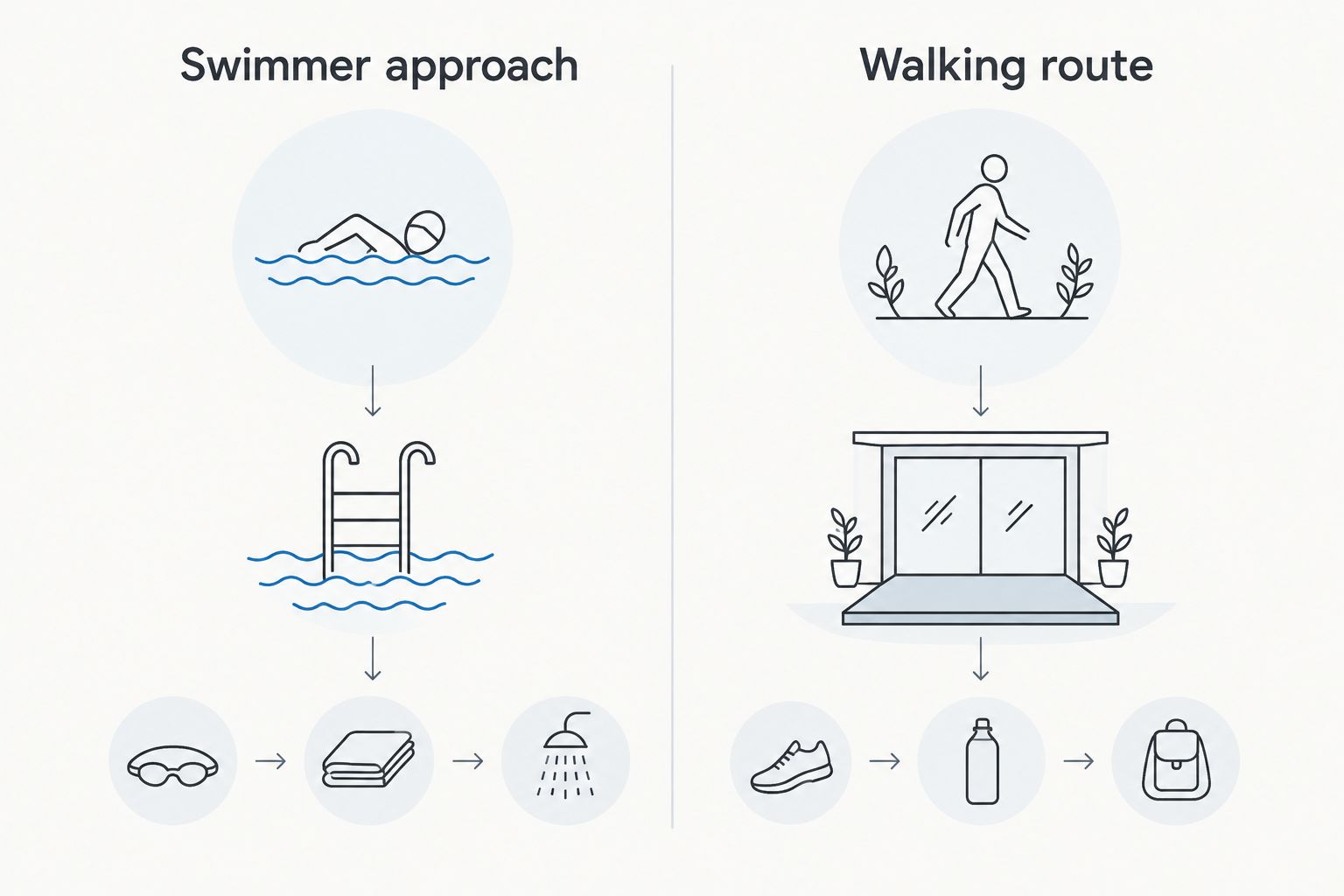
Before approving its location, trace 2 routes: the swimmer's approach and the pedestrian's path past the ladder. Neither route should depend on moving stored equipment.
4. Dock lighting: best dock accessories for nighttime access
Dock lighting should help you see where you walk and board. Bright fixtures aimed toward the water or approaching boat can create glare instead of useful visibility.
Plan light placement around steps, changes in level, and the boarding area. Have a qualified electrical contractor address equipment suitability, wiring, and applicable electrical requirements; a decorative fixture is not a substitute for that work.
Dock lighting pros:
- Makes walking surfaces and transitions easier to identify.
- Helps define the boarding area after dark.
- Allows illumination to follow the dock's actual layout.
Dock lighting cons:
- Poor aiming creates glare for people approaching the dock.
- Powered fixtures add electrical installation and maintenance needs.
Best for: Homeowners who return after dark or regularly use the dock in the evening.
Verdict: Buy lighting planned around visibility, not maximum brightness.
5. Hose holder: best dock accessories for rinse-area organization
A hose holder gives your rinse hose a defined storage location. It helps keep a stored hose out of the walking route, but the hose still needs managing while you use it.
Locate the holder near the intended rinse area without putting mounting hardware or hose loops beside a boarding step. Confirm that the proposed attachment suits the dock structure.
Hose holder pros:
- Keeps a stored hose off the deck.
- Makes rinse equipment easier to locate.
- Separates hose storage from the boarding area when properly positioned.
Hose holder cons:
- A deployed hose can still cross the walking route.
- The holder does not address water connections or drainage.
Best for: Homeowners who regularly rinse boating equipment at the dock.
Verdict: Buy a hose holder when a loose hose is the problem; resolve water-supply work separately.
6. Dock storage box: best dock accessories for loose equipment
A dock storage box gives small equipment a consistent home. Choose its position before choosing its size, because a convenient lid means little if the box blocks boarding or lift access.
Check the manufacturer's instructions for mounting, ventilation, and weather exposure. Do not assume a closed box keeps contents dry or that every item belongs in an enclosed waterfront container.
Dock storage box pros:
- Keeps loose equipment together.
- Reduces clutter when gear is returned after use.
- Creates a predictable place for frequently used items.
Dock storage box cons:
- Uses deck space even when empty.
- Lid movement and stored contents add clearance and maintenance questions.
Best for: Homeowners with a clear storage need and enough unobstructed dock space.
Verdict: Hold off on a storage box until its full footprint and open lid fit the plan.
7. Dock railing: best dock accessories for exposed walking edges
Dock railing provides a physical boundary along selected edges. It needs to fit the dock's use: a continuous barrier can interfere with boarding, handling lines, or accessing the boat lift.
Treat railing as a construction decision, not a decorative attachment. Posts, connections, openings, and applicable requirements belong in the contractor's scope discussion.
For cable-style infill, choosing stainless steel cable railing kits does not resolve the supporting post layout, attachment details, or maintenance needs. Review the complete railing assembly and its intended waterfront exposure rather than choosing by the infill material alone.
Dock railing pros:
- Defines an edge along a planned walking area.
- Creates a physical boundary where the design calls for one.
- Can separate gathering space from an exposed edge.
Dock railing cons:
- Can block boarding and interfere with mooring lines.
- Adds structural connections and inspection needs.
Best for: Homeowners whose dock layout calls for a boundary away from necessary boat access.
Verdict: Hold railing selection until the contractor confirms where a barrier belongs.
How the dock accessories are ranked
This ranking puts routine boat contact, secure line handling, and water exit ahead of convenience accessories. Lighting addresses a distinct access need, while hose storage and equipment storage solve narrower organization problems.
Railing ranks last because its suitability depends heavily on the dock layout—not because it lacks value. These are planning recommendations, not results from product testing or a comparison of named manufacturers.
Turn your accessory list into a qualified project quote
For a 2026 dock project, give the contractor enough information to evaluate the installation rather than quote disconnected hardware. Priority Marine Construction installs custom docks and boat lifts for waterfront homeowners throughout Pinellas County, including Clearwater Beach.
Bring these details to the discussion:
- Boat information: Boat model, dimensions, and normal boarding location.
- Property layout: Photos showing the dock, shoreline access, and existing lift if present.
- Main problem: Identify contact damage, difficult access, poor visibility, or clutter.
- Desired accessories: Separate essential items from optional additions.
- Installation scope: Ask who handles mounting, electrical work, and any required approvals.
- Maintenance needs: Ask how each accessory will be inspected, cleaned, and replaced.
Request a quote that identifies accessory locations and attachment work. Keep 1 clear walking route on the proposed plan, and ask the contractor to show how doors, lids, hoses, and mooring lines affect it during use.
Request a custom dock quote
Discuss your boat, property layout, and dock accessory needs in Pinellas County.
Which dock accessories should you choose?
Start with dock bumpers where the hull contacts the dock, then address line handling and access. Add lighting when you use the dock after dark; add storage only when it leaves the working area clear.
Priority Marine Construction is best for Pinellas County homeowners planning dock accessories as part of a custom dock installation. For your 2026 project, request a layout-based quote rather than approving an accessory list without mounting locations.
FAQ
What are the best dock accessories for a residential dock?
Dock bumpers are the default first choice where a boat routinely contacts the dock. Cleats, a boarding ladder, and lighting address separate line-handling and access needs; choose them around the boat and property layout.
Which dock accessories should I plan before construction?
Plan accessories that need structural mounting, electrical work, or dedicated clearance before construction. Cleats, ladders, lighting, and railings all affect the dock layout and installation scope.
Are dock bumpers enough to protect my boat?
Dock bumpers do not replace suitable mooring lines, boat-mounted fenders, or careful boat handling. Place bumpers at actual hull-contact locations and check for exposed edges around them.
How do I choose a ladder for my dock?
Choose a dock ladder around water-level range, climbing reach, mounting requirements, and clear access. Confirm that someone in the water can reach it and climb onto an unobstructed landing.
Is stainless steel railing maintenance-free near saltwater?
Stainless steel railing is not maintenance-free near saltwater. Follow the assembly manufacturer’s cleaning and inspection instructions, and check connections as well as visible infill.
Can Priority Marine Construction plan accessories with a new dock?
Priority Marine Construction builds and installs custom docks and boat lifts throughout Pinellas County, including Clearwater Beach. Request a project quote that identifies your desired dock accessories, mounting locations, and related installation work.
What should I include in a dock accessory quote request in 2026?
Include boat details, property photos, the main problem to solve, and your desired accessories. Ask the contractor to identify mounting work, electrical scope, clearance needs, and responsibility for applicable approvals.
One last thing
Before approving the layout, act out a normal return to the dock: secure the boat, step ashore, move your gear, and put the hose away. Any accessory that obstructs that sequence needs a different location—or does not belong on the dock.
Related guides
- Boat lift accessories for saltwater protection
- Custom dock features for entertaining waterfront guests