
Best overall for a suitable residential site: a four-piling lift. Best for restricted piling layouts: an elevator lift. Best for sheltered water with changing water levels: a floating lift. Best for an existing, structurally suitable boathouse: an overhead lift. These are the boat lift types for saltwater docks to compare for your Pinellas County installation in 2026.
- Four-piling boat lifts are the default shortlist for saltwater docks when the boat, water depth, and piling layout fit.
- Elevator lifts suit constrained dock layouts, but their angled travel path needs clearance.
- Floating lifts follow water levels; exposure, anchoring, and hull compatibility determine whether they fit.
- Priority Marine Construction builds custom boat lifts and docks for Clearwater Beach waterfront properties.
Why this matters
A lift must fit your boat and your waterfront property. Choosing the mechanism before checking the site leaves the important questions unanswered: where the boat sits, how you board, and whether the lift reaches usable water.
Priority Marine Construction is a fit for Clearwater Beach homeowners seeking custom boat lift and dock construction. You can start with Priority Marine Construction and request a quote around your boat and property rather than a lift type alone.
For your 2026 project, separate the choice into two decisions: which layout works at the site, and which equipment suits saltwater service. A familiar lift style does not establish either answer by itself.
What makes the best boat lift types for saltwater docks?
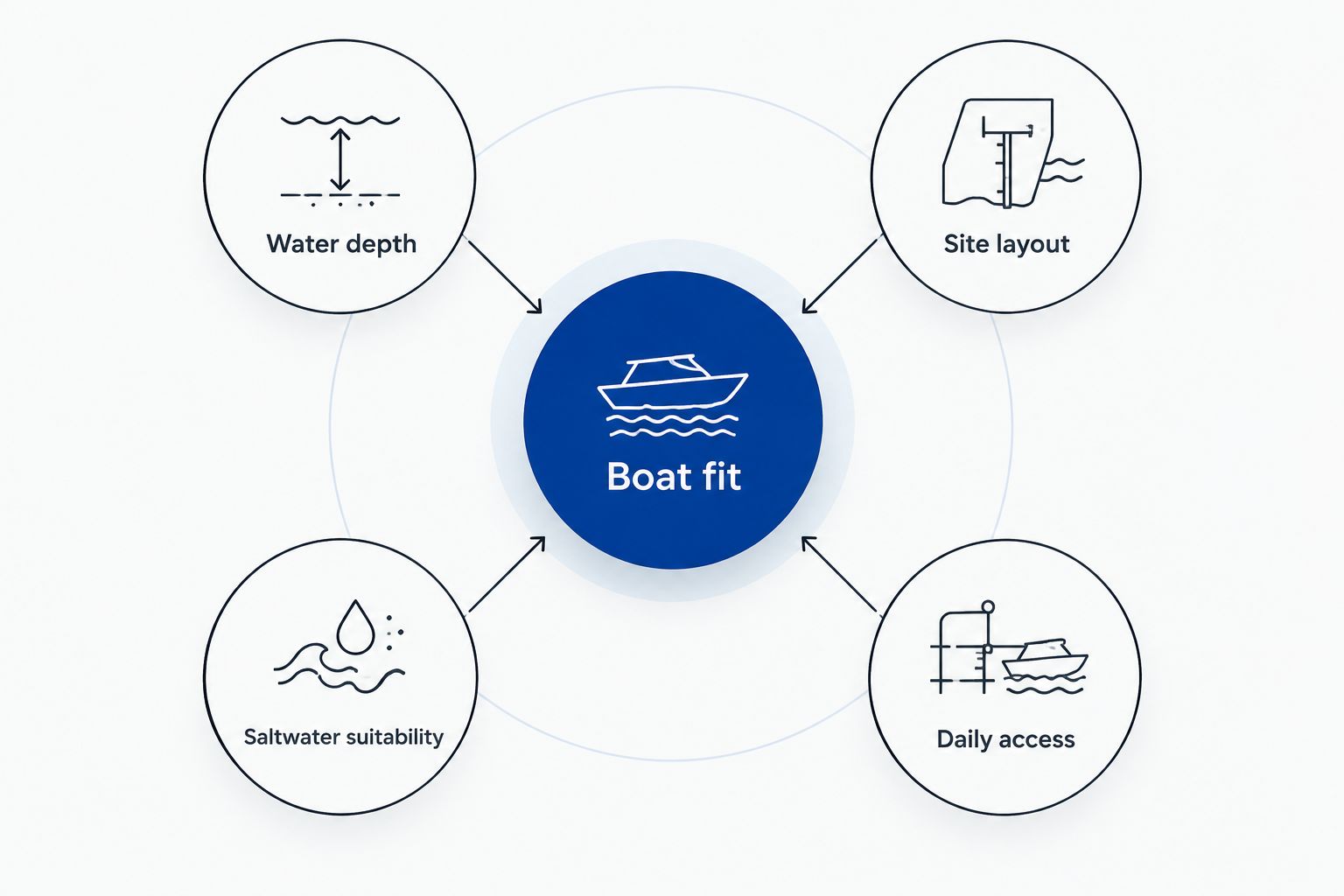
Use these criteria before comparing equipment:
- Boat fit: Confirm loaded operating weight, hull shape, beam, propulsion clearance, and bunk requirements.
- Water depth: Check whether the boat can enter and leave the lowered lift at the water levels you expect to use it.
- Site layout: Allow for pilings, lift movement, neighboring structures, and a practical approach from the water.
- Saltwater suitability: Check the specified materials, component compatibility, corrosion protection, and maintenance instructions.
- Daily access: Plan boarding, control access, inspection access, and the route between your house and boat.
Treat these as pass-or-fail questions first. A convenient boarding position cannot compensate for inadequate depth, and a high-capacity lift cannot compensate for the wrong hull support.
Boat lift types at a glance
| Lift type | Best for | Standout feature | Key limitation |
|---|---|---|---|
| Four-piling lift | A residential site with a workable piling layout | A cradle supported between four pilings | Needs room for the pilings and boat approach |
| Elevator lift | A site where a conventional piling arrangement does not fit | A cradle traveling on angled rails | Needs clear space along the full travel path |
| Floating lift | Sheltered water where following water levels matters | Buoyancy-based support that rises and falls with the water | Requires suitable anchoring, exposure conditions, and boat compatibility |
| Overhead boathouse lift | An existing boathouse with a suitable supporting structure | Lifting equipment supported above the boat | Depends on verified structural capacity and clearances |
The table compares installation layouts, not interchangeable products. Every option still needs a specified capacity, suitable boat supports, and a site-specific installation plan.
1. Four-piling lift: best for a conventional residential layout
A four-piling boat lift supports a lifting cradle between four support pilings. It is the default starting point when your property has room for that arrangement and your boat can approach it without an awkward turn.
For a 2026 residential installation, ask the contractor to show the boat in both its raised and lowered positions. Check the boarding side as carefully as the lifting position; the most useful layout lets you reach the boat without obstructing the dock.
Four-piling lift pros:
- Provides a defined berth and a repeatable boat position.
- Allows hull supports to be specified around the boat.
- Can be planned alongside a new custom dock layout.
Four-piling lift cons:
- Requires a workable arrangement of four support pilings.
- Pilings and lifting equipment occupy waterfront space.
- Low-water depth can limit launching even when lifting capacity is adequate.
Best for: Homeowners whose boat, water depth, and property layout support a conventional piling-mounted installation.
Ask where each piling goes and how you will approach in wind or current. Also ask which components need inspection and how those components remain accessible after the dock is finished.
Verdict: Buy this layout when the piling arrangement, depth, and boarding access all fit.
2. Elevator lift: best for a constrained piling layout
An elevator boat lift moves its cradle along angled rails rather than straight between a conventional four-piling arrangement. That different movement can solve a layout problem, but it creates its own clearance requirements.
The important drawing shows the entire travel path, not just the raised boat. Your hull, outboard or drive, and lift structure need clearance throughout operation.
Elevator lift pros:
- Offers an alternative where a conventional piling footprint does not work.
- Moves the boat away from and toward the dock along a defined path.
- Allows a different relationship between the boarding edge and lifting equipment.
Elevator lift cons:
- The angled travel path needs unobstructed space.
- Rails and submerged components require inspection access.
- Bottom conditions, support requirements, and depth can rule out a proposed arrangement.
Best for: Homeowners whose property needs an alternative to a conventional four-piling layout.
Do not interpret a compact appearance at dock level as proof that the installation fits. Ask the contractor to identify the boat's lowest operating position and the space the equipment occupies underwater.
For elevator lift proposals in 2026, request the same clear explanation you would expect for a conventional lift: support method, boat position, usable depth, and maintenance access.
Verdict: Buy an elevator layout when it solves a documented site constraint without creating a clearance problem.
3. Floating lift: best for sheltered water and changing levels
A floating boat lift uses buoyancy to support the boat and moves with the surrounding water level. Designs differ, so confirm whether a proposal uses an air-operated lifting system or another floating platform arrangement.
Following the water level does not remove the need for adequate depth. The boat must still reach the lift, and the system needs enough room to operate without grounding or contacting nearby structures.
Floating lift pros:
- Follows changes in water level rather than staying at a fixed elevation.
- Offers a different support arrangement from a piling-mounted cradle.
- Can suit sheltered settings when the boat and attachment system are compatible.
Floating lift cons:
- Anchoring or attachment must suit the site's exposure and movement.
- Hull shape and propulsion layout can restrict compatible designs.
- Floating components occupy space at the water surface.
Best for: Homeowners with sheltered water who need a lift that follows water levels and have a compatible boat and attachment arrangement.
Ask how the proposed system behaves around wakes and what keeps it positioned beside the dock. Confirm the entry procedure as well; a lift that supports the boat correctly must also be practical to load and unload.
Do not choose a floating lift solely because it appears to avoid piling work. The complete attachment, clearance, and maintenance plan determines whether it is a useful alternative.
Verdict: Buy only after the specific floating system is matched to your boat, exposure, and attachment conditions.
4. Overhead lift: best for a structurally suitable boathouse
An overhead boathouse lift supports its lifting equipment from a structure above the boat. This option belongs on your shortlist when you already have a boathouse and its load-bearing structure is verified for the proposed installation.
A roof is not proof of lifting capacity. The supporting members and connections must be suitable for the boat and lift loads, with enough clearance for the complete lifting arrangement.
Overhead lift pros:
- Uses an overhead support arrangement within a suitable boathouse.
- Positions the boat within an existing covered berth.
- Offers an alternative to adding a separate open-water lift layout.
Overhead lift cons:
- Depends on verified capacity of the supporting structure.
- Roof height, beam placement, and lifting hardware restrict clearance.
- Structural alterations can add work beyond the lift installation itself.
Best for: Homeowners with an existing boathouse that can support the proposed lift after structural review.
Ask what supports the load, not simply where the motor attaches. Confirm how the boat's windshield, tower, hardtop, or other tall equipment fits throughout lifting and boarding.
Treat an overhead lift as a structure-and-equipment decision. Selecting the lifting mechanism without resolving the supporting structure leaves the central question open.
Verdict: Hold until structural suitability and operating clearances are confirmed.
Saltwater details to settle before accepting a quote
The lift type describes the layout. It does not tell you whether every component is suitable for a saltwater installation.
Ask for the proposed materials and maintenance requirements in writing. Saltwater suitability involves the complete assembly, including fasteners, lifting components, connections, controls, and electrical equipment—not just the main frame.
Use these questions to compare proposals:
- What materials and protective finishes are specified?
- How are incompatible metal contacts addressed?
- Which components need rinsing, lubrication, adjustment, or replacement inspections?
- How will electrical equipment and connections be installed for the waterfront setting?
- Who provides the operating instructions and maintenance requirements?
Keep ordinary storage and storm preparation separate. Raising a boat out of the water is not a storm-protection guarantee; follow the equipment instructions and an appropriate storm plan for your property.
Bring these details to your quote request
A useful quote starts with the boat you actually operate and the waterfront you actually have. Give the contractor these 3 quote inputs:
- Boat details: Make, model, hull information, propulsion arrangement, and loaded weight including fuel, water, batteries, and carried equipment.
- Property details: Address, photographs from land and water, existing dock layout, and any available drawings.
- Use requirements: Boarding preferences, expected use, access concerns, and any planned boat change.
For depth discussions, cover 2 water levels: expected low water and expected high water. Ask how each affects launching, clearances, and access rather than relying on a photograph taken at a favorable tide.
For a 2026 installation, ask each contractor to explain the proposed scope, permit responsibilities, exclusions, and information still needed before final selection. Compare equivalent scopes rather than lift labels alone.
Priority Marine Construction builds custom boat lifts and docks for Clearwater Beach properties. Request a quote that addresses both installations together when your project includes a new or changed dock.
Request a custom installation quote
Share your boat details and Clearwater Beach property needs to discuss your boat lift and dock project.
How the lift types rank
This ranking puts site fit before convenience: boat support, usable depth, installation footprint, saltwater suitability, and access. A four-piling lift is the default shortlist only where those requirements fit.
The other types serve distinct needs rather than taking lower places on a quality scale. An elevator lift addresses a different layout; a floating lift follows water levels; an overhead lift depends on an existing supporting structure.
Which boat lift type should you choose?
Start with a four-piling lift, then require a site-specific reason to choose another layout. Choose an elevator lift for a verified layout constraint, a floating lift for suitable sheltered conditions, or an overhead lift for a structurally suitable boathouse.
For Clearwater Beach and Pinellas County homeowners, the next move is a qualified project quote—not an equipment order based on lift style alone. Resolve boat weight, depth, support, and boarding access before approving the installation.
FAQ
What’s the best boat lift type for a saltwater dock?
A four-piling lift is the default starting point when your boat, water depth, and piling layout fit. Elevator, floating, and overhead lifts address different site requirements rather than serving as direct upgrades.
Is an elevator lift better than a four-piling lift?
An elevator lift is better suited to some constrained layouts, not automatically better overall. Its angled travel path needs enough clearance for the boat and lifting equipment throughout operation.
Can a floating boat lift work in saltwater?
A floating boat lift can work in saltwater when the specific system is suitable for that use. Confirm boat compatibility, attachment requirements, exposure limits, and maintenance instructions before selecting it.
How do I choose the right boat lift capacity?
Choose capacity using the boat’s loaded operating weight, not its empty weight alone. Include fuel, water, batteries, equipment, and carried items, then have the installer confirm the required capacity and hull support.
Can I install an overhead lift in my existing boathouse?
An overhead lift requires a supporting structure verified for the proposed loads. The roof alone does not establish suitability; structural members, connections, and boat clearances need review.
What should I send when requesting a boat lift quote?
Send your boat details, property address, dock photographs, and boarding requirements. Priority Marine Construction builds custom boat lifts and docks for Clearwater Beach properties, so identify whether your project includes dock work as well.
One last thing
Walk through boarding before approving the lift layout. Identify where you stand, where the boat sits, and how you reach the controls without stepping across lifting equipment or an awkward gap.
A lift can fit the boat on paper and still make every outing inconvenient. Settle that everyday movement while the layout is still a drawing.