
Best overall for straightforward maintenance access: a piling-mounted cable lift. Best for avoiding lifting-cable upkeep: a cable-free hydraulic lift. Best for restricted dock layouts: an elevator lift. Best for floating-dock compatibility: a pneumatic floating lift. Compare these boat lift styles by maintenance with Priority Marine Construction, which builds custom boat lifts and docks throughout Pinellas County, including Clearwater Beach.
- Compare boat lift styles by maintenance access, exposed components, and the manufacturer’s service requirements—not drive type alone.
- Piling-mounted cable lifts are the default shortlist choice when cables and drive components are accessible for service.
- Cable-free hydraulic lifts eliminate lifting-cable upkeep but still require hydraulic-system inspection.
- Priority Marine Construction builds custom boat lifts and docks for waterfront properties throughout Pinellas County.
Why this matters
A boat lift moves maintenance work; it does not eliminate it. Cables need inspection, hydraulic systems need checks, and pneumatic lifts add air-system components. Equipment that is difficult to reach also makes routine work harder.
For a 2026 installation, start with the boat and property, then compare the service tasks each suitable design requires. The lowest-maintenance choice on paper is the wrong choice if its important components cannot be reached safely at your dock.
This ranking prioritizes inspection access and clear maintenance responsibilities. It does not claim that one mechanism has a measured service-life advantage over every other design.
What makes the best low-maintenance boat lift?
Use these criteria before choosing a style:
- Service access: Can a qualified technician reach the drive, lifting components, connections, and controls without dismantling surrounding dock features?
- Lifting mechanism: Identify whether the proposed lift uses cables, hydraulic cylinders, air-supported tanks, or a combination. The style name alone does not tell you.
- Water exposure: Ask which components remain submerged and which rise clear of the water. Inspecting submerged equipment requires a different plan.
- Boat fit: Confirm the loaded boat weight, hull support, and operating clearance. Maintenance convenience cannot compensate for an unsuitable lift.
- Written requirements: Get the actual manufacturer's inspection, lubrication, cleaning, and replacement instructions for the proposed equipment.
Use the boat lift weight-capacity guide before narrowing the mechanism. A capacity decision belongs ahead of a preference about cables, cylinders, or controls.
Boat lift styles by maintenance: at a glance
These categories overlap: an elevator lift can use cables, and a piling-mounted lift can use hydraulic equipment. The table compares specific configurations, not mutually exclusive engineering categories.
| Rank and configuration | Best for | Maintenance advantage | Key limitation |
|---|---|---|---|
| 1. Piling-mounted cable lift | Homeowners prioritizing accessible mechanical inspection | Cables, drives, and connections can be inspected where the installation provides access | Cables, sheaves, and winding components still need attention |
| 2. Cable-free hydraulic lift | Homeowners specifically avoiding lifting-cable upkeep | Removes lifting cables from the maintenance checklist | Cylinders, hoses, seals, and hydraulic fluid introduce different checks |
| 3. Elevator lift | Properties needing a side-mounted lifting arrangement | Concentrates the lifting arrangement along one side of the dock | Track, carriage, and drive access need careful planning |
| 4. Pneumatic floating lift | Compatible floating-dock settings | Uses air-supported flotation rather than a conventional overhead cable hoist | Tanks, air lines, valves, and submerged components require inspection |
Choose the configuration you can inspect and service safely, not the one with the shortest sales description.
1. Piling-mounted cable lift: best for accessible inspection
A piling-mounted cable lift raises a supported boat using cables and a drive assembly. It is the default starting point in this guide when the property supports the arrangement and the proposed installation gives technicians clear access to service points.
The maintenance advantage is visibility, not freedom from maintenance. Ask the installer to identify the cable paths, sheaves, winding components, and structural connections on the proposed layout.
Piling-mounted cable lift pros
- Cable condition can be checked visually where the cable path is accessible.
- The service checklist can identify specific cables, sheaves, drives, and connections.
- A dock layout can preserve access around the lifting equipment.
Piling-mounted cable lift cons
- Lifting cables require inspection for deterioration and other damage.
- Winding and sheave components add maintenance points.
- Poor access around pilings or dock edges makes inspection harder.
Best for: A homeowner whose dock arrangement permits safe access to the cable system and drive equipment.
For a 2026 quote, request a drawing that shows where service work takes place. Do not accept a general statement that the lift is easy to maintain without seeing which components remain accessible with the boat raised.
Verdict: Buy when the boat fit, structural design, and maintenance access are confirmed.
2. Cable-free hydraulic lift: best for avoiding cable upkeep
A cable-free hydraulic lift uses hydraulic equipment to move the lifting structure without lifting cables. Confirm that the proposed model is actually cable-free; a hydraulic drive does not automatically establish how every part of a lift operates.
This configuration removes cable inspection and replacement from that part of the system. It does not remove the need to inspect hoses, fittings, cylinders, seals, and fluid condition according to the manufacturer's instructions.
Cable-free hydraulic lift pros
- Eliminates lifting-cable maintenance in a genuinely cable-free design.
- Gives homeowners a clear alternative when cable upkeep is the main concern.
- Allows the quote discussion to focus on hydraulic-component protection and access.
Cable-free hydraulic lift cons
- Hydraulic leaks require diagnosis and repair.
- Hoses, seals, and cylinder surfaces still need inspection.
- A concealed or difficult-to-reach power unit complicates servicing.
Best for: A homeowner who specifically wants to avoid lifting cables and accepts hydraulic-system maintenance instead.
Ask where the power unit sits and how a technician reaches each hydraulic connection. Also ask how the boat is secured before maintenance begins; the answer should follow the equipment manufacturer's procedure, not an improvised dockside method.
Verdict: Buy when avoiding lifting cables is the priority and hydraulic service access is clear.
3. Elevator lift: best for restricted dock layouts
An elevator lift uses an angled or vertical lifting arrangement positioned along one side of the boat. Its strongest reason for selection is property fit, rather than a blanket promise of less maintenance.
The maintenance checklist depends on the drive and lifting mechanism specified. For a cable-driven elevator lift, include the cable system as well as the carriage, tracks, guides, and structural attachments.
Elevator lift pros
- Provides a side-mounted configuration for properties where that arrangement fits.
- Keeps the layout discussion focused on the available dock edge and boat approach.
- Lets you evaluate carriage and guide access before construction.
Elevator lift cons
- Track and carriage condition add inspection responsibilities.
- Lower components can be difficult to reach, depending on the installation.
- A cable-driven model retains cable-related maintenance.
Best for: A homeowner whose waterfront layout favors a side-mounted lifting arrangement over the other suitable options.
For your 2026 project, ask the contractor to explain how the lower portions of the system are inspected. A clean-looking installation is not proof that service access has been planned.
Verdict: Hold until the contractor confirms both site suitability and a practical service method.
4. Pneumatic floating lift: best for floating-dock compatibility
A pneumatic floating lift uses air and buoyancy to raise a supported boat. Its maintenance needs center on the flotation structure and air system rather than a conventional overhead cable-hoist assembly.
Treat this as a site-specific option. Compatibility with the dock, available water depth, boat, and installation conditions must be established before comparing maintenance convenience.
Pneumatic floating lift pros
- Offers an alternative to conventional overhead cable lifting.
- Gives compatible floating-dock installations another configuration to assess.
- Makes air-system condition a defined part of the service checklist.
Pneumatic floating lift cons
- Air lines, valves, connections, and tanks require inspection.
- Submerged surfaces require attention to marine growth and condition.
- Inspection access depends on the floating structure and its connections.
Best for: A homeowner with a compatible floating-dock setting who accepts air-system and submerged-component maintenance.
Ask how the proposed system is inspected below the waterline and how loss of air is diagnosed. Do not assume that fewer visible lifting parts mean fewer total maintenance tasks.
Verdict: Hold until floating-dock compatibility and the underwater inspection plan are confirmed.
Plan maintenance access before installation
The best opportunity to improve maintenance access is before the lift and dock layout are finalized. Priority Marine Construction's custom boat lift and dock installations give Pinellas County homeowners a reason to discuss both structures together rather than treat the lift as an isolated purchase.
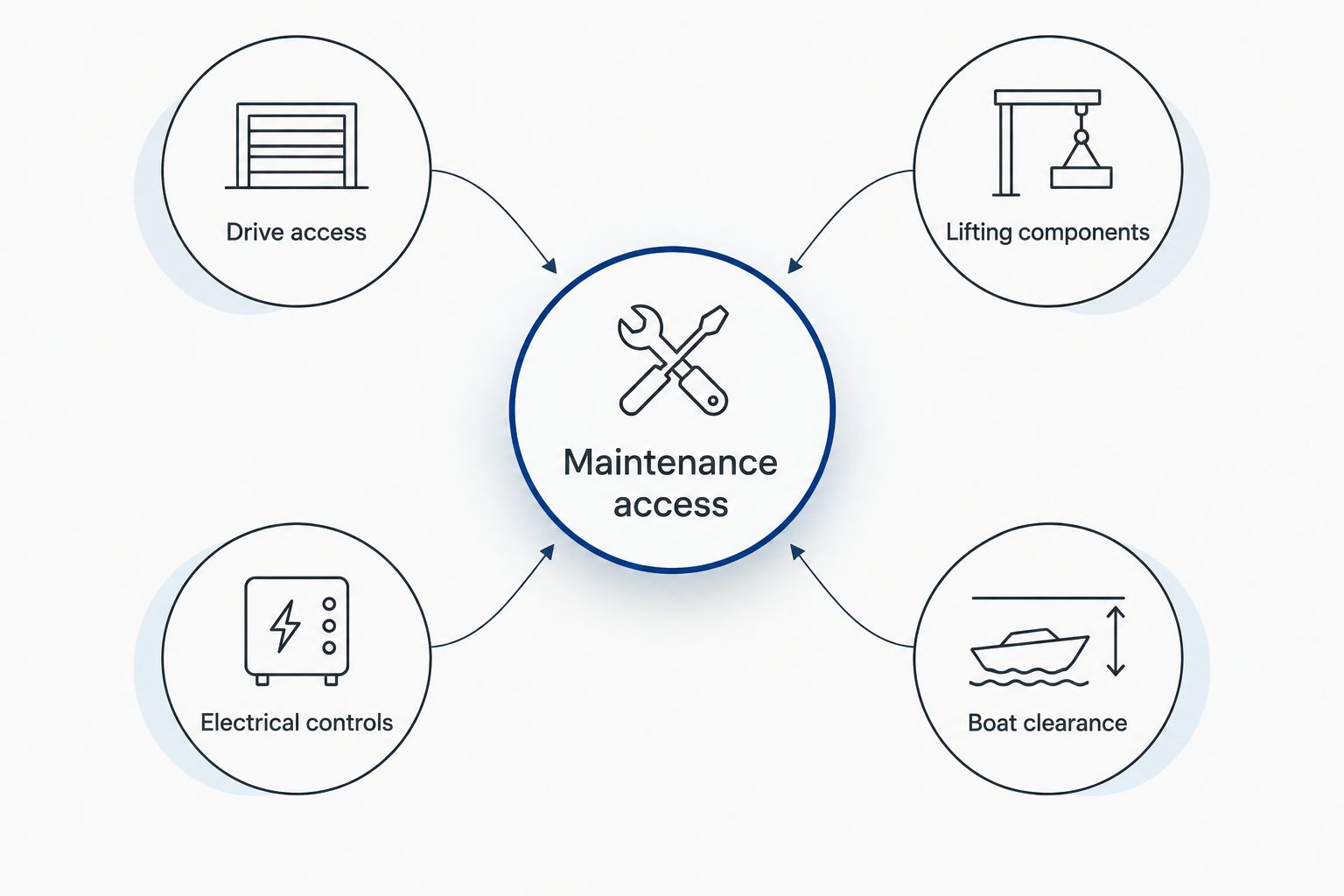
Ask the contractor to mark these areas on the proposed layout:
- Drive access: Show where a technician reaches motors, power units, and drive assemblies.
- Lifting components: Identify the cables, cylinders, tracks, or tanks that require inspection.
- Electrical controls: Keep the control location accessible and have electrical work addressed by qualified personnel.
- Boat clearance: Show how the boat, hull supports, and dock relate during operation and service.
Never enter beneath a suspended boat or attempt repairs on energized lifting equipment. Follow the manufacturer's securing procedures and use qualified service personnel for lifting-system and electrical work.
What to include in a qualified project quote
A useful 2026 quote starts with your boat and property information. Send the boat's exact model, available loaded-weight information, propulsion details, and relevant manufacturer documents rather than asking for a lift based only on boat length.
Prepare 2 sets of photos: one showing the waterfront approach and one showing the existing dock, pilings, and lift area. Photos support the initial discussion; they do not replace a site assessment.
Request 1 written maintenance schedule for the specific proposed equipment. Ask the contractor to identify manufacturer-required tasks, owner checks, and work that calls for a technician.
Keep 3 records together after installation: the equipment manual, installation documentation, and service history. These records give the next technician a clearer starting point than a description of what the lift usually does.
Priority Marine Construction builds custom boat lifts, docks, and decks throughout Pinellas County, including Clearwater Beach. Request a quote that addresses your boat, property layout, and service access without assuming a particular mechanism is suitable before assessment.
Request a Custom Boat Lift Quote
Discuss your boat, Pinellas County property, dock layout, and maintenance-access priorities.
How the styles are ranked
This guide ranks configurations by accessible inspection points, the maintenance tasks their mechanisms introduce, and the clarity of the service plan. It is not a product test or a measured comparison of repair frequency.
For 2026, the practical default is a piling-mounted cable lift with confirmed service access. Move to another configuration when the boat, property, or a specific maintenance preference provides a clear reason.
Which boat lift style should you choose?
Start with a piling-mounted cable lift if straightforward inspection access is your priority. Choose a cable-free hydraulic configuration to avoid lifting-cable upkeep, an elevator arrangement for a suitable restricted layout, or a pneumatic floating lift for a compatible floating-dock setting.
Priority Marine Construction is a custom boat lift and dock contractor for homeowners throughout Pinellas County. Bring your maintenance priorities into the quote discussion, but let the boat and site requirements set the shortlist.
FAQ
What’s the best boat lift style for low maintenance?
A piling-mounted cable lift is this guide’s default choice when the installation provides straightforward inspection and service access. It still requires cable, drive, and connection checks; no boat lift style is maintenance-free.
Is a hydraulic boat lift maintenance-free?
No, a hydraulic boat lift requires maintenance of its hydraulic components and lifting structure. A cable-free configuration removes lifting-cable upkeep, but hoses, seals, cylinders, and fluid still need attention under the manufacturer’s instructions.
Does an elevator boat lift need more maintenance?
An elevator boat lift does not have a universal maintenance ranking independent of its design. Compare the specified drive, tracks, carriage, lifting components, and service access rather than assuming the style name determines the workload.
How often should I service my boat lift?
Follow the maintenance schedule for the exact lift and drive equipment installed at your property. Ask the installer to explain inspection intervals, exposure-related requirements, and which tasks require qualified service personnel.
Can I choose a boat lift using boat length alone?
No, boat length alone does not establish lift suitability. The quote also needs loaded-weight information, hull-support requirements, propulsion details, operating clearance, and a property assessment.
What should I ask a boat lift contractor before requesting a quote?
Ask which configurations fit your boat and property, where maintenance components will sit, and how technicians will reach them. Request the proposed equipment’s written maintenance requirements before making the final selection.
Does Priority Marine Construction serve homeowners outside Clearwater Beach?
Yes, Priority Marine Construction serves waterfront homeowners throughout Pinellas County, including Clearwater Beach. Its stated services include custom boat lifts, docks, and decks.
One last thing
Before approving the layout, ask the contractor to point to every component that needs routine attention. If service access cannot be explained clearly before installation, resolve it before choosing the lift.
Related guides
- Boat lift motor and drive options for Florida waterfronts
- Boat lift types for Pinellas County saltwater docks
- Boat lift accessories for saltwater protection