
Best overall starting layout: a side-mounted lift with the boat parallel to the dock, where boundaries and approach room allow. Best for straight-in access: perpendicular placement. Best for reaching usable water beyond the existing dock: dock-end placement. This 2026 guide compares boat lift placement for narrow lots so you can choose a workable layout before requesting a custom installation quote.
- Boat lift placement for narrow lots starts with boundaries, usable water, and the boat’s approach—not lift hardware.
- Parallel placement suits alongside boarding; perpendicular placement suits a clear straight-in approach.
- Dock-end placement addresses water access, but the boat still needs a safe boarding route.
- Priority Marine Construction builds custom boat lifts and docks for homeowners throughout Pinellas County, including Clearwater Beach.
Why this matters
A narrow waterfront lot creates competing demands: room to store the boat, room to maneuver, and room to walk along the dock. A lift that fits on a drawing still fails the practical test if you cannot approach it cleanly or board without stepping around equipment.
Priority Marine Construction builds and installs custom boat lifts and docks throughout Pinellas County, including Clearwater Beach. For your 2026 project, start with the boat and property together rather than choosing a lift and trying to squeeze it into the remaining space.
Priority Marine Construction is a fit for Pinellas County homeowners seeking custom boat lift placement coordinated with a residential dock. The right quote starts with a layout that explains how the boat arrives, where it rests, and how you reach it.
What makes the best boat lift placement for narrow lots
Judge each proposed location against these criteria before comparing equipment:
- Boundary fit: Confirm the allowable construction area and applicable restrictions. Do not assume fence lines continued over the water define it.
- Boat approach: Trace the route into and out of the lift, including turns and backing movements.
- Water depth: Check the proposed location against the boat’s draft and water-level conditions, not a single high-water observation.
- Boarding access: Keep a practical route from shore to the boarding side without relying on a neighboring dock.
- Structural suitability: Identify the supports, dock changes, and site assessment the installation requires.
- Service access: Leave access for inspection and maintenance instead of filling every remaining gap with equipment.
For a 2026 installation, ask for these points to appear in the proposed layout or written scope. A label such as compact does not explain whether an installation fits your boat, your shoreline, or your permitted construction area.
Placement options at a glance
| Placement option | Best for | Standout feature | Key limitation |
|---|---|---|---|
| Parallel placement | Alongside boarding | Boat runs beside the dock | Needs adequate side clearance and approach room |
| Perpendicular placement | Straight-in approaches | Boat points toward or away from shore | Projects into the water and needs end clearance |
| Dock-end placement | Accessing usable water farther out | Positions the lift beyond the dock’s side area | Boarding and allowable projection need careful review |
| Offset placement | Working around an obstruction | Moves the lift away from a blocked approach | Adds layout complexity and can complicate boarding |
| Integrated lift pocket | A coordinated dock rebuild | Dock and lift are planned as one layout | Requires changes to the dock rather than lift placement alone |
These are placement strategies, not interchangeable lift products. A location still needs a suitable lift type, support arrangement, and boat-specific setup. The strongest layout satisfies all the criteria rather than winning on footprint alone.
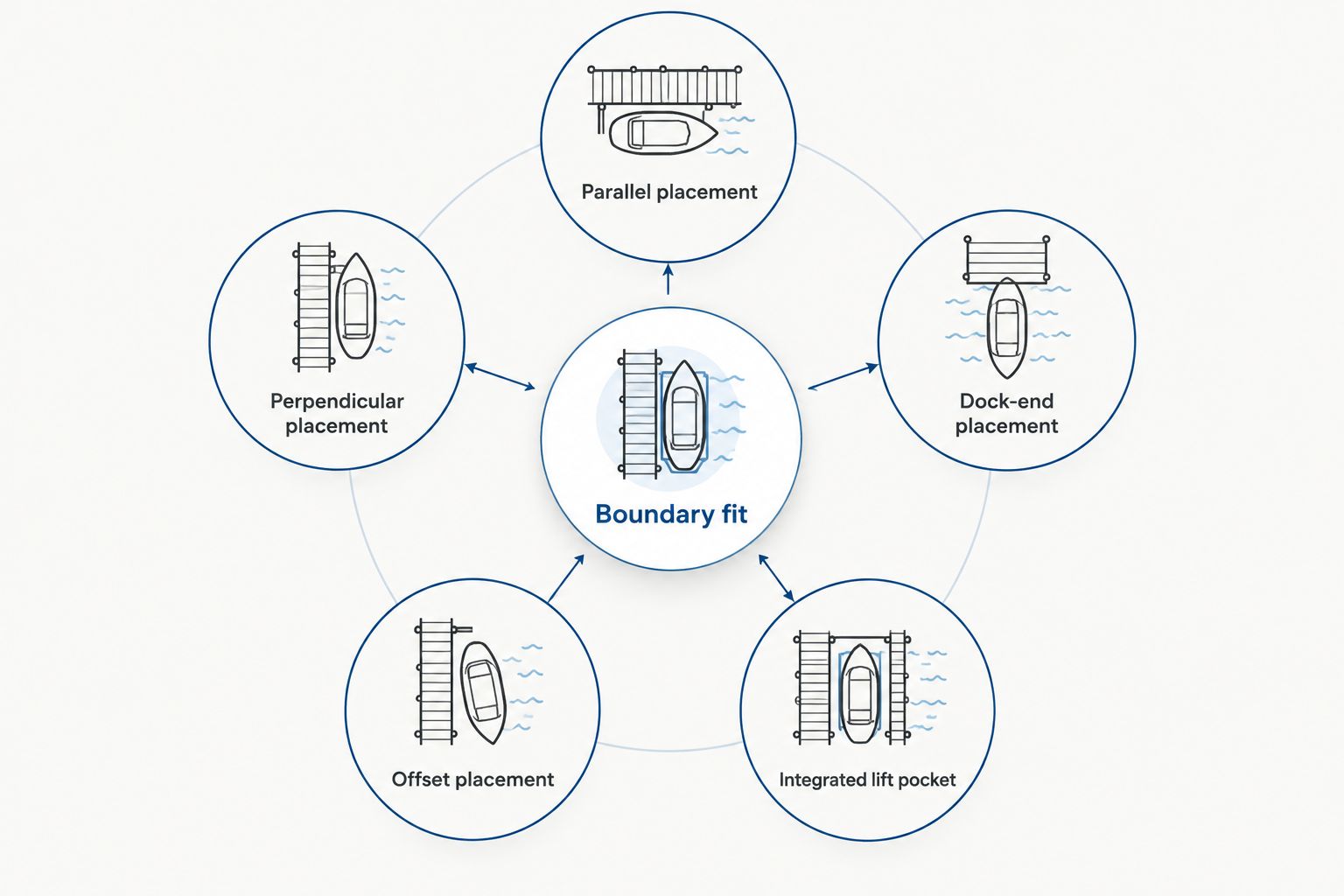
1. Parallel placement: best for alongside boarding
Parallel placement keeps the boat’s length running beside the dock. It is a useful starting point when you want to board from the dock edge and preserve a direct walking route from shore.
The key question is whether the boat can reach that position. A narrow opening, nearby structure, or awkward turn can rule out an otherwise tidy alongside layout.
Parallel placement pros:
- Places the boat beside the dock for boarding.
- Makes the boarding relationship easy to show on a plan.
- Separates the boat’s resting position from the dock walkway when properly arranged.
Parallel placement cons:
- Requires room for the boat, lift supports, and necessary clearances beside the dock.
- Does not solve a restricted approach by itself.
- Can put the lift too close to a boundary if the plan considers only hull width.
Ask the contractor to show the whole installation footprint, not just a boat outline. Include supports, guide components, and the space needed to enter the lift.
Best for: Homeowners whose usable water and allowable construction area support alongside storage and boarding.
Verdict: Buy into this layout when side clearance and the approach are confirmed; skip it when either depends on neighboring space.
2. Perpendicular placement: best for a straight-in approach
Perpendicular placement points the boat toward or away from the shoreline. It deserves consideration when the clearest route to the lift runs directly in from open water rather than alongside the dock.
A narrow lot does not automatically make this the best choice. The boat’s length extends along the shore-to-water direction, so the plan must account for projection and maneuvering beyond the lift.
Perpendicular placement pros:
- Aligns storage with a straight-in approach where site conditions support it.
- Provides an alternative when alongside entry requires an awkward turn.
- Lets the contractor plan a boarding edge beside the boat.
Perpendicular placement cons:
- Requires adequate room beyond the lift for approach and departure.
- Needs careful review of allowable waterward projection.
- Can require dock changes to create useful boarding access.
Ask to see both arrival and departure paths. An easy approach is only half the decision if backing away leaves little room to turn.
Best for: Properties with a clear straight-in water approach and sufficient allowable projection.
Verdict: Buy into perpendicular placement when the full approach and departure fit; hold when the drawing shows only the stored boat.
3. Dock-end placement: best for usable water farther out
Dock-end placement locates the lift at or beyond the outer end of the dock. Consider it when the area beside the existing dock does not provide suitable water access for the boat.
Farther out is not automatically deep enough. The proposed boat position still needs a depth assessment, a permitted layout, and a boarding route that works with the dock.
Dock-end placement pros:
- Directs the layout toward water beyond the existing side area.
- Leaves the dock’s shoreward sides outside the lift footprint.
- Allows the approach to be assessed from the dock’s outer end.
Dock-end placement cons:
- Can separate the boat’s boarding point from the existing walkway.
- Requires review of dock-end supports and any proposed extension.
- Does not remove projection or navigation constraints.
For a shallow approach, compare the placement proposal with these dock designs for shallow waterfront lots. Depth and dock layout belong in the same decision.
Best for: Properties where suitable water lies beyond the dock-side area and the proposed construction is allowable.
Verdict: Hold until depth, access, and projection are confirmed; buy only when all three work together.
4. Offset placement: best for avoiding a fixed obstruction
Offset placement moves the lift away from a direct alignment with the existing dock or approach. It addresses a specific obstruction rather than serving as a default narrow-lot solution.
An offset can change where the boat enters and where you board. Require the contractor to show both relationships clearly rather than accepting an angled sketch as proof of fit.
Offset placement pros:
- Creates a layout alternative around a documented obstruction.
- Lets the boat position respond to the available approach.
- Opens a discussion about relocating access instead of forcing a straight alignment.
Offset placement cons:
- Complicates the relationship between the boat, supports, and walkway.
- Can introduce a boarding gap or awkward transfer point.
- Requires confirmation that the selected equipment suits the proposed arrangement.
Do not treat offset placement as permission to improvise lift geometry. Equipment configuration and structural requirements still govern the installation.
Best for: A site with an identifiable obstruction and a workable alternative approach within the allowable area.
Verdict: Hold for a documented layout; skip an offset that solves the obstruction but creates an unsafe boarding route.
5. Integrated lift pocket: best for a dock rebuild
An integrated lift pocket plans the dock around the boat’s storage position. Instead of fitting a lift beside an unchanged walkway, the project coordinates the dock edges, boarding location, and lift footprint from the start.
This is the most relevant option when you already intend to replace or substantially alter the dock. It is not a shortcut around limited waterfront space or construction restrictions.
Integrated lift pocket pros:
- Coordinates boarding access with the lift location.
- Makes walking space part of the initial design.
- Lets the contractor assess dock and lift requirements together.
Integrated lift pocket cons:
- Expands the scope beyond a lift-only installation.
- Can be unnecessary when an existing dock already supports a workable layout.
- Still requires adequate approach room outside the pocket.
Ask Priority Marine Construction to show how a custom dock and boat lift would work together for your property. Compare the proposed pocket with retaining the existing dock before committing to the larger scope.
Best for: Homeowners planning a dock rebuild who need boarding and boat storage designed together.
Verdict: Buy into coordinated planning during a rebuild; skip dock alterations that add no clear access benefit.
How to compare a 2026 placement proposal
This ranking prioritizes boundary fit, approach, depth, boarding, structural suitability, and maintenance access. Parallel placement is the starting recommendation because it directly addresses alongside boarding—not because it fits every narrow property.
Before requesting a final quote, prepare a clear project brief:
- Boat details: Supply the make, model, dimensions, draft, and operating load information available from the boat documentation.
- Property records: Share the survey and existing dock information you have.
- Site photographs: Show the shoreline, dock, neighboring structures, and water approach.
- Daily use: Explain where you board, how you carry gear, and who needs access.
- Scope boundaries: State whether you want a lift-only project, dock alterations, or a complete replacement.
Keep lift capacity separate from placement. A well-positioned lift still needs the correct capacity and setup for the actual boat and its carried equipment.
Request a Custom Boat Lift Quote
Discuss your boat, dock, and waterfront layout for a Pinellas County residential installation.
Which placement should you choose?
Start with parallel placement if alongside boarding, boundaries, and maneuvering room all work. Choose perpendicular placement for a clear straight-in approach, dock-end placement for suitable water farther out, or an offset only to solve a specific obstruction.
For a 2026 dock rebuild, compare an integrated lift pocket before settling on the dock footprint. Priority Marine Construction serves homeowners throughout Pinellas County, including Clearwater Beach; request a custom boat lift and dock quote based on your boat and property rather than a generic layout.
FAQ
What’s the best boat lift placement for a narrow lot?
Parallel placement is a useful starting point when alongside boarding, boundaries, depth, and approach room all work. Perpendicular, dock-end, offset, or integrated layouts address different site constraints.
Is perpendicular placement better than parallel placement?
Perpendicular placement is better suited to a clear straight-in approach; parallel placement suits alongside boarding. Compare the complete boat path and boarding route rather than choosing by orientation alone.
Can I put a boat lift at the end of my dock?
Dock-end placement is an option when the proposed location has suitable water, allowable projection, structural support, and boarding access. An existing dock does not by itself establish that the lift location is suitable.
How close can a boat lift go to my waterfront boundary?
The allowable location depends on the property and applicable requirements. Have the proposed footprint checked against the relevant survey, waterfront boundaries, and construction restrictions rather than using a generic setback.
Should I choose the lift before deciding where it goes?
Choose the placement and lift configuration together. The boat, water depth, supports, approach, and boarding access determine whether a proposed combination works.
What should I send when requesting a narrow-lot boat lift quote?
Send boat specifications, available property records, dock photographs, and a description of your access needs. State whether the project includes dock changes so the quote addresses the intended scope.
One last thing
Ask for the boat to be shown in its approach position as well as its stored position. A layout can look orderly with the boat on the lift and still leave no practical route into it.
Make that drawing part of your 2026 quote discussion. It turns a general promise of fit into a specific conversation about how you will actually use the installation.
Related guides
- Boat lift types for Pinellas County saltwater docks
- Boat lift weight capacities for common Pinellas County boats
- Dock railing and safety features for waterfront homes