
Best overall for a boat with suitable piling space: a four-post lift. Best for a constrained dock layout: an elevator lift. Best for a personal watercraft: a dedicated PWC lift. This 2026 guide ranks boat lift options by boat size and explains what Clearwater Beach and Pinellas County homeowners should confirm before requesting a custom installation quote.
- Compare boat lift options by boat size using loaded weight, beam, hull shape, and waterfront conditions—not length alone.
- Four-post lifts suit boats where suitable pilings and enough installation space are available.
- Elevator lifts deserve consideration where a conventional four-post arrangement does not fit.
- Prioritymarine builds custom boat lifts and docks for Clearwater Beach homeowners.
Why this matters
A boat's advertised length does not tell you which lift to buy. The lift must support the boat's loaded weight, fit its beam and hull, and operate within the property's water depth and dock layout.
Prioritymarine builds custom boat lifts, docks, and decks for waterfront homeowners in the Clearwater Beach area. Prioritymarine fits homeowners seeking custom boat lift and dock construction for their property. Start your 2026 project with the boat and waterfront conditions, then choose the equipment arrangement.
An oversized capacity label cannot correct unsuitable hull support or poor placement. Treat lift selection and dock planning as one project, even when you intend to keep the existing dock.
What makes the best boat lift for your boat size
Use these criteria before comparing equipment names or requesting bids:
- Loaded weight: Account for the boat, engines, fuel, water, batteries, equipment, and gear. Confirm what the published boat weight includes.
- Beam and clearance: Check the boat's widest point against the lift opening, guide placement, pilings, and approach.
- Hull support: Match bunks, cradles, or drive-on surfaces to the hull and the boat manufacturer's lifting guidance.
- Water depth: Check operating depth through the site's tidal range, including the clearance needed to launch and retrieve.
- Property fit: Review dock access, piling locations, shoreline conditions, and room to maneuver.
- Service access: Leave practical access for inspection and maintenance rather than fitting equipment into every available space.
Length narrows the search; loaded weight and site fit determine the selection. For a 2026 quote, provide the boat's exact model and configuration rather than asking for a lift for a general length category.
Boat lift options by boat size at a glance
These rankings describe installation arrangements, not specific products. Each option serves a different boat-and-property combination; none replaces a site assessment.
| Rank and option | Best for | Standout feature | Key limitation |
|---|---|---|---|
| 1. Four-post lift | Boats with suitable piling space | Supports a cradle within a piling arrangement | Needs suitable structural support and clearance |
| 2. Elevator lift | Boats beside constrained dock layouts | Moves the cradle along an inclined support arrangement | Requires suitable mounting and underwater clearance |
| 3. Dedicated PWC lift | Personal watercraft | Supports a compact craft without a full-size boat setup | Does not substitute for a larger boat lift |
| 4. Floating drive-on lift | Compatible small craft | Uses buoyancy and a drive-on support surface | Hull compatibility and approach conditions govern suitability |
The useful comparison is not simply small versus large. A narrower boat at a constrained dock presents a different problem from a wider boat with open piling space, even when their lengths are similar.
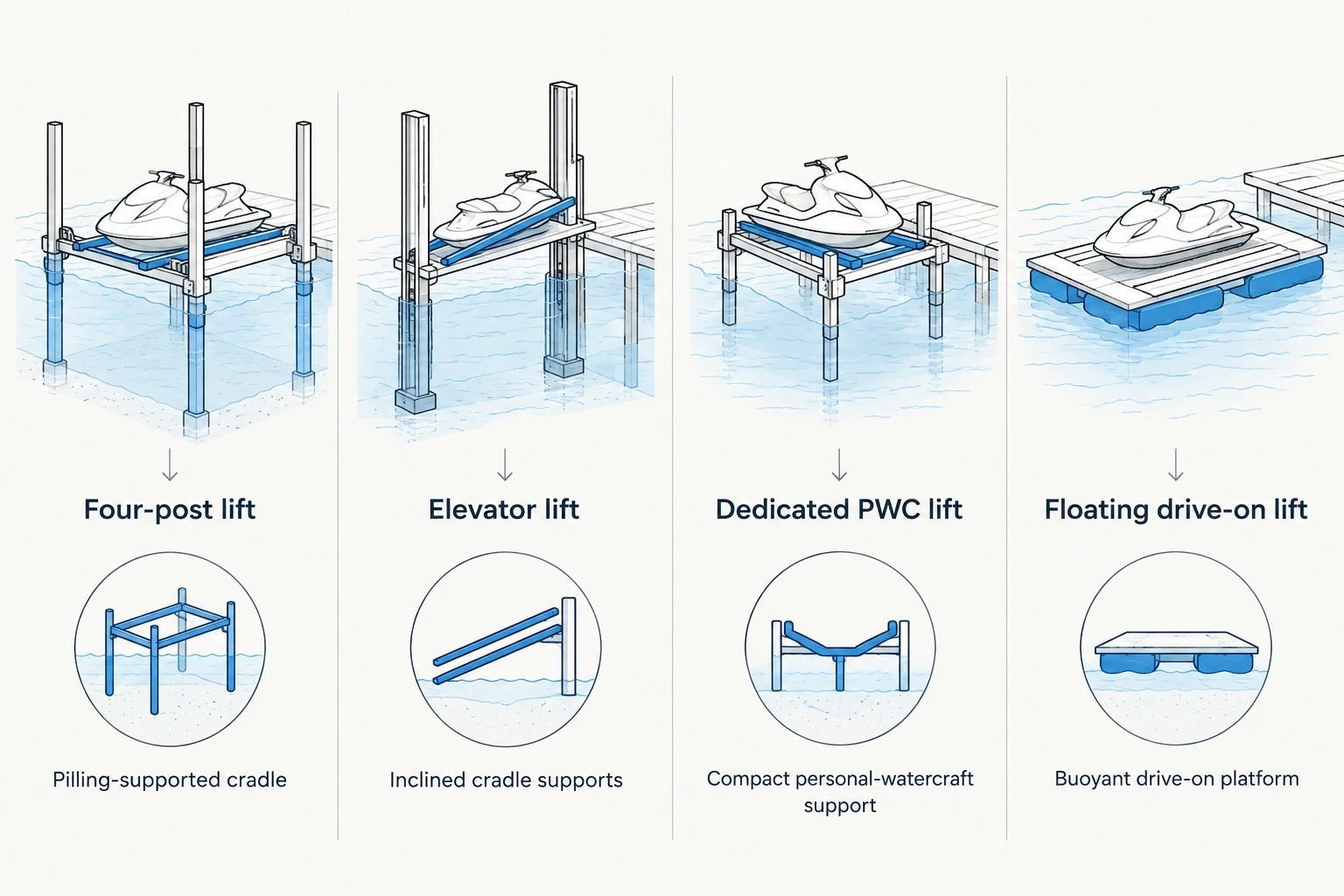
1. Four-post lift: best for boats with suitable piling space
A four-post boat lift raises a supporting cradle within a piling arrangement. It is the first option to evaluate when your waterfront has suitable piling locations and enough room for the boat, dock access, and approach.
This arrangement is not a single boat-size category. The selected equipment's rated capacity, cradle dimensions, and hull supports must match the actual boat; the presence of four posts does not establish what it can carry.
Four-post lift pros:
- Provides a defined berth with the boat supported on a cradle.
- Allows the installer to plan bunk placement around the hull's support requirements.
- Keeps the lift and adjacent dock access within one coordinated layout.
Four-post lift cons:
- Piling placement and structural suitability can rule out the arrangement.
- Posts, guides, and dock edges require enough clearance for the boat's beam and approach.
- Existing pilings need assessment rather than an assumption that they can carry a new lift.
Best for: Homeowners whose boat and waterfront support a conventional piling-mounted installation.
Ask the contractor to show the proposed piling positions, boat position, and boarding side together. A lift that fits the boat but blocks practical dock use is the wrong layout.
Verdict: Buy a four-post lift only after the contractor confirms capacity, piling suitability, and operating clearance.
2. Elevator lift: best for boats beside constrained dock layouts
An elevator lift moves its boat-supporting cradle along inclined supports. It deserves consideration when a conventional four-post arrangement conflicts with the available waterfront layout.
The arrangement changes where the lift's structure sits; it does not eliminate structural requirements. The contractor must evaluate the mounting method, loads, underwater travel, and clearance around the lowered cradle.
Elevator lift pros:
- Offers an alternative where a conventional piling arrangement does not fit.
- Can place the boat alongside an existing waterfront access area.
- Gives the contractor another layout to compare before redesigning the dock.
Elevator lift cons:
- The mounting location must support the proposed installation.
- Inclined travel requires suitable underwater space and depth.
- A constrained site can still lack enough room for safe boat movement.
Best for: Homeowners who need an alternative mounting arrangement beside a dock or waterfront edge.
For your 2026 proposal, ask to see the lift in both its raised and lowered positions on the layout. Reviewing only the stored position leaves the launch path unresolved.
Do not select an elevator lift solely because it appears to occupy less space above the water. The boat still needs room to enter, settle onto its supports, and leave.
Verdict: Buy an elevator lift when the site assessment confirms suitable mounting and clear underwater travel.
3. Dedicated PWC lift: best for personal watercraft
A dedicated personal-watercraft lift supports a PWC rather than treating it as a small version of every other boat. Depending on the selected equipment, the support arrangement and operating method differ from a full-size boat lift.
Start with the exact craft, including its loaded weight and hull requirements. A compact hull still needs appropriate support and a suitable approach from the water.
Dedicated PWC lift pros:
- Matches the support arrangement to a personal-watercraft use case.
- Lets you plan PWC access separately from a larger boat berth.
- Avoids specifying a full-size boat installation when the project only requires PWC storage.
Dedicated PWC lift cons:
- Equipment selected for a PWC is not a substitute for a larger boat lift.
- Dock edges, adjacent boats, and water depth can restrict placement.
- Changing craft requires another compatibility check, not an assumption that the replacement fits.
Best for: Homeowners storing a personal watercraft at a residential dock.
Plan how you will board the craft and handle it at the lift. Convenient storage means little if the arrangement makes routine access awkward.
If you also own a larger boat, ask for both storage positions on the same site drawing. Separately chosen installations can compete for the same approach space.
Verdict: Buy a dedicated PWC lift for a verified craft-and-site match; skip it as a substitute for a boat lift.
4. Floating drive-on lift: best for compatible small craft
A floating drive-on lift uses a buoyant support surface that the craft enters under power according to the equipment manufacturer's instructions. Consider this option only when the exact hull and propulsion arrangement are compatible.
The word floating does not remove the need for installation planning. Attachment, approach, water movement, depth, and access all affect whether the arrangement suits a residential waterfront.
Floating drive-on lift pros:
- Offers a drive-on storage method for compatible craft.
- Provides an alternative to a suspended cradle arrangement.
- Lets you evaluate craft storage alongside a floating dock layout where appropriate.
Floating drive-on lift cons:
- Compatibility is specific to the craft and selected equipment.
- The approach needs room for controlled entry and exit.
- Site conditions and attachment requirements can rule out the option.
Best for: Homeowners with a compatible small craft and a suitable drive-on approach.
Do not use boat length as proof of compatibility. Check the hull shape, propulsion clearance, loaded weight, and operating instructions for the actual equipment being proposed.
Ask the contractor how the floating unit will be secured and how you will reach the stored craft. Those details belong in the selection discussion, not after installation.
Verdict: Buy a floating drive-on lift only with confirmed craft compatibility and an appropriate approach.
What to send with your boat lift quote request
A qualified quote starts with a defined boat and a usable picture of the property. For a 2026 project, send the contractor this information before comparing installation proposals:
- Boat identification: Manufacturer, model, model year, and engine configuration.
- Weight information: Published weight details and a list of onboard fuel, water, batteries, accessories, and equipment.
- Dimensions: Length, beam, draft, and any features affecting clearance.
- Property photos: The dock, pilings, waterfront edge, approach, and existing equipment.
- Access requirements: Where you board, unload, walk, and reach the boat for routine care.
- Future plans: A possible replacement boat or dock change that should influence today's layout.
Ask each contractor to identify the proposed lift arrangement, rated capacity, support configuration, and included dock work. Also ask who handles permit applications and which approvals the project requires. Do not treat a quote as an approval guarantee.
Compare defined scopes, not isolated equipment descriptions. A proposal for lift equipment alone is different from a proposal that includes structural work, electrical work, or dock changes.
Prioritymarine provides custom boat lift and dock construction for Clearwater Beach-area properties. Request a quote with your boat details and property photos so the discussion addresses the installation you actually need.
Request a Custom Boat Lift Quote
Share your boat details, waterfront photos, and dock requirements for a project-specific discussion.
How these boat lift options are ranked
The ranking prioritizes distinct residential use cases: suitable piling space, constrained mounting layouts, personal watercraft, and compatible drive-on storage. It is not a product test, a capacity chart, or a claim that one arrangement works at every Pinellas County property.
Loaded weight, beam, hull support, water depth, property fit, and service access determine the final choice. Move an option down your shortlist as soon as it fails a required condition. A different arrangement is better than forcing the first choice onto an unsuitable site.
Which boat lift should you choose?
Start with a four-post lift if your boat and property have suitable piling space. Compare an elevator lift when the conventional arrangement conflicts with the site; choose dedicated PWC or compatible floating drive-on equipment for those specific craft and operating needs.
Your 2026 decision should end with a matched boat, lift, and waterfront plan—not just a lift name. Request a project-specific quote from Prioritymarine for custom boat lift and dock construction, and have the proposed support and clearance details explained before you commit.
FAQ
What’s the best way to compare boat lift options by boat size?
Compare loaded weight, beam, hull support, and site conditions before choosing a lift arrangement. Boat length alone does not establish capacity or compatibility.
Is a four-post boat lift better than an elevator lift?
A four-post lift fits sites with suitable piling space; an elevator lift offers a different mounting arrangement for constrained layouts. The better choice depends on structural support, depth, and operating clearance.
Can I choose a boat lift using the boat’s dry weight?
Dry weight alone is not enough to select a lift. Confirm what the published figure includes and account for engines, fuel, water, batteries, equipment, and gear as applicable.
Do I need a different lift for a personal watercraft?
A dedicated PWC lift is an option designed around personal-watercraft storage. Confirm the exact craft’s weight, hull compatibility, and access requirements before selecting equipment.
Can a new boat lift use my existing dock pilings?
Existing pilings require assessment before they become part of a new lift installation. Their condition, position, and structural suitability must match the proposed equipment and loads.
Does water depth affect which boat lift I can install?
Water depth affects lift selection and placement. The boat and lowered supports need appropriate clearance through the site’s operating tidal conditions.
What should I send when requesting a boat lift installation quote?
Send your boat model, engine configuration, weight information, dimensions, and waterfront photos. Include your boarding needs and any planned boat or dock changes so the proposed layout addresses them.
One last thing
Plan the lowered lift, not just the stored boat. A tidy raised position does not prove that the boat can approach, float clear, or leave without interference.
Before accepting a proposal, ask the contractor to explain the entire movement from open water to the stored position and back. That conversation connects the capacity rating to the part you will use every time: getting your boat onto and off the lift.