
Best overall starting point: a manufacturer-approved enclosed gear drive. Best for a compatible belt-drive replacement: a matching belt-drive assembly. Best for a purpose-built hydraulic lift: hydraulic power. Best for a battery-powered installation: an approved DC system. For a custom installation, Priority Marine Construction helps waterfront homeowners throughout Pinellas County, including Clearwater Beach, match the lift to the boat and property.
- Compare boat lift motor options by lift compatibility, loaded boat weight, electrical supply, and service access.
- An enclosed gear drive is the default shortlist choice, not an automatic replacement for another drive type.
- Hydraulic and battery-powered systems require compatible lift designs; neither is a universal motor upgrade.
- Priority Marine Construction builds custom boat lifts and docks throughout Pinellas County, including Clearwater Beach.
Why this matters
A boat lift motor turns the mechanism that raises your boat. The drive transfers that power through belts, gears, cables, or a hydraulic system, depending on the lift design. Buying a motor without checking the rest of that system leaves the main selection questions unanswered.
For your 2026 project, choose the lift arrangement before choosing the motor. Priority Marine Construction is a fit for Pinellas County homeowners planning custom boat lift and dock installations. Start with the boat, the waterfront layout, and the equipment already installed—not a promise that one motor suits every dock.
What makes the best boat lift motor options?
Use these criteria to compare a new installation or a replacement. A drive that fails the compatibility check belongs off your shortlist, regardless of its features.
- Lift compatibility: Confirm the approved motor, drive, mounting arrangement, and controls for the specific lift. Similar-looking assemblies are not proof of interchangeability.
- Loaded boat weight: Select the complete lift around the boat's operating weight, including equipment and supplies. Review boat lift weight capacities for common Pinellas County boats before narrowing the drive choice.
- Electrical supply: Match the motor nameplate and controller requirements to the available circuit. Common U.S. supply references include 120 V, 240 V, and 60 Hz; those figures do not establish what your particular lift requires.
- Waterfront exposure: Evaluate the specified enclosure, connections, covers, and maintenance instructions. A cover does not make an assembly waterproof.
- Service access: Leave access to motors, belts, gearboxes, hydraulic components, and controls. A difficult-to-reach assembly makes routine inspection harder.
- Daily operation: Decide where you will operate the lift and how you will observe the boat during movement. Remote operation does not replace a clear view of the lifting area.
Boat lift motors and drives at a glance
This 2026 comparison ranks system types by their intended use. It does not rank named manufacturers or claim that every system fits every boat.
| Rank and option | Best for | Standout feature | Key limitation |
|---|---|---|---|
| 1. Enclosed gear drive | A new installation designed around geared lifting equipment | Gears transfer motor power within a housing | Requires the correct gearing, mounting, and lift approval |
| 2. Belt drive | Retaining a compatible belt-driven lift | A belt transfers power between pulleys | Belt condition, tension, alignment, and guarding need attention |
| 3. Hydraulic drive | A lift designed around hydraulic actuation | A power unit operates hydraulic cylinders | Hoses, seals, fittings, and fluid add service requirements |
| 4. Battery-powered DC system | A compatible lift planned around battery power | Stored electrical energy powers the motor | Charging, battery condition, and system compatibility govern use |
Drive type and lift type are different decisions. Use the guide to boat lift types for Pinellas County saltwater docks to compare the overall lifting arrangement before treating this table as a parts list.
1. Enclosed gear drive: best for a planned new installation
An enclosed gear drive transfers motor power through gears inside a housing. It is a useful starting point for a new custom lift because the motor, gearing, mounting, and controls can be selected together rather than adapted around an unidentified existing assembly.
Best for: homeowners choosing a complete new lift with an approved geared drive. The enclosure separates the gearing from direct contact, but it does not eliminate inspection, corrosion checks, or manufacturer-specified maintenance.
Enclosed gear drive pros
- The gearing sits inside a housing rather than using an exposed belt between pulleys.
- A complete installation can match the motor and gearing to the lift design.
- Manufacturer specifications provide a basis for checking the required drive assembly.
Enclosed gear drive cons
- The wrong gear ratio or mounting arrangement makes an otherwise suitable motor unsuitable.
- Internal components require the correct service procedure; the housing is not a maintenance exemption.
- Replacing an existing belt drive with a geared drive requires explicit compatibility confirmation.
For a 2026 quote, ask the contractor to identify the proposed drive arrangement and explain its fit with the selected lift. Ask where service personnel will reach the assembly without removing unrelated dock features.
Do not accept horsepower as the complete explanation. Lift capacity depends on the complete lifting system, including its structure and lifting components, not simply the motor's output.
Verdict: Buy an enclosed gear drive when it is specified for the complete lift; skip an unverified conversion.
2. Belt drive: best for a matching existing-lift replacement
A belt drive transfers rotation from the motor pulley to another pulley through a belt. For an existing belt-driven lift, a correctly matched replacement can preserve the intended drive arrangement instead of introducing a different mechanism.
Best for: homeowners repairing a compatible belt-driven lift after a complete inspection. A motor replacement is a repair decision, not a reason to assume the cables, supports, or controls remain suitable.
Belt drive pros
- It retains the original drive concept when the lift specifies a belt-driven assembly.
- Belt condition and pulley alignment are inspection points on accessible assemblies.
- Correct replacement parts let the repair follow the lift's documented configuration.
Belt drive cons
- Belt wear, tension, and alignment require attention under the manufacturer's instructions.
- Moving belts and pulleys need appropriate guarding.
- A new motor does not correct a damaged pulley, slipping belt, or problem elsewhere in the lift.
Before authorizing a replacement, have the contractor identify the motor and inspect the driven components. Report what the lift does: whether the motor runs, whether the belt moves, and whether the boat rises evenly. Make observations from a safe position; do not reach into operating equipment.
Do not order a stronger motor to overcome unexplained resistance. Binding or uneven movement needs diagnosis before another powered attempt.
Verdict: Buy a matching belt-drive replacement when the remaining lift passes inspection; hold if the fault is unresolved.
3. Hydraulic drive: best for a purpose-built hydraulic lift
A hydraulic power unit uses an electric motor and pump to move fluid that operates cylinders. The cylinders provide lifting motion through the lift's designed arrangement, rather than making a hydraulic unit a replacement for any cable-drive motor.
Best for: homeowners evaluating a complete lift designed for hydraulic operation. Compare the entire installation, including cylinder placement, hose routing, power-unit access, and the boat's clearance through the lifting range.
Hydraulic drive pros
- Hydraulic cylinders provide the lifting action in a purpose-designed system.
- The design can place the power unit separately from the cylinders, subject to its specifications.
- A complete hydraulic installation brings the power unit and lifting mechanism into one equipment selection.
Hydraulic drive cons
- Hoses, seals, fittings, and fluid introduce additional inspection and service points.
- A leak requires attention; fluid loss is not normal operation to work around.
- Hydraulic equipment is not a drop-in conversion for a lift designed around another drive.
Ask where hoses will run and how they will be protected from damage. Confirm how the contractor will provide access to connections and the power unit without obstructing your normal dock use.
Keep the discussion tied to your boat and property. A hydraulic label alone establishes neither lifting speed nor suitability for a particular hull, water depth, or dock arrangement. Those details belong in the proposed equipment specification.
Verdict: Buy hydraulic power as part of an approved hydraulic lift; skip piecemeal conversions without documented approval.
4. Battery-powered DC system: best for planned battery operation
A battery-powered DC system runs its motor from stored electrical energy. An approved solar charging arrangement can replenish the battery, but the panel does not replace the need to size and maintain the battery system correctly.
Best for: homeowners whose selected lift supports battery operation and a suitable charging plan. This is a power-system choice, not a separate guarantee about how the lift raises the boat. A DC motor still needs a compatible drive and controller.
Battery-powered DC system pros
- The motor draws operating power from a battery rather than directly from an AC branch circuit.
- Compatible charging equipment can be selected around the installation.
- The charging arrangement can be evaluated alongside dock layout and operating habits.
Battery-powered DC system cons
- Available operation depends on battery condition, charge level, and system demand.
- Solar charging depends on exposure and the approved equipment's charging requirements.
- Batteries, terminals, connections, and charging equipment add maintenance tasks.
For a 2026 installation, have the contractor explain the battery location, charging method, controller, and required maintenance. If solar charging is proposed, assess shade at the actual panel location rather than assuming a sunny waterfront means uninterrupted sun.
Ask what procedure applies when the battery cannot operate the lift. Do not assume an emergency lowering method exists or that another battery or charger can be substituted.
Verdict: Buy an approved DC system with a defined charging plan; hold if battery sizing or charging remains unresolved.
How these options were ranked
The ranking prioritizes compatibility, complete-system selection, electrical fit, exposure, and service access. Enclosed gear drives lead as a new-installation shortlist choice; belt drives serve compatible repairs, hydraulic systems serve hydraulic lifts, and DC systems serve planned battery operation.
These are use-case recommendations, not measured performance results. No speed, noise, service-life, or maintenance advantage is assigned without specifications for the actual equipment being quoted.
Which boat lift motor option should you choose?
For a new custom lift, start by discussing an approved enclosed gear drive, then compare alternatives against your property and boat. For an existing lift, start with identification and inspection—not this ranking's first-place option.
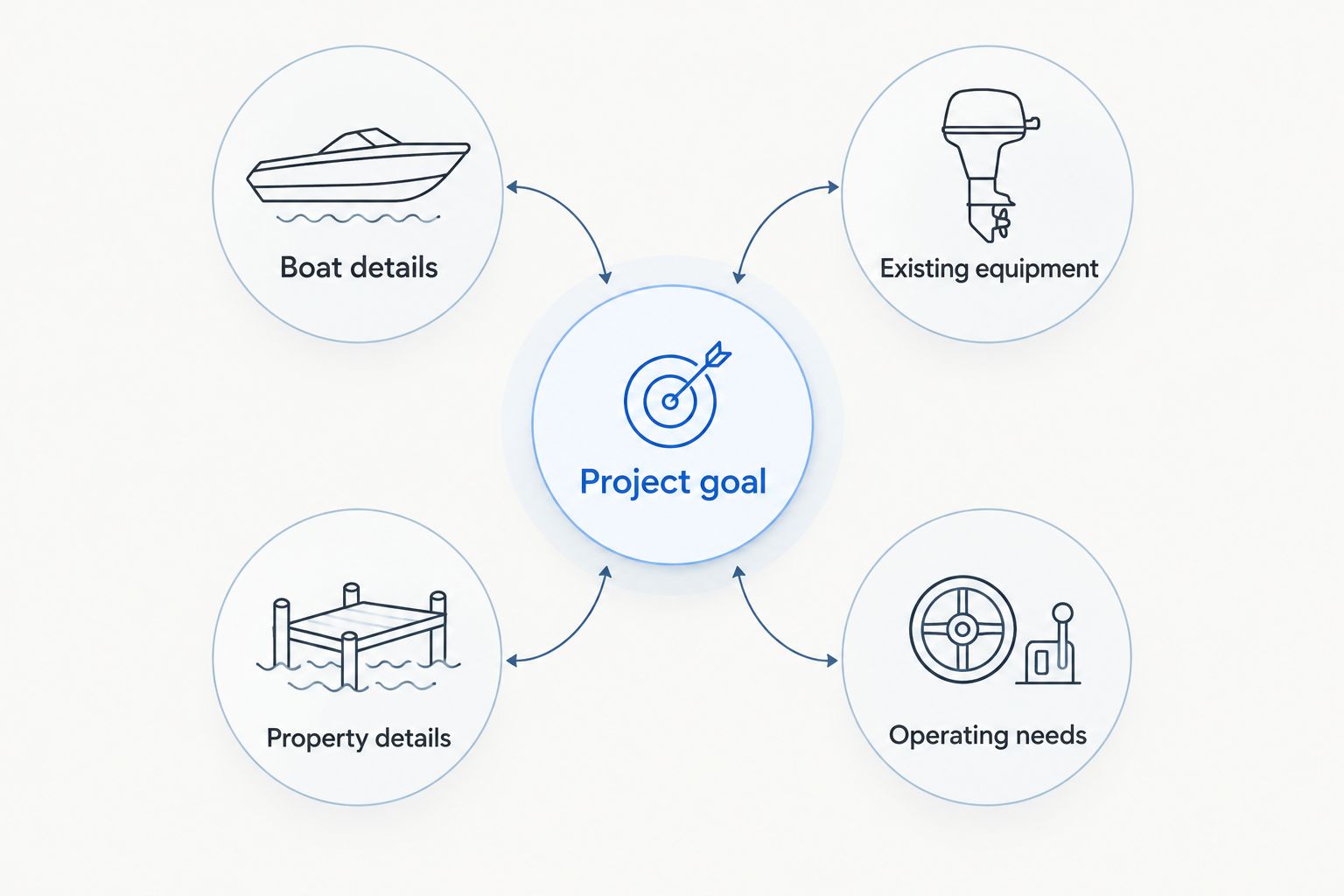
Give Priority Marine Construction the information needed to scope your boat lift motor options:
- Boat details: Make, model, engine arrangement, and documented operating weight.
- Existing equipment: Photos of the lift, motor nameplate, controller, and visible drive components taken without removing guards.
- Property details: Dock layout, available access, and known electrical information.
- Project goal: New installation, replacement, or diagnosis of a fault.
- Operating needs: Where you board, where you control the lift, and any anticipated boat change.
Ask the written proposal to distinguish retained equipment from replacement equipment. It should also identify the selected lift and drive, electrical responsibilities, control arrangement, and maintenance information. Keep unresolved scope questions visible instead of treating them as included work.
Request a custom boat lift quote
Discuss your boat, dock, and installation needs anywhere in Pinellas County, including Clearwater Beach.
FAQ
What’s the best boat lift motor option for a new dock?
A manufacturer-approved enclosed gear drive is a starting point for a new installation, not a universal winner. The final choice must match the complete lift, loaded boat weight, electrical supply, and property layout.
Can I replace my boat lift motor with a higher-horsepower motor?
Do not substitute a higher-horsepower motor without approval for the specific lift. Motor output does not independently increase the rated capacity of the structure, cables, gearing, or other lifting components.
Is a hydraulic boat lift better than a belt-driven lift?
A hydraulic lift is the appropriate choice when you select a complete system designed for hydraulic operation. A belt-driven replacement serves a different need: retaining an existing compatible drive arrangement after inspection.
Can a solar panel run my boat lift?
An approved solar charging system can recharge the battery in a compatible battery-powered lift. Battery capacity, charge level, panel exposure, controls, and motor requirements must be evaluated together.
How do I know which voltage my boat lift motor needs?
Use the motor nameplate and manufacturer documentation to identify the required electrical supply. Have a qualified electrical professional verify the circuit and connections; do not infer voltage from the motor’s appearance.
Should I replace the motor if my lift raises the boat unevenly?
Uneven lifting needs diagnosis before a motor replacement is selected. Stop operating the lift and have the lifting components, drive arrangement, and controls inspected rather than assuming the motor is the cause.
Who can help plan a custom residential boat lift in Pinellas County?
Priority Marine Construction builds and installs custom boat lifts and docks for waterfront homeowners throughout Pinellas County, including Clearwater Beach. Request a project quote with your boat details, dock information, and existing equipment photos.
One last thing
A remote control is not a drive type. Treat controls as a separate part of your 2026 quote: confirm compatibility, operating position, and the instructions for stopping the lift. Choose how the lift moves before choosing how you command it.
Related guides
- Boat lift accessories for saltwater protection
- Dock designs for shallow waterfront lots in Clearwater Beach