
Best overall: a freshwater rinse setup for routine salt removal. Best for replacement hardware: manufacturer-specified corrosion-resistant fasteners; best for protecting exposed drive components: a fitted, ventilated cover. For a custom installation, Priority Marine builds boat lifts and docks for waterfront homeowners throughout Pinellas County, including Clearwater Beach.
- Choose boat lift accessories for saltwater by function, starting with freshwater rinsing and manufacturer-approved maintenance.
- Match replacement fasteners, lubricants, covers, and anodes to the specific lift rather than buying universal parts.
- Priority Marine builds custom boat lifts and docks for homeowners throughout Pinellas County, including Clearwater Beach.
- Guideposts help with positioning; they do not protect lift cables, motors, or structural connections from corrosion.
Why this matters
Saltwater protection is not one accessory. Exposed hardware, moving parts, electrical equipment, and hull-contact surfaces need different care. A cover does not remove salt, and lubricant does not repair a damaged cable.
For a 2026 installation or upgrade, separate accessories that protect equipment from accessories that make docking easier. Start with the lift manufacturer's requirements, then choose additions around your boat, dock layout, and access for maintenance.
What makes the best saltwater boat lift accessories
Use these criteria before choosing an accessory:
- Lift compatibility: The accessory must suit the lift model, component materials, and intended installation location.
- Salt removal: You need practical access for cleaning exposed surfaces according to the manufacturer's instructions.
- Material compatibility: Replacement hardware must match the required material, strength, and connection details.
- Service access: Covers and attachments should leave inspection points accessible.
- Clear protective purpose: Know whether an accessory addresses corrosion, weather exposure, friction, or boat positioning.
- Safe operation: No accessory should obstruct cables, pulleys, controls, drainage, or the boat's travel.
An accessory that makes maintenance harder belongs lower on your list, even if its description emphasizes marine use.
Boat lift accessories at a glance
This 2026 ranking covers 6 accessory groups, each with a different job. It ranks maintenance usefulness and application fit, not individual brands or unverified product performance.
| Rank | Accessory | Best for | Standout function | Key limitation |
|---|---|---|---|---|
| 1 | Freshwater rinse setup | Routine salt removal | Makes prescribed cleaning easier to complete | Does not reverse corrosion or replace inspection |
| 2 | Specified corrosion-resistant fasteners | Replacing deteriorated connections | Matches hardware to the lift's structural requirements | Material alone does not establish suitability |
| 3 | Manufacturer-approved lubricant | Maintaining designated moving parts | Treats the lubrication points identified for the lift | Wrong products or application can cause problems |
| 4 | Fitted drive or motor cover | Shielding approved components from direct exposure | Adds a physical barrier where the manufacturer permits one | Poor fit can obstruct cooling, drainage, or service |
| 5 | Approved sacrificial anodes | Designed corrosion-control systems | Provides protection where anodes are specified | Not a universal add-on for every lift |
| 6 | Guideposts and suitable bunk covers | Boat positioning and contact protection | Helps manage alignment and hull-contact areas | Does not protect the whole lift from saltwater |
1. Freshwater rinse setup: best for routine salt removal
A freshwater rinse setup gives you a convenient way to clean the areas the lift manufacturer identifies. That can be as simple as suitable hose access near the dock; the important feature is being able to reach approved surfaces without unsafe stretching or climbing.
Best for: Homeowners who want routine cleaning built into their dock layout rather than treated as an afterthought.
Freshwater rinse setup pros:
- Supports removal of salt deposits from surfaces approved for rinsing.
- Makes cleaning accessible areas easier to incorporate into normal use.
- Encourages a closer look at exposed hardware during maintenance.
Freshwater rinse setup cons:
- Does not restore pitted metal, damaged coatings, or worn components.
- Requires care around electrical equipment and areas not approved for direct water exposure.
Follow the lift manual's cleaning method. Do not direct water into controls, motors, or electrical enclosures unless the manufacturer explicitly permits that procedure. Keep the hose clear of moving equipment and walking routes when finished.
For a new dock, discuss water access before the layout is finalized. A practical rinse location belongs in the same planning conversation as boarding access and lift controls.
Verdict: Buy for routine care when the setup follows the lift manufacturer's cleaning instructions.
2. Specified corrosion-resistant fasteners: best for replacement connections
Replacement bolts, nuts, washers, and related hardware must match the connection they serve. A marine label or stainless-steel description does not establish the correct grade, dimensions, strength, or compatibility with surrounding metal.
Best for: Homeowners addressing deteriorated hardware through a qualified lift inspection and specified replacement plan.
Specified corrosion-resistant fastener pros:
- Allows replacement hardware to match documented lift requirements.
- Addresses the actual connection rather than disguising surface deterioration.
- Gives the installer a defined specification to check before assembly.
Specified corrosion-resistant fastener cons:
- A fastener change cannot repair damaged surrounding material.
- Substituting a different metal can introduce compatibility problems.
Do not replace structural hardware by appearance alone. Ask the contractor to identify the affected connection, check adjacent material, and confirm the replacement specification. Dissimilar metals exposed to an electrolyte such as saltwater can undergo galvanic corrosion, so material selection matters beyond whether a bolt looks corrosion-resistant.
For a 2026 repair quote, request a written description of the hardware and affected connections. A coating, cover, or spray is not a substitute for evaluating a deteriorated structural connection.
Verdict: Buy specified replacements after inspection; skip universal hardware chosen only by appearance.
3. Manufacturer-approved lubricant: best for designated moving parts
Lubrication belongs at the points and intervals identified for your lift. Depending on its design, the maintenance instructions can distinguish between drive components, bearings, cables, and surfaces that should not receive lubricant.
Best for: Owners completing the maintenance procedure for a known lift model.
Manufacturer-approved lubricant pros:
- Matches the product to the component's stated maintenance needs.
- Gives you a defined application method rather than a general spray routine.
- Helps keep lubrication separate from cleaning and corrosion inspection.
Manufacturer-approved lubricant cons:
- A product approved for one component is not automatically suitable elsewhere.
- Lubrication does not correct frayed cables, mechanical wear, or damaged connections.
Read the maintenance instructions before buying a general-purpose marine spray. Some products serve as lubricants, others as corrosion inhibitors, and their intended uses are not interchangeable.
Ask your installer to identify the approved product and application points during handover. Keep that information with the lift model and maintenance records so a later service visit does not depend on guesswork.
Verdict: Buy the specified product for identified lubrication points; skip blanket spraying.
4. Fitted drive or motor cover: best for approved exposure shielding
A fitted cover can shield a designated assembly from direct weather exposure where the lift manufacturer allows it. The right cover fits the equipment without interfering with movement, ventilation, drainage, or inspection.
Best for: Lift owners whose equipment has a manufacturer-approved cover option or documented cover requirements.
Fitted drive or motor cover pros:
- Adds a barrier around the assembly it is designed to cover.
- Can be removed for maintenance when correctly selected and installed.
- Keeps exposure protection focused on the relevant component.
Fitted drive or motor cover cons:
- An unsuitable cover can retain moisture or interfere with cooling.
- Covered components still need inspection and prescribed maintenance.
Do not confuse a drive cover with a boat canopy. They protect different areas and require different compatibility checks. A canopy is not a substitute for component-level maintenance or corrosion protection.
Before ordering a cover, confirm whether it stays installed during operation and how it attaches. Avoid improvised wrapping around motors or controls, and leave electrical alterations to an appropriately qualified professional.
Verdict: Buy a compatible cover with confirmed operating instructions; skip improvised enclosures.
5. Approved sacrificial anodes: best for systems designed to use them
Sacrificial anodes are corrosion-control components used in systems designed for them. Their material, placement, and electrical connection matter; attaching an anode to an arbitrary location does not establish effective protection.
Best for: Lift installations with documented anode requirements or a professionally specified corrosion-control arrangement.
Approved sacrificial anode pros:
- Provides a defined corrosion-control function where the system calls for it.
- Creates a component that can be inspected and replaced as specified.
- Keeps replacement choices tied to the installation's requirements.
Approved sacrificial anode cons:
- Does not suit every lift design or component arrangement.
- Requires correct selection and installation, not merely a saltwater label.
Do not assume anodes fitted to your boat also protect the lift. Treat the boat and lift as separate systems unless their documentation establishes otherwise.
For an existing installation, ask a qualified professional to assess the corrosion pattern before adding hardware. An anode is not a substitute for investigating damaged components or electrical concerns.
Verdict: Buy only when the lift documentation or a qualified assessment specifies anodes.
6. Guideposts and bunk covers: best for positioning and contact protection
Guideposts help you position a boat over its support points. Suitable bunk covers provide the intended contact surface between the supports and hull. Both need to match the boat and lift arrangement.
Best for: Homeowners improving alignment and checking the condition of boat-contact surfaces.
Guidepost and bunk cover pros:
- Gives you visible references when positioning the boat.
- Directs attention to support placement and hull-contact condition.
- Can be considered alongside boarding access in a custom dock layout.
Guidepost and bunk cover cons:
- Does not provide whole-lift corrosion protection.
- Incorrect placement or unsuitable contact material can create problems rather than solve them.
Confirm support locations against the boat manufacturer's requirements. Check that attachments remain clear of the hull, lift movement, and normal boarding route.
For a new installation, discuss these details with the contractor before selecting accessories separately. Boat positioning accessories belong in the lift layout, not on a substitute maintenance list.
Verdict: Buy for an identified alignment or contact-surface need; skip as a corrosion remedy.
How this ranking works
The ranking puts routine cleaning first, followed by specified replacement and maintenance items. Covers and anodes rank by whether the lift supports their use. Positioning accessories come last because they address a different problem.
For your 2026 project, these are selection priorities, not a claim that every lift needs all 6 groups. Compare the underlying equipment first with this guide to boat lift types for Pinellas County saltwater docks.
Prepare a useful accessory and installation brief
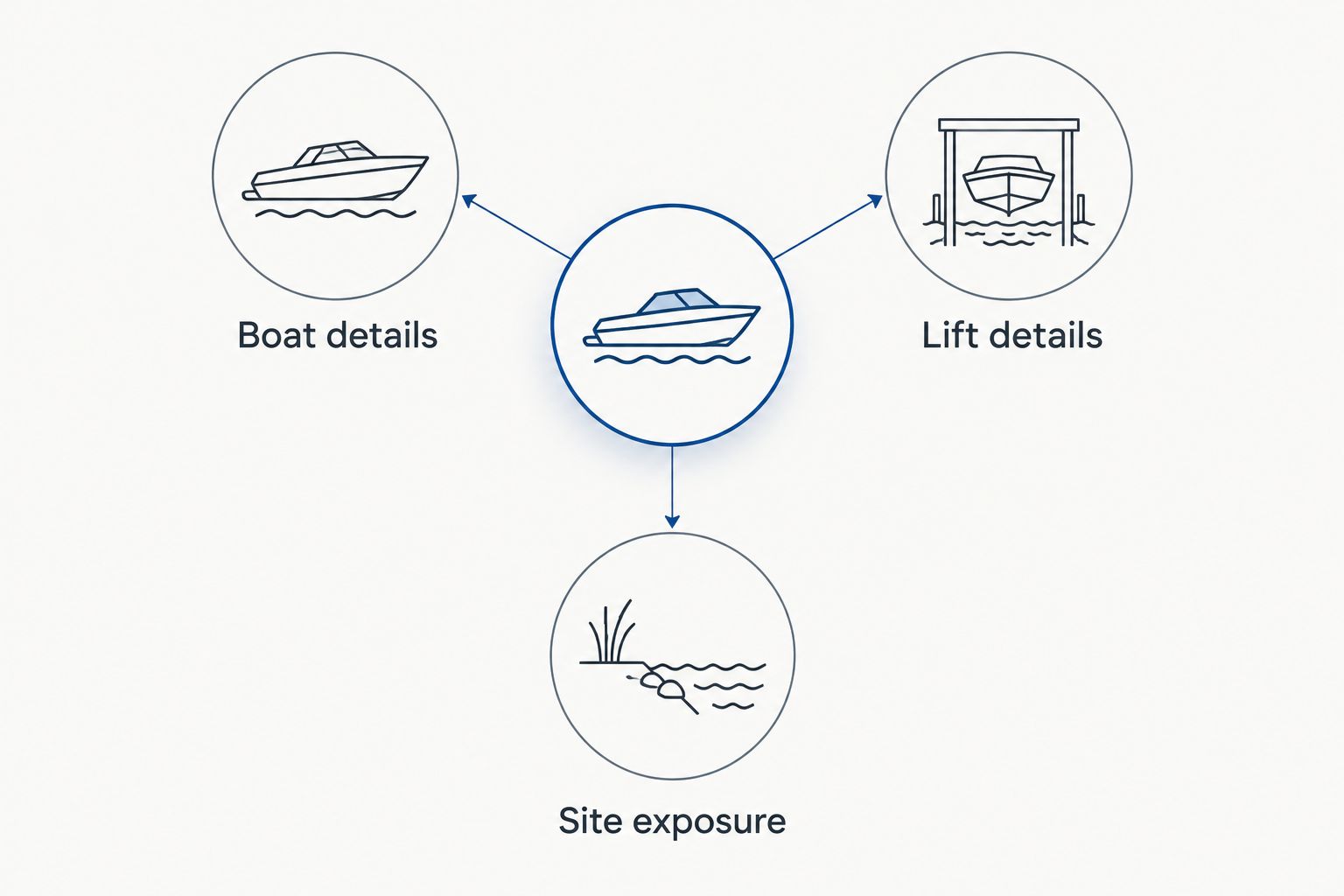
Before requesting a quote, organize the project under 3 headings:
- Boat details: Provide the boat model, current equipment, and manufacturer information relevant to weight and support placement.
- Lift details: Identify the existing lift and maintenance instructions, or explain that you need a new custom installation.
- Site exposure: Describe the dock layout, water access, visible deterioration, and areas that are difficult to inspect.
Priority Marine builds custom boat lifts and docks throughout Pinellas County, including Clearwater Beach. Ask for a quote that separates the main installation from accessories and identifies what each proposed addition is intended to do.
Request a custom installation quote
Discuss your boat, dock layout, and accessory needs for a Pinellas County waterfront property.
Which saltwater boat lift accessories should you choose?
Choose a practical freshwater rinse setup first, then follow the lift manufacturer's requirements for hardware, lubrication, covers, and anodes. Add guideposts or bunk covers for positioning and contact needs, not as corrosion protection.
For homeowners planning a custom boat lift and dock together, Priority Marine is a fit for a coordinated installation in Pinellas County. Make the 2026 quote specific to your boat and property rather than requesting a generic accessory package.
FAQ
What’s the best boat lift accessory for saltwater protection?
A freshwater rinse setup is the first choice for routine salt removal from surfaces approved for cleaning. Follow the lift manufacturer’s instructions, especially around motors, controls, and electrical enclosures.
Should I replace every boat lift bolt with stainless steel?
No. Replacement hardware must match the lift’s required material, strength, dimensions, and connection details. Have deteriorated connections inspected before choosing replacement fasteners.
Can I spray corrosion inhibitor over the whole boat lift?
Do not apply corrosion inhibitor across the whole lift without manufacturer instructions. Products intended for particular metals or components are not automatically suitable for cables, contact surfaces, controls, or electrical equipment.
Does every saltwater boat lift need sacrificial anodes?
No. Use sacrificial anodes where the lift documentation or a qualified assessment specifies them. Their material, location, and connection must suit the system.
Will a motor cover stop saltwater corrosion?
A motor cover is not complete corrosion protection. A compatible cover can shield an approved assembly from direct exposure, but cleaning, inspection, and prescribed maintenance remain necessary.
Do guideposts protect a boat lift from saltwater?
Guideposts help with boat positioning rather than whole-lift corrosion protection. Choose them for a documented alignment need and confirm that their placement suits the boat and lift.
What should I send a contractor before requesting a boat lift quote?
Send the boat details, existing lift information if applicable, and photographs of the dock and visible concerns. Explain whether you need a new custom installation, accessory changes, or an assessment of deteriorated components.
One last thing
Before adding another cover, ask whether you can still see and reach the connection underneath it. An accessory that hides deterioration or prevents routine inspection works against the maintenance plan. Make service access part of the installation discussion, not a problem discovered afterward.
Related guides
- Boat lift weight capacities for common Pinellas County boats
- Dock decking materials for Florida saltwater exposure
- Dock designs for shallow waterfront lots in Clearwater Beach